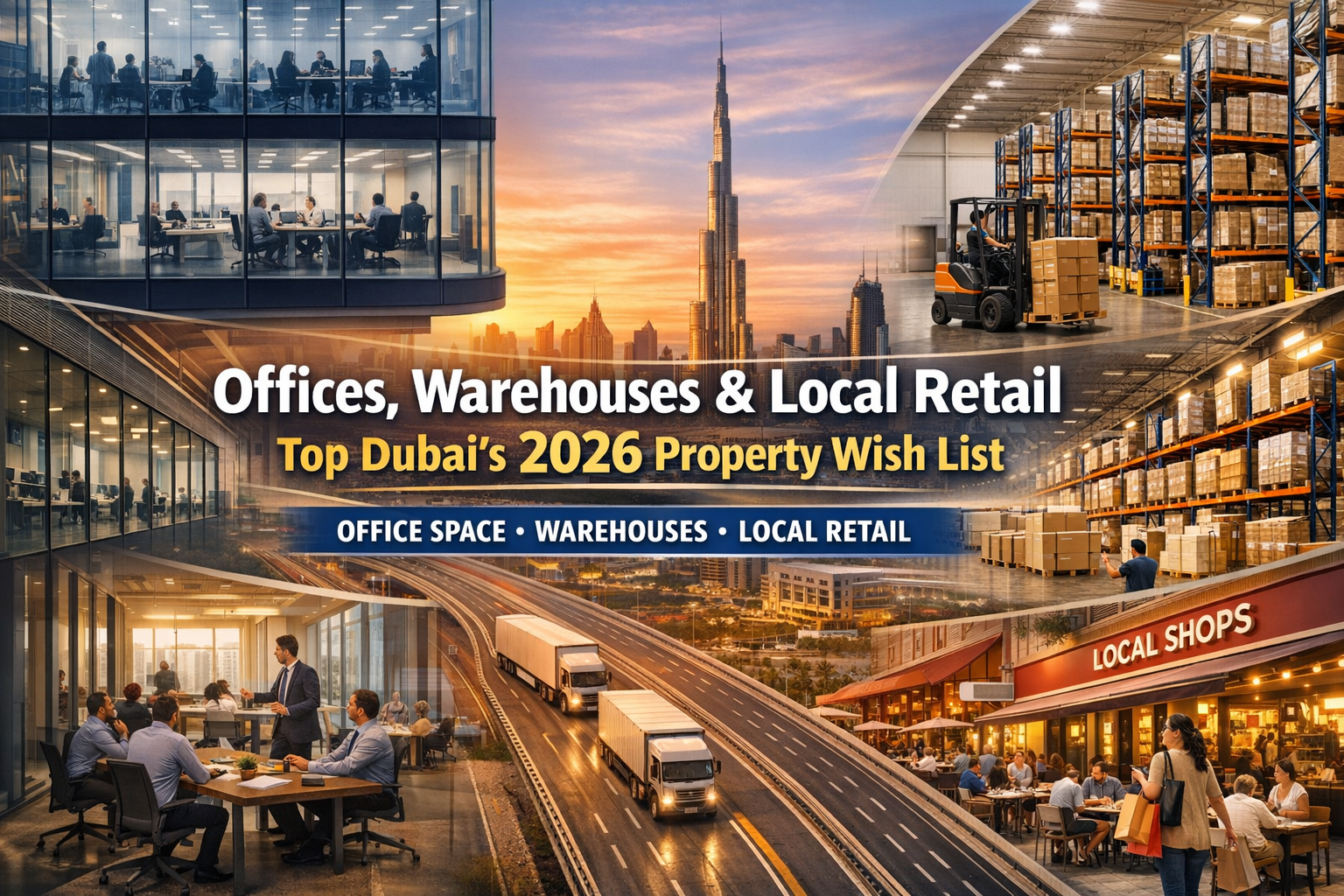
Dubai’s 2026 property landscape is being shaped by assets that generate stable income, support business growth, and align with logistics and consumption patterns. Offices, warehouses, and local retail are not simply trending categories; they represent structural demand segments anchored in population growth, enterprise expansion, and supply-chain optimization. These asset classes are capturing capital from regional investors, institutional buyers, and owner-occupiers seeking long-term value with operational utility.
This demand concentration reflects a shift toward productive real estate, where properties are measured by efficiency, location intelligence, and tenant resilience. Commercial users are prioritizing connectivity, zoning flexibility, and last-mile proximity, while investors are targeting high-occupancy corridors with predictable cash flow.
Office Space: Flight to Quality and Business-Centric Locations
Grade A Offices Lead Corporate Leasing Decisions
The office sector is dominated by Grade A buildings offering smart infrastructure, flexible floor plates, premium sustainability ratings, and transit connectivity. Businesses expanding in Dubai are selecting properties that reduce operating friction and enhance employee experience. This has created sustained demand in business districts where accessibility and amenities intersect.
Key features driving office demand include:
-
High-speed digital infrastructure
-
Energy-efficient building systems
-
Proximity to metro lines and arterial roads
-
Integrated retail and dining within complexes
These characteristics directly translate into lower vacancy rates and longer lease tenures, strengthening yield stability for property owners.
SME and Startup Clusters Increase Mid-Size Office Absorption
Beyond large corporate tenants, SMEs, fintech firms, e-commerce operators, and professional services companies are fueling absorption of mid-size office units. These businesses prefer modular office layouts that can scale with headcount while remaining cost-controlled.
Business parks and mixed-use developments offering flexible leasing models, co-working hybrids, and shared facilities are outperforming conventional office towers. The result is a diversified tenant mix that reduces income volatility for landlords and supports consistent demand cycles.
Warehouses: Logistics, E-Commerce, and Industrial Modernization
Last-Mile Distribution Redefines Warehouse Location Strategy
Warehouse demand in 2026 is driven primarily by e-commerce fulfillment, food distribution, pharmaceuticals, and spare-parts logistics. Proximity to residential zones and expressways is now more valuable than large peripheral industrial estates alone.
High-performing warehouse locations typically feature:
-
Direct highway access
-
Short delivery radii to population centers
-
Zoning for 24/7 operations
-
Adaptability for cold storage and automation
These parameters are essential for businesses competing on delivery speed and inventory turnover.
Modern Industrial Facilities Command Premium Leasing Rates
Tenants increasingly prefer purpose-built logistics facilities equipped with:
-
High ceiling clearance
-
Automated loading docks
-
Climate control compatibility
-
Digital inventory management integration
Older warehouse stock is being replaced or repositioned as logistics-grade infrastructure becomes essential rather than optional. This modernization cycle is attracting capital into industrial real estate as a defensive, income-secure investment class with low vacancy risk.
Local Retail: Community-Centric, High-Frequency Commerce
Neighborhood Retail Outperforms Destination Malls
Local retail is emerging as one of the strongest performers because it serves daily consumption needs. Grocery outlets, pharmacies, salons, clinics, cafes, and service-based shops generate consistent footfall regardless of economic cycles.
Community retail thrives when it offers:
-
Direct street visibility
-
Convenient parking
-
Walkability within residential clusters
-
High population density catchment areas
These factors drive stable tenant revenues, supporting reliable rent payments and long-term lease renewals.
Service-Oriented Retail Drives Tenant Retention
Retail tenants offering essential and repeat-use services demonstrate higher lease stability than discretionary retailers. This includes:
-
Medical clinics
-
Diagnostic labs
-
Education centers
-
Fitness studios
-
Repair and maintenance services
Such businesses embed themselves into local routines, resulting in lower churn and stronger occupancy continuity for property owners.
Why Investors Are Prioritizing These Three Asset Classes

Predictable Income Streams and Portfolio Stability
Offices, warehouses, and local retail generate regular lease income tied to operational business needs, not seasonal tourism or speculative resale cycles. This provides investors with:
-
Lower volatility
-
Higher tenant stickiness
-
Reduced exposure to luxury market swings
Yield-focused buyers value these characteristics because they support long-term portfolio compounding rather than short-term capital gains alone.
Liquidity and Exit Flexibility
Commercial assets in these categories benefit from broader buyer pools, including:
-
Institutional funds
-
Private investors
-
End-user businesses
-
Family offices
This liquidity improves exit optionality, allowing owners to sell, refinance, or redevelop based on market timing and asset performance.
Zoning, Infrastructure, and Mixed-Use Integration
Planning Policies Favor Multi-Functional Developments
Urban planning frameworks increasingly support mixed-use zoning, where offices, retail, and light industrial functions coexist within planned districts. This integration reduces commute times, enhances land efficiency, and improves commercial ecosystem synergy.
Developments combining:
-
Business offices
-
Logistics support units
-
Community retail clusters
are achieving higher overall occupancy and diversified income channels.
Transit Connectivity Multiplies Property Value
Assets located near:
-
Metro stations
-
Major interchanges
-
Freight corridors
consistently outperform isolated developments. Connectivity directly impacts tenant recruitment, delivery efficiency, and workforce accessibility, all of which strengthen leasing demand and valuation benchmarks.
Tenant Demand Signals for 2026 and Beyond
Corporate Expansion Anchors Office Leasing
Regional headquarters, regional sales offices, and back-office operations continue to expand due to:
-
Trade connectivity
-
Regulatory ease
-
Financial services clustering
This creates multi-year leasing pipelines that absorb new supply while keeping prime districts tightly occupied.
Supply Chain Resilience Drives Industrial Take-Up
Companies are diversifying suppliers and increasing local inventory capacity. This fuels sustained demand for:
-
Fulfillment centers
-
Cold storage facilities
-
Spare parts depots
Warehousing is no longer auxiliary infrastructure; it is central to revenue continuity, making industrial real estate a strategic necessity.
Population Density Sustains Community Retail
Residential expansion directly feeds retail sustainability. High-rise communities, gated villa clusters, and suburban townships all require localized service ecosystems, locking in long-term retail demand.
Development Strategies Aligning with Market Demand
Flexible Design Enables Multi-Tenant Optimization
Developers focusing on:
-
Subdividable office floors
-
Scalable warehouse units
-
Modular retail shells
are capturing wider tenant segments and shortening vacancy cycles. Flexibility translates into faster lease-up rates and stronger revenue resilience.
Sustainability Features Improve Tenant Retention
Energy efficiency, water conservation, and green building certifications reduce operating costs for tenants. This not only supports environmental compliance but also increases lease renewal probabilities.
Commercial Real Estate as an Operational Asset Class
Unlike purely speculative investments, these property types are embedded in business operations. Tenants rely on these spaces to:
-
Serve customers
-
Store inventory
-
Manage employees
-
Deliver services
This operational dependency ensures structural occupancy, insulating investors from abrupt demand collapses that can affect discretionary property segments.
Capital Allocation Trends Support Continued Demand
Financial institutions, private equity funds, and cross-border investors are channeling capital into:
-
Business parks
-
Logistics hubs
-
Community retail centers
These allocations are guided by performance metrics such as:
-
Rent collection consistency
-
Lease duration stability
-
Asset adaptability
Capital follows predictable performance, reinforcing development and acquisition pipelines in these categories.
Strategic Positioning for Long-Term Growth
The 2026 property wish list reflects a market prioritizing function, income durability, and operational relevance. Offices support economic productivity, warehouses enable commerce velocity, and local retail sustains daily life. Together, these assets form the backbone of urban commercial ecosystems.
Properties aligned with these uses benefit from:
-
Continuous tenant demand
-
Policy-aligned urban planning
-
Infrastructure-driven value appreciation
This convergence of economic, demographic, and logistical factors ensures that these asset classes remain central to portfolio construction and development strategies.
Market Outlook: Durable Demand Anchored in Utility
The commercial segments leading demand are those delivering measurable utility to businesses and communities. This utility translates into occupancy stability, rental growth capacity, and sustained investor appetite.
Offices, warehouses, and local retail are not temporary trends. They are core urban infrastructure assets that expand in tandem with enterprise activity, consumer needs, and population distribution. Their dominance on Dubai’s 2026 property wish list reflects rational capital allocation toward assets that work, earn, and endure.