Understanding the New AI Wave in Real Estate
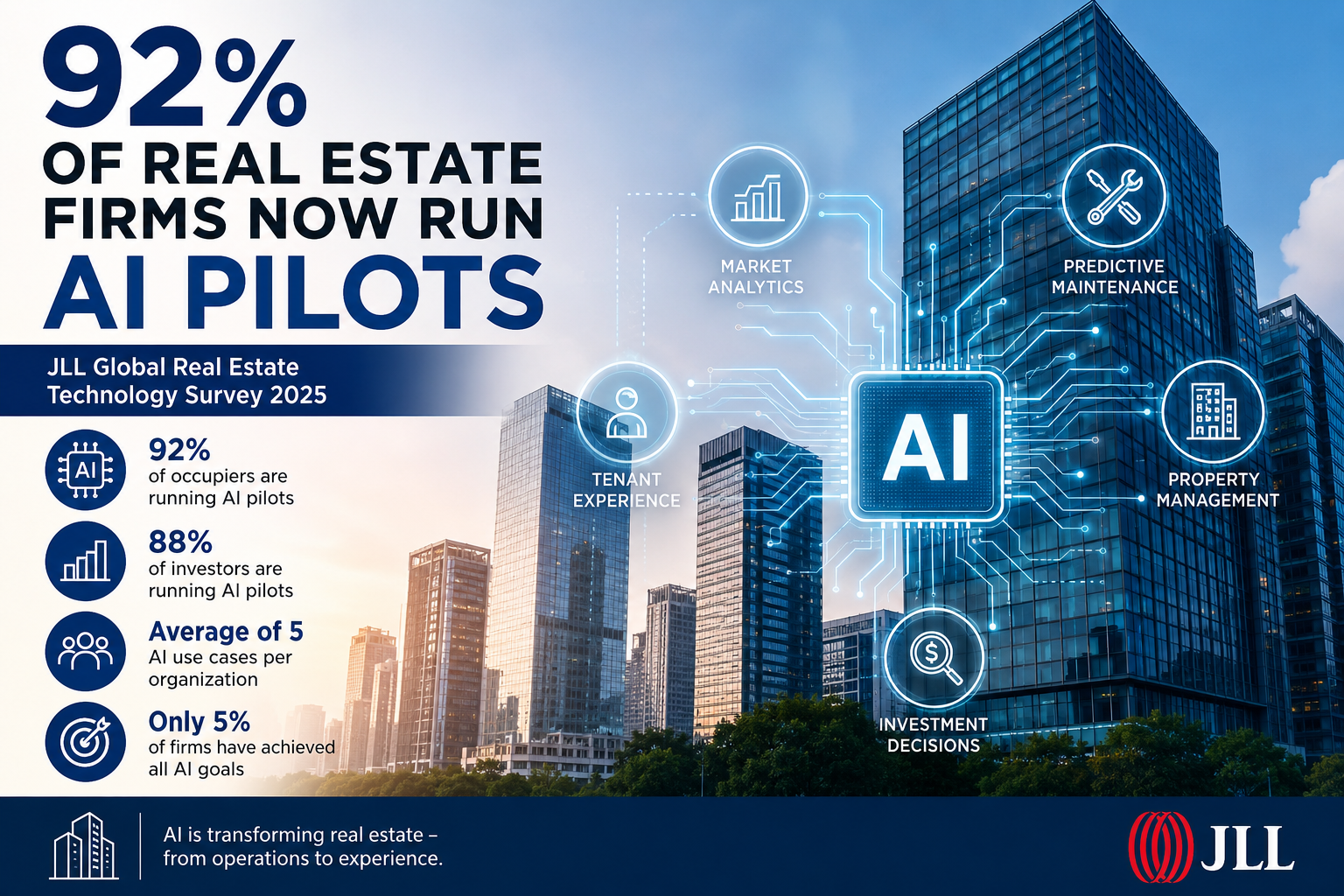
The real estate industry is experiencing one of the most significant technological transformations in its history. For decades, property transactions, leasing operations, asset management, and facility maintenance relied heavily on manual processes, spreadsheets, and human judgment. Today, artificial intelligence (AI) is rapidly changing that reality. According to recent research from JLL’s 2025 Global Real Estate Technology Survey, an astonishing 92% of corporate real estate occupiers are now running AI pilots, highlighting how deeply AI has penetrated the sector. Just a few years ago, AI adoption in real estate was largely experimental. Now, it has become a strategic priority for organizations seeking efficiency, growth, and competitive advantage.
What makes this shift particularly remarkable is the speed at which it occurred. JLL reports that the percentage of companies running AI pilots increased from less than 5% to 92% in only three years. Such rapid adoption is rare even in technology-driven industries. Real estate companies have recognized that AI is no longer a futuristic concept but a practical tool capable of streamlining operations, improving decision-making, and unlocking new business opportunities. Whether it’s predictive maintenance, portfolio optimization, lease management, or customer service automation, AI is quickly becoming embedded into daily business functions. The industry is moving from asking whether AI is valuable to determining how it can deliver measurable results at scale.
What the JLL Survey Reveals
The survey conducted by JLL involved more than 1,500 senior commercial real estate decision-makers across multiple international markets. The findings reveal that AI experimentation has become nearly universal among both investors and occupiers. Approximately 88% of investors, owners, and landlords are piloting AI projects, while occupiers have reached the 92% mark. Most organizations are simultaneously pursuing multiple AI initiatives, averaging five use cases per company.
This widespread adoption signals a major strategic shift. Rather than focusing solely on productivity improvements, many firms are investing in AI to generate long-term business value. Real estate leaders increasingly view AI as a tool capable of driving revenue growth, improving tenant experiences, optimizing portfolios, and strengthening competitive positioning. The survey also demonstrates that organizations are allocating substantial resources toward technology infrastructure, cybersecurity upgrades, and AI-related consulting services. AI has become more than an innovation project; it is now a central component of corporate strategy.
Why AI Adoption Has Accelerated So Quickly
Several factors explain why AI adoption has surged across the real estate sector. First, the emergence of advanced generative AI tools has dramatically reduced the barrier to entry. Companies can now deploy AI-powered solutions without building complex systems from scratch. Cloud computing, machine learning platforms, and software-as-a-service solutions have made implementation faster and more affordable.
Second, competitive pressure has intensified. Real estate firms operate in increasingly complex markets where speed and accuracy are essential. Organizations that leverage AI can process vast amounts of market data, identify trends earlier, and make more informed decisions than competitors relying solely on traditional methods. Third, executive leadership teams have embraced AI as a strategic necessity rather than an optional experiment. Many C-suite executives now view AI adoption as critical to future business growth, driving organizations to accelerate implementation efforts across multiple departments.
The Numbers Behind the AI Boom
Key Findings from JLL’s Global Real Estate Technology Survey
The statistics emerging from JLL’s research paint a fascinating picture of an industry undergoing rapid transformation. The survey found that nearly all real estate organizations have either launched or are actively testing AI initiatives. This dramatic increase reflects a broader trend occurring across global industries, but the pace of adoption within real estate is particularly noteworthy.
| Metric | Result |
|---|---|
| Occupiers running AI pilots | 92% |
| Investors/owners running AI pilots | 88% |
| Companies achieving all AI goals | 5% |
| Organizations pursuing multiple AI use cases | Average of 5 |
| Firms reporting increased tech budgets due to AI | 87% |
These numbers illustrate both the enthusiasm surrounding AI and the challenges that remain. While adoption rates are extremely high, successful implementation remains elusive for many organizations. The gap between experimentation and measurable business outcomes has become one of the industry’s most important strategic issues.
AI Budget Growth Across the Industry
AI is not merely attracting attention; it is attracting investment. According to JLL, 87% of investors report that their technology budgets have increased specifically because of AI initiatives. Organizations are allocating significant resources toward AI consulting, cybersecurity enhancements, cloud infrastructure, and data management platforms.
This investment trend highlights growing confidence in AI’s long-term value. Rather than treating AI as a short-term experiment, companies are making substantial commitments to the technologies and infrastructure necessary for sustainable success. The willingness to increase technology spending despite broader economic uncertainties suggests that industry leaders believe AI will fundamentally reshape commercial real estate over the coming decade. Organizations that fail to invest today may find themselves struggling to compete in tomorrow’s increasingly digital marketplace.
Why Real Estate Companies Are Investing in AI
Improving Operational Efficiency
One of the primary reasons real estate companies are embracing AI is its ability to improve operational efficiency. Real estate operations involve enormous volumes of data, documentation, and repetitive administrative tasks. AI excels at automating these processes, reducing manual effort while improving accuracy.
Property managers can use AI to predict maintenance requirements before equipment fails. Leasing teams can automate document review and tenant communications. Investment managers can rapidly analyze market trends and evaluate opportunities. By eliminating repetitive tasks, AI enables employees to focus on higher-value activities that require creativity, relationship building, and strategic thinking. This shift can generate substantial productivity gains across entire organizations. Many firms view AI as a force multiplier that enhances human capabilities rather than replacing human expertise.
Enhancing Customer and Tenant Experiences
Modern tenants and property buyers expect fast, personalized, and seamless experiences. AI helps real estate companies meet these expectations through intelligent automation and data-driven insights. Chatbots can answer questions instantly, virtual assistants can schedule appointments, and recommendation engines can match clients with suitable properties.
The result is a more responsive and customer-focused business model. AI can analyze behavioral patterns, preferences, and historical interactions to deliver personalized experiences that strengthen customer relationships. In an increasingly competitive market, superior customer service often becomes a critical differentiator. Companies that leverage AI effectively can provide faster responses, better recommendations, and more consistent service quality than traditional competitors. This ability to enhance customer satisfaction is one of the strongest drivers behind AI adoption across the industry.
The Most Popular AI Use Cases in Real Estate
Property Management and Maintenance
Property management has emerged as one of the most promising applications for AI. Building systems generate massive amounts of operational data related to energy consumption, equipment performance, occupancy patterns, and maintenance needs. AI algorithms can analyze this data in real time, identifying issues before they become costly problems.
Predictive maintenance is particularly valuable because it helps reduce downtime, extend equipment life, and lower operational costs. Instead of waiting for systems to fail, property managers can proactively schedule maintenance activities based on AI-generated recommendations. This approach improves tenant satisfaction while reducing unexpected expenses. As buildings become increasingly connected through Internet of Things (IoT) devices, AI’s role in property management will continue to expand significantly.
Market Analysis and Investment Decisions
Real estate investment decisions involve analyzing large quantities of data from multiple sources. AI can process market reports, economic indicators, demographic trends, and property performance metrics far more efficiently than traditional methods. This capability allows investors to identify opportunities and risks with greater speed and precision.
AI-powered analytics platforms can forecast market trends, estimate property values, and evaluate investment scenarios. By leveraging machine learning models, firms can uncover patterns that might otherwise remain hidden. These insights support more informed decision-making and help investors allocate capital more effectively. As market conditions become increasingly dynamic, AI-driven analytics are becoming indispensable tools for investment professionals.
Leasing and Occupancy Optimization
Leasing operations are another area where AI is delivering meaningful value. AI systems can analyze tenant behavior, occupancy trends, and lease data to optimize space utilization and improve retention rates. Leasing teams can use AI to identify potential vacancies earlier and develop targeted retention strategies.
Occupancy optimization is particularly important in commercial real estate, where even small improvements can significantly impact profitability. AI can help organizations understand how spaces are being used, identify inefficiencies, and recommend adjustments that improve overall performance. This data-driven approach supports better decision-making and contributes directly to stronger financial outcomes.
The AI Implementation Gap
Why Only 5% of Firms Achieve All AI Goals
Despite widespread adoption, only about 5% of organizations report achieving all of their AI program objectives. This finding represents one of the most important insights from JLL’s research. The issue is not a lack of interest or investment; it is the challenge of translating pilot projects into scalable business solutions.
Many companies launch multiple AI initiatives simultaneously without establishing the foundational capabilities necessary for long-term success. They may underestimate the complexity of integrating AI into existing workflows or fail to align projects with clear business objectives. As a result, promising pilots often remain isolated experiments rather than evolving into enterprise-wide solutions. The gap between adoption and achievement highlights the importance of strategic planning, organizational readiness, and effective execution.
Common Challenges Slowing Success
Several recurring challenges contribute to the implementation gap. Data quality issues are among the most significant obstacles. AI systems depend on accurate, consistent, and accessible data. Many real estate organizations operate with fragmented data environments that limit AI effectiveness.
Organizations also face challenges related to workforce readiness, governance, and change management. Employees may lack the skills needed to use AI effectively, while leaders struggle to establish appropriate oversight mechanisms. Resistance to change can further slow adoption efforts. Companies that address these challenges proactively are far more likely to achieve meaningful results from their AI investments.
The Role of Data in AI Success
Building a Strong Data Foundation
Experts consistently emphasize that successful AI initiatives begin with strong data foundations. AI systems are only as effective as the information they receive. Organizations with fragmented, incomplete, or inconsistent data often struggle to achieve meaningful outcomes.
Leading firms are investing heavily in data integration, governance, and quality management. They recognize that clean, accessible data is essential for advanced analytics, machine learning, and automation. By establishing centralized data platforms, organizations create the conditions necessary for AI to deliver sustainable value. This foundational work may not be as exciting as launching new AI applications, but it is often the determining factor between success and failure.
Data Security and Governance Concerns
As AI adoption increases, so do concerns surrounding cybersecurity and governance. Real estate companies manage sensitive financial, operational, and tenant information. Protecting this data is essential for maintaining trust and regulatory compliance.
Many organizations are prioritizing investments in cybersecurity infrastructure alongside AI deployment. Governance frameworks help ensure that AI systems operate responsibly, transparently, and ethically. These considerations are becoming increasingly important as regulators and stakeholders demand greater accountability for AI-driven decisions. Companies that establish strong governance practices today will be better positioned to manage future risks and opportunities.
How Leading Firms Are Scaling AI Successfully
From Pilot Projects to Enterprise Deployment
The most successful organizations approach AI strategically rather than experimentally. Instead of launching numerous disconnected pilots, they focus on a small number of high-impact use cases aligned with clear business objectives. They establish measurable success metrics, invest in supporting infrastructure, and create processes for scaling successful initiatives.
These companies also recognize that AI transformation extends beyond technology. It requires changes in workflows, organizational structures, and employee capabilities. By integrating AI into broader business strategies, leading firms maximize the likelihood of achieving sustainable results and long-term competitive advantages.
Best Practices for Sustainable AI Adoption
Several best practices consistently emerge among successful AI adopters. These include establishing executive sponsorship, investing in data quality, prioritizing workforce training, and focusing on measurable business outcomes. Organizations should also adopt a phased implementation approach, scaling gradually rather than attempting large-scale transformations overnight.
The most effective AI strategies emphasize continuous learning and adaptation. Technology evolves rapidly, and organizations must remain flexible to capitalize on emerging opportunities. Firms that combine technological innovation with strong governance and operational discipline are most likely to realize meaningful returns on their AI investments.
The Future of AI in Real Estate
Emerging Trends for 2026 and Beyond
Looking ahead, AI is expected to become even more deeply integrated into real estate operations. Emerging technologies such as autonomous AI agents, advanced predictive analytics, and intelligent building management systems will expand the range of possible applications. Industry experts anticipate greater automation of routine tasks and increasingly sophisticated decision-support capabilities.
As AI capabilities mature, organizations will move beyond experimentation toward enterprise-wide deployment. This transition will likely separate industry leaders from laggards. Companies that establish strong foundations today will be positioned to capitalize on future innovations more effectively than competitors still struggling with basic implementation challenges.
Competitive Advantages for Early Adopters
Early adopters of AI stand to gain significant advantages in efficiency, customer experience, risk management, and profitability. By leveraging AI to make faster and more informed decisions, organizations can respond more effectively to changing market conditions. They can identify opportunities earlier, optimize operations more efficiently, and deliver superior services to clients and tenants.
The competitive landscape is evolving rapidly. As AI becomes more widespread, simply adopting the technology will no longer be enough. Success will depend on how effectively organizations integrate AI into their business models and operational processes. The firms that master this transition are likely to emerge as industry leaders in the years ahead.
Conclusion
The finding that 92% of real estate firms now run AI pilots represents a defining moment for the industry. AI adoption has progressed from niche experimentation to mainstream business strategy in an extraordinarily short period. Yet the story is not solely about adoption; it is also about execution. While nearly every organization is exploring AI, only a small percentage have achieved their intended outcomes.
The path forward is clear. Real estate companies must move beyond pilot projects and focus on building strong data foundations, effective governance frameworks, and scalable implementation strategies. Those that succeed will unlock substantial gains in efficiency, customer satisfaction, and competitive advantage. As AI continues to reshape the real estate landscape, the organizations that act strategically today will be best positioned to thrive tomorrow.
FAQs
1. What does JLL’s survey say about AI adoption in real estate?
JLL’s 2025 Global Real Estate Technology Survey found that 92% of corporate real estate occupiers and 88% of investors, owners, and landlords are running AI pilot programs.
2. Why are real estate firms investing heavily in AI?
Companies are investing in AI to improve operational efficiency, enhance customer experiences, optimize portfolios, automate workflows, and gain competitive advantages in increasingly complex markets.
3. Why have only 5% of firms achieved all their AI goals?
Many organizations struggle with poor data quality, insufficient infrastructure, lack of governance, workforce readiness issues, and difficulties scaling pilot projects into enterprise-wide solutions.
4. What are the most common AI applications in real estate?
Popular applications include predictive maintenance, property management, leasing optimization, market analysis, investment forecasting, customer service automation, and occupancy management.
5. What is the future of AI in commercial real estate?
The future includes broader adoption of predictive analytics, intelligent building systems, autonomous AI agents, and enterprise-wide automation that will transform how properties are managed, leased, and invested in.