Understanding Dubai’s Two-Speed Property Market
Dubai’s real estate market has entered a fascinating new phase. For years, headlines focused on broad market growth, rising prices, and record-breaking transactions. Today, however, a more nuanced story is unfolding. The emirate’s property market is increasingly operating at two different speeds. On one side, luxury villas, waterfront mansions, branded residences, and ultra-prime properties continue to attract global wealth and achieve record prices. On the other side, portions of the mainstream apartment market are experiencing slower growth as new supply enters the market and buyers become more selective.
This division is not necessarily a warning sign. In fact, many analysts view it as evidence that Dubai’s property sector is maturing. Instead of every property type rising simultaneously, investors are now distinguishing between scarce, premium assets and mass-market developments. The result is a healthier environment where quality, location, and long-term value matter more than speculation.
Recent market reports show that luxury properties continue to outperform due to limited supply and sustained international demand. Prime residential values have reached new highs while transaction values continue to climb across the upper end of the market. Meanwhile, buyers in mid-market segments have become more cautious, carefully evaluating future supply, rental demand, and resale potential before making decisions.
What Does a Two-Speed Market Mean?
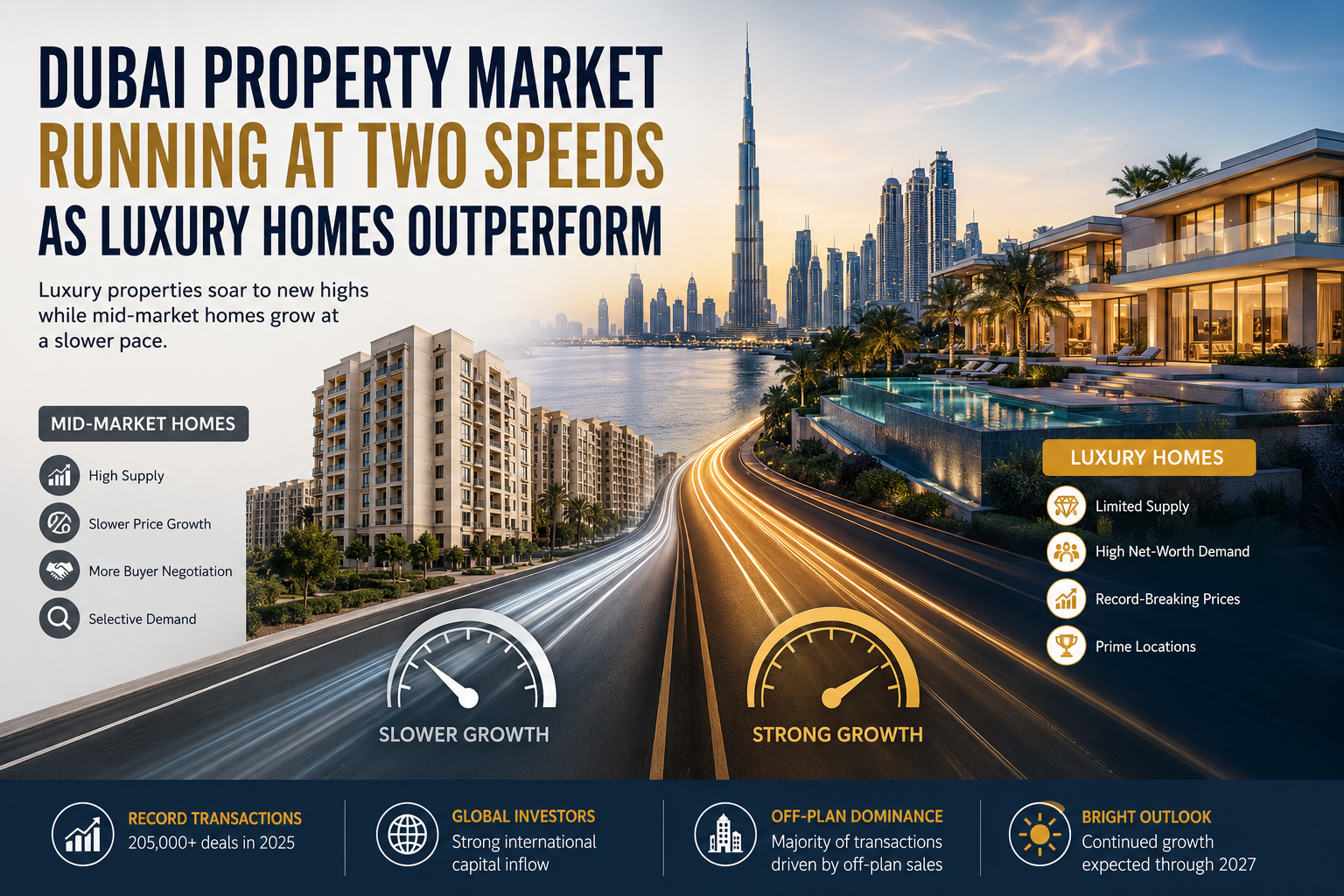
A two-speed property market occurs when different segments perform at noticeably different rates. Think of it as a highway where luxury real estate is traveling in the fast lane while mainstream housing moves at a more moderate pace. Both segments may still be progressing forward, but the speed of growth varies significantly.
In Dubai, the fast lane is occupied by ultra-luxury villas, branded residences, penthouses, and waterfront developments. These assets benefit from scarcity, prestige, and international demand. Buyers in this category often prioritize wealth preservation, lifestyle quality, and long-term capital appreciation over short-term market fluctuations.
The slower lane primarily includes standard apartments in high-density communities where supply is increasing rapidly. As more units become available, buyers gain leverage and can negotiate better deals. This dynamic creates greater competition among sellers and developers, resulting in more moderate price growth and, in some areas, localized corrections. Rather than signaling weakness, this segmentation demonstrates a more sophisticated and balanced market structure.
Current State of Dubai Real Estate in 2026
Dubai’s property market remains one of the world’s most active and closely watched investment destinations. Despite global economic uncertainties and regional geopolitical challenges, the emirate continues to attract investors, entrepreneurs, and high-net-worth individuals from across the globe.
The numbers remain impressive. Residential transaction volumes reached record levels in 2025, with more than 205,000 deals completed and transaction values exceeding AED 544 billion. The momentum has carried into 2026, supported by foreign investment, population growth, business-friendly policies, and Dubai’s reputation as a global hub for commerce and lifestyle.
Record Transactions and Investment Activity
One of the most striking characteristics of Dubai’s property market is its ability to maintain strong transaction activity even during periods of uncertainty. According to market data, luxury transactions have continued to rise, with properties valued above AED 15 million recording significant year-on-year growth. Prime residential sales and off-plan transactions have both demonstrated remarkable resilience.
Foreign investment remains a major driver. International buyers view Dubai as a safe destination for capital, offering political stability, favorable tax policies, world-class infrastructure, and attractive residency programs. In Q1 2026 alone, billions of dirhams flowed into the market from overseas investors seeking both lifestyle benefits and investment returns.
Why Luxury Homes Are Outperforming the Wider Market
Global Wealth Migration into Dubai
Perhaps the most important factor supporting Dubai’s luxury sector is the ongoing migration of global wealth. Wealthy individuals from Europe, Asia, the Middle East, and other regions continue to relocate assets and residency to Dubai. This trend has intensified as investors seek jurisdictions offering economic stability, favorable tax treatment, and high-quality lifestyles.
Unlike traditional property cycles driven primarily by local demand, Dubai’s luxury market benefits from international capital flows. Ultra-high-net-worth individuals are often less sensitive to mortgage rates or short-term economic fluctuations. Their purchasing decisions focus on security, prestige, lifestyle, and long-term wealth preservation.
As a result, demand for trophy assets remains exceptionally strong. Luxury villas, waterfront mansions, and premium penthouses continue to attract buyers willing to pay record prices for exclusive locations and world-class amenities.
Limited Supply of Trophy Assets
Scarcity is another powerful force behind luxury market performance. Unlike standard apartment developments, there are only so many beachfront villas, private island residences, and iconic penthouses available in Dubai.
When supply remains limited and demand continues to grow, prices naturally rise. Prime communities such as Palm Jumeirah and Jumeirah Bay Island offer unique characteristics that cannot easily be replicated elsewhere. Investors recognize this scarcity and are often willing to pay a premium to secure these rare assets.
Recent data indicates luxury prices in prime communities continue to achieve double-digit growth while mainstream apartments experience more moderate increases. This supply-demand imbalance remains one of the strongest supports for the luxury sector’s continued outperformance.
Rise of Branded Residences
Another major trend transforming Dubai’s luxury market is the rapid expansion of branded residences. These developments combine luxury real estate with globally recognized hospitality and lifestyle brands.
Branded residences often command significant price premiums because buyers value reputation, service quality, and exclusivity. Features such as concierge services, wellness facilities, hotel-style amenities, and professional property management make these developments particularly attractive to international investors.
The popularity of branded residences reflects a broader shift in luxury buyer behavior. Today’s affluent purchasers are not simply buying square footage; they are investing in experiences, convenience, and lifestyle ecosystems. This trend is expected to remain a major growth driver in the coming years.
Prime Areas Leading the Luxury Boom
| Location | Key Strength | Market Performance |
|---|---|---|
| Palm Jumeirah | Waterfront luxury villas and apartments | Strong double-digit growth |
| Downtown Dubai | Iconic skyline and premium residences | High international demand |
| Emirates Hills | Ultra-exclusive villa community | Limited supply supports pricing |
| Jumeirah Bay Island | Trophy properties and privacy | Among the city’s most prestigious markets |
Palm Jumeirah
Palm Jumeirah continues to serve as one of Dubai’s most desirable luxury destinations. Its combination of beachfront living, exclusive villas, and world-class hospitality creates a unique value proposition that appeals to global buyers. Properties on the Palm consistently command premium pricing and remain among the city’s most sought-after assets.
Downtown Dubai
Downtown Dubai remains synonymous with prestige and urban luxury. Home to iconic landmarks and premium residential towers, the area attracts both investors and end-users seeking a central location and strong long-term value. Demand continues to support impressive price growth in the district.
Challenges Facing Mid-Market Properties
Growing Apartment Supply
While luxury assets benefit from scarcity, many mid-market communities face increasing competition due to a substantial development pipeline. Thousands of new apartments are scheduled for completion, providing buyers with more options and reducing urgency.
This does not mean the market is collapsing. Instead, it suggests a transition toward greater selectivity. Buyers are increasingly evaluating factors such as developer reputation, building quality, service charges, transportation links, and community amenities before committing to a purchase.
Increased Buyer Negotiation Power
As supply grows, buyers gain leverage. Sellers can no longer rely solely on broad market momentum to secure sales. Competitive pricing, quality construction, and attractive payment plans have become increasingly important.
This environment favors informed investors who conduct detailed market research. Rather than purchasing based on hype, successful buyers focus on long-term fundamentals and realistic growth prospects. The shift toward rational decision-making is a hallmark of a mature real estate market.
Off-Plan Properties and Market Dynamics
Why Off-Plan Continues to Dominate
Off-plan developments remain a dominant force in Dubai’s property market. Flexible payment plans, lower entry prices, and access to new projects continue to attract investors.
In both luxury and mainstream segments, off-plan sales account for a substantial portion of transactions. Developers continue launching ambitious projects designed to meet growing demand from domestic and international buyers. Recent data shows off-plan activity representing a large majority of luxury transaction value.
Risks Associated with Over-Supply
Despite strong demand, investors must remain aware of supply-related risks. Communities with large numbers of similar apartment units may face increased competition and slower price appreciation.
The key is differentiation. Properties located in well-planned communities with strong infrastructure, quality amenities, and established demand drivers are likely to perform better than generic developments lacking unique advantages. Smart investors increasingly prioritize these factors when evaluating opportunities.
Investor Opportunities in a Two-Tier Market
Luxury Investment Strategies
For investors targeting the luxury segment, scarcity remains the central theme. Waterfront villas, branded residences, and prime penthouses offer strong long-term potential due to limited supply and sustained international demand.
Many high-net-worth investors view these properties as wealth-preservation vehicles rather than purely speculative investments. This mindset contributes to market stability and supports ongoing price growth in premium locations. Record-breaking transactions continue to reinforce confidence in Dubai’s luxury market.
Value Opportunities in Emerging Communities
The slower-moving segment of the market also presents opportunities. Buyers willing to conduct thorough research may find attractive value in emerging communities with strong infrastructure plans and growing populations.
Areas offering affordable entry points, solid rental demand, and future development potential could deliver compelling returns over the long term. Success depends on selecting communities with sustainable demand drivers rather than simply chasing short-term appreciation.
Future Outlook for Dubai Property Market
Expected Trends Through 2027
Looking ahead, Dubai’s property market appears likely to maintain its two-speed structure. Luxury homes are expected to continue outperforming due to global wealth migration, limited supply, and strong investor confidence.
At the same time, mainstream segments may experience more measured growth as new inventory enters the market. This does not imply weakness; rather, it reflects a transition toward a more mature and selective real estate environment.
Major development announcements, including multi-billion-dollar projects, demonstrate continued confidence in Dubai’s long-term growth story. As infrastructure expands and the city attracts more residents and businesses, demand for quality real estate should remain strong across multiple segments.
Conclusion
Dubai’s property market is no longer moving as a single entity. The emergence of a two-speed market reflects increasing sophistication, where luxury assets and prime communities are outperforming broader market segments. Global wealth migration, limited supply, branded residences, and investor confidence continue to fuel demand at the top end of the market.
Meanwhile, mid-market properties are entering a phase of greater competition and selectivity. Buyers are becoming more analytical, focusing on quality, location, and long-term fundamentals rather than chasing rapid gains.
For investors, this creates both opportunities and challenges. Success in 2026 and beyond will depend on understanding market segmentation, identifying scarcity-driven assets, and recognizing where long-term value truly exists. Dubai remains one of the world’s most dynamic real estate markets, but the rules of the game are evolving. Those who adapt to the new reality will be best positioned to benefit from the emirate’s next phase of growth.
FAQs
1. Why are luxury homes outperforming in Dubai?
Luxury homes benefit from limited supply, strong international demand, global wealth migration, and Dubai’s reputation as a safe investment destination.
2. What is a two-speed property market?
A two-speed market occurs when one segment, such as luxury real estate, grows significantly faster than another segment, such as mainstream apartments.
3. Are Dubai property prices still rising in 2026?
Yes, although growth varies by segment. Prime and luxury properties continue to record strong gains, while some mid-market areas experience slower growth.
4. Is Dubai still attractive for foreign investors?
Yes. Dubai continues to attract global investors due to its tax advantages, infrastructure, residency programs, and strong economic outlook.
5. Which areas are leading Dubai’s luxury property market?
Palm Jumeirah, Downtown Dubai, Emirates Hills, and Jumeirah Bay Island remain among the strongest-performing luxury locations.