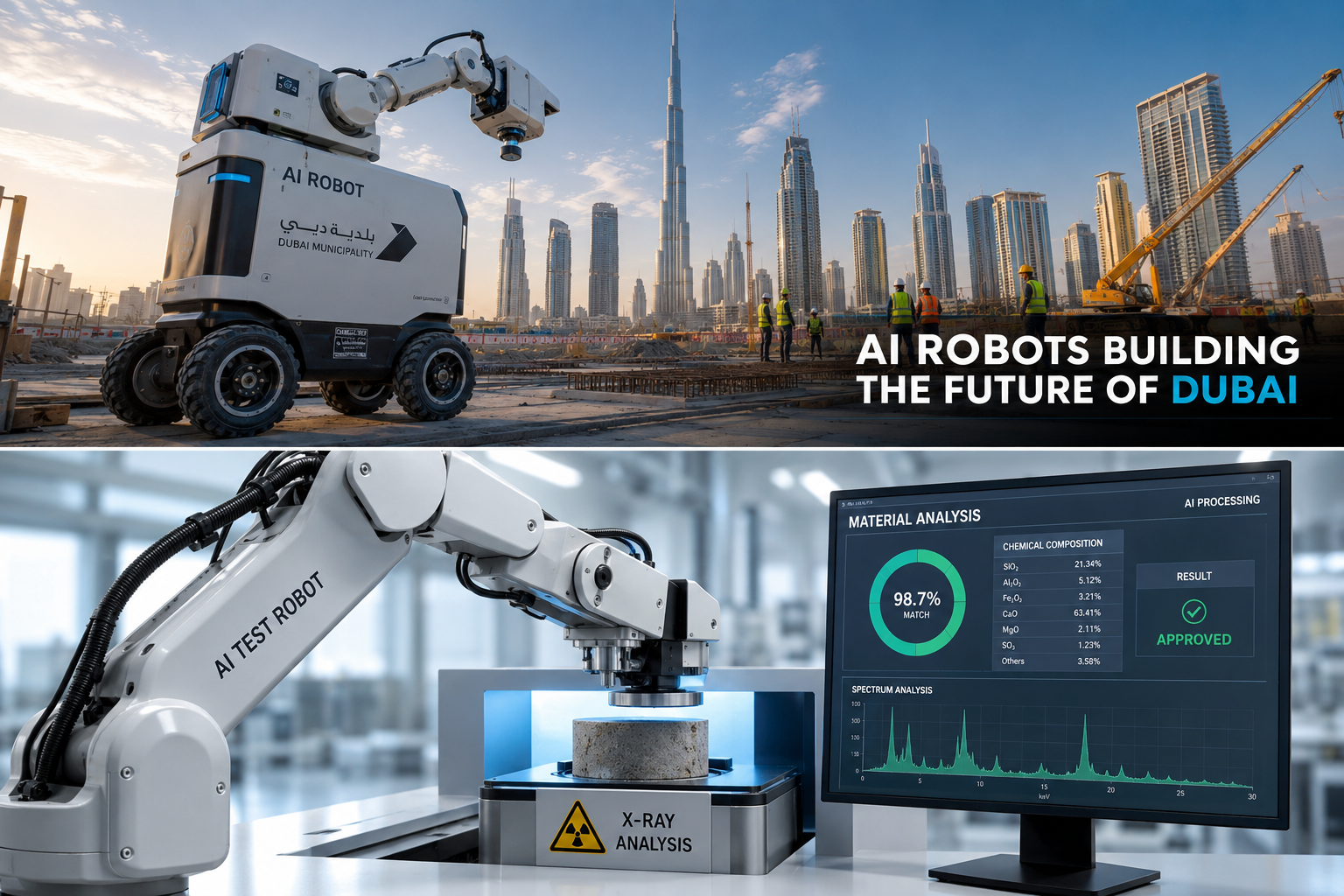
Dubai has never been afraid of embracing groundbreaking technology. From autonomous public transport to AI-powered government services, the emirate consistently positions itself as one of the world’s smartest cities. Now, another remarkable innovation is reshaping one of its largest industries—construction. Dubai Municipality has introduced AI-powered robots capable of testing cement and construction materials, dramatically changing how quality control is performed on construction sites. Instead of relying solely on traditional laboratory processes that once required several working days, these intelligent robotic systems complete detailed chemical analyses in only eight minutes, delivering faster, more accurate, and more reliable results. According to Dubai Municipality, the new technology has increased daily testing capacity by approximately 650%, enabling contractors and consultants to receive laboratory reports significantly faster.
Dubai’s Vision for AI-Powered Construction
Dubai’s rapid urban expansion requires equally advanced methods for maintaining quality, safety, and efficiency. Every year, billions of dollars are invested in residential towers, commercial developments, transportation infrastructure, and smart city initiatives. Managing projects at this scale demands precision that traditional manual inspection methods struggle to provide. AI robotics fills this gap by automating repetitive laboratory processes while maintaining exceptional accuracy. Rather than replacing engineers, these intelligent machines enhance their capabilities by eliminating delays and minimizing human error. The initiative also aligns with Dubai’s long-term digital transformation strategy, which encourages the adoption of artificial intelligence across public services and infrastructure development. Officials believe automation will not only improve operational efficiency but also strengthen confidence in Dubai’s construction standards among global investors and developers. By integrating robotics into laboratory testing today, Dubai is laying the foundation for a future where AI supports nearly every stage of the construction lifecycle.
Why Dubai Is Investing in Construction
Dubai has become synonymous with ambitious engineering projects, iconic skyscrapers, and futuristic urban planning. As the city continues to expand, the pressure to deliver high-quality buildings within shorter timelines has grown significantly. Traditional construction processes often involve lengthy material testing, manual inspections, and multiple quality assurance checkpoints that can slow project completion. By introducing AI-powered robots, Dubai is addressing these bottlenecks while reinforcing its reputation as a global innovation hub. The government’s commitment to digital transformation extends beyond public services and into industries that have the greatest economic impact. Construction contributes substantially to Dubai’s economy, making technological modernization a strategic priority rather than simply an operational improvement.
Artificial intelligence enables laboratories to analyze construction materials with remarkable speed and consistency. Every batch of cement, concrete, and raw material must comply with strict engineering specifications before being approved for use. This level of automation reduces the possibility of human error while ensuring that every project follows internationally recognized quality standards. Engineers receive actionable insights much faster, allowing contractors to resolve issues before they affect construction schedules.
The investment also reflects Dubai’s broader vision of becoming one of the world’s leading smart cities. Government agencies increasingly rely on AI to optimize public services, improve operational efficiency, and enhance decision-making. The construction sector naturally fits within this strategy because infrastructure development forms the backbone of economic growth. Every improvement in material testing, quality control, and project management creates ripple effects across the entire industry. Developers benefit from reduced delays, consultants gain access to more reliable data, and residents ultimately enjoy safer and better-built structures.
Another important factor is international competitiveness. Dubai attracts investors and developers from around the globe who expect world-class standards throughout the construction process. AI robotics demonstrates that the city continues to embrace cutting-edge technology to maintain its competitive advantage. By reducing turnaround times and improving laboratory accuracy, Dubai strengthens confidence among global investors looking to launch large-scale residential, commercial, and mixed-use developments. This proactive approach helps ensure that the city’s construction industry remains one of the most advanced and reliable in the world.
The Role of Dubai Municipality in AI
Dubai Municipality has played a central role in driving technological innovation across the emirate’s construction sector. As the regulatory authority responsible for overseeing building standards, environmental protection, and public infrastructure, the municipality continually seeks solutions that improve efficiency while maintaining the highest quality benchmarks. The introduction of AI-powered laboratory robots is part of a broader initiative to modernize testing procedures and provide faster services to contractors, consultants, and developers. Instead of relying solely on conventional laboratory techniques, the municipality now leverages advanced robotics capable of conducting sophisticated chemical analyses with exceptional speed and precision.
One of the most impressive aspects of this initiative is the use of X-ray fluorescence (XRF) technology integrated with artificial intelligence. The robotic system automatically prepares material samples, performs high-resolution scans, interprets chemical compositions, and generates comprehensive laboratory reports without extensive manual intervention. Tasks that previously required several hours—or even multiple working days—can now be completed in approximately eight minutes. This dramatic reduction in testing time enables construction projects to move forward more quickly while maintaining strict compliance with engineering standards.
Dubai Municipality has also reported significant improvements in laboratory productivity since deploying AI robots. Daily testing capacity has increased by approximately 650%, allowing laboratories to process substantially more samples without sacrificing accuracy. This increased efficiency benefits the entire construction ecosystem by reducing waiting periods for approvals and enabling engineers to make faster project decisions. Contractors can schedule material deliveries with greater confidence, consultants receive timely quality assurance reports, and project managers experience fewer disruptions caused by laboratory delays.
Beyond operational efficiency, Dubai Municipality’s investment reflects its commitment to sustainability and innovation. Faster testing reduces unnecessary material waste because defective products can be identified before entering construction sites. Digital reporting also minimizes paperwork while creating comprehensive databases that support long-term quality monitoring. As artificial intelligence continues to evolve, Dubai Municipality is expected to expand its use across additional inspection processes, predictive maintenance systems, and smart infrastructure management. This positions the organization as a global leader in applying AI to public construction services and sets an example that other cities may soon follow.
How AI Robots Are Transforming Construction Sites
Construction sites have traditionally depended on skilled workers, engineers, surveyors, and laboratory technicians performing numerous manual tasks throughout every phase of a project. While human expertise remains irreplaceable, many repetitive activities consume valuable time and increase the likelihood of errors. AI-powered robots are changing this dynamic by automating critical inspection and testing procedures that previously slowed project progress. Rather than replacing construction professionals, these intelligent machines function as highly efficient assistants capable of working continuously with remarkable precision. Their integration allows engineers to focus on strategic planning, design improvements, and problem-solving instead of routine laboratory operations.
One of the biggest transformations lies in material verification. Every construction project depends on the quality of its raw materials, especially cement and concrete. Even minor inconsistencies in chemical composition can affect structural strength, durability, and long-term safety. AI robots quickly analyze these materials using advanced imaging technologies and machine learning algorithms that compare results against established engineering standards. Any deviations are detected immediately, enabling corrective action before materials are incorporated into buildings. This proactive approach significantly reduces the risk of structural defects and costly rework later in the construction process.
AI robotics also improves communication between laboratories and construction teams. Instead of waiting days for laboratory reports, engineers receive digital results almost instantly. This faster information flow accelerates project decision-making and minimizes downtime caused by pending approvals. Contractors can confidently proceed with subsequent construction phases knowing that materials have already passed rigorous quality assessments. The combination of automation, artificial intelligence, and digital reporting creates a more connected construction environment where every stakeholder benefits from real-time data and faster collaboration.
Perhaps the most significant impact is the shift toward predictive construction management. Modern AI systems continuously collect valuable performance data that can be analyzed over time to identify recurring issues, optimize material selection, and improve future project planning. As more construction sites adopt intelligent robotics, these systems will become increasingly capable of forecasting quality risks before they occur. This evolution moves construction away from reactive problem-solving toward proactive quality assurance, ultimately delivering safer buildings, shorter construction timelines, and more efficient resource utilization. The rise of AI robots therefore represents not just an incremental improvement but a fundamental transformation in how the construction industry operates.
Automated Material Testing
Material testing forms the foundation of every successful construction project. Before any cement, concrete, or aggregate is used, it must undergo rigorous testing to ensure it meets engineering and safety standards. Traditionally, these tests involved multiple manual processes, laboratory technicians, and lengthy waiting periods. AI-powered robots have transformed this workflow by automating sample preparation, chemical analysis, and report generation with minimal human intervention. This not only accelerates the testing process but also delivers highly consistent and repeatable results that improve confidence among engineers and contractors.
The robots use advanced sensors and machine learning algorithms to identify variations in material composition that might be overlooked during manual inspections. Their ability to analyze thousands of data points within minutes significantly reduces the chances of defective materials entering construction sites. Faster testing also minimizes project delays caused by pending laboratory approvals, enabling contractors to maintain tight construction schedules without compromising quality. As construction projects become larger and more complex, automated testing provides the scalability needed to handle increasing workloads while maintaining exceptional accuracy.
X-Ray Technology and AI Analysis
One of the most impressive features of Dubai’s AI robots is their integration of X-ray Fluorescence (XRF) technology. This sophisticated technique allows the robots to determine the exact chemical composition of construction materials without destroying the sample. The AI system interprets these chemical signatures in real time, comparing them against international construction standards to identify any irregularities or contaminants.
Because the analysis is automated, results are generated in approximately eight minutes, compared to the hours or days required by traditional laboratory methods. The technology also minimizes human error, ensuring consistent outcomes regardless of workload or operator experience. Engineers receive comprehensive digital reports almost instantly, allowing them to make informed decisions without delaying project timelines. This combination of AI and X-ray technology represents one of the most significant advancements in construction quality assurance in recent years.
Smart Inspection and Quality Control
Quality control extends beyond material testing. Throughout construction, engineers must inspect structural components, verify compliance with approved designs, and ensure workmanship meets regulatory standards. AI-powered inspection systems are increasingly assisting these responsibilities by collecting and analyzing data faster than traditional manual methods.
Modern AI solutions can identify cracks, surface defects, dimensional inconsistencies, and structural anomalies with exceptional precision. When integrated with cameras, drones, and sensors, these intelligent systems continuously monitor project progress and alert engineers whenever deviations are detected. Instead of relying solely on scheduled inspections, construction teams benefit from near real-time monitoring that helps resolve issues before they become major structural concerns.
Digital inspection records also improve accountability. Every analysis, photograph, measurement, and laboratory result is stored electronically, creating a comprehensive project history that can be reviewed whenever necessary. This transparency strengthens quality assurance while simplifying regulatory compliance for developers and government authorities.
Benefits of AI Robots in Construction
Faster Testing and Higher Accuracy
Speed is one of the greatest advantages of AI-powered robotics. Construction projects often operate under tight deadlines where even small delays can lead to significant financial losses. By reducing laboratory testing from several days to just minutes, AI robots help keep projects moving efficiently.
Equally important is accuracy. Unlike manual processes that may be influenced by fatigue or inconsistencies, AI systems follow standardized analytical procedures every time. Their ability to process large datasets and identify microscopic variations ensures reliable results that support better engineering decisions. Higher accuracy ultimately translates into stronger, safer, and longer-lasting buildings.
Improved Worker Safety
Construction remains one of the world’s highest-risk industries. Workers regularly operate around heavy machinery, hazardous materials, and physically demanding environments. AI robots reduce exposure to these risks by automating repetitive laboratory tasks and hazardous inspection activities.
Rather than replacing skilled professionals, robotics allows workers to focus on higher-value responsibilities requiring human judgment and expertise. Engineers spend less time performing repetitive tests and more time supervising projects, solving technical challenges, and improving construction quality. This collaborative approach creates safer workplaces while enhancing productivity.
Better Project Efficiency
Efficiency influences every aspect of construction, from budgeting and scheduling to resource allocation. AI robots streamline operations by providing faster laboratory results, reducing bottlenecks, and improving communication between laboratories and construction sites.
Real-time reporting enables contractors to make immediate decisions regarding material approvals, procurement, and scheduling. Reduced waiting times minimize equipment downtime and prevent unnecessary project interruptions. Over time, these efficiency gains can significantly lower construction costs while helping projects reach completion ahead of schedule.
Real-World Impact on Dubai’s Construction Industry
Dubai is home to some of the world’s most ambitious construction projects, including skyscrapers, luxury developments, transportation networks, and smart city infrastructure. These projects demand exceptional quality standards and rapid execution. AI-powered robotics supports these objectives by improving laboratory efficiency and ensuring consistent compliance with engineering requirements.
Supporting Mega Infrastructure Projects
Large-scale developments require thousands of material tests throughout their lifecycle. AI-powered laboratories can process significantly more samples than conventional facilities, making them particularly valuable for mega projects involving multiple contractors and suppliers.
Rapid testing helps maintain construction momentum while ensuring every structural component meets rigorous engineering specifications. This capability is especially important for high-rise buildings, airports, highways, and other critical infrastructure where quality cannot be compromised.
Sustainability and Environmental Benefits
AI contributes to sustainability by reducing waste, improving resource utilization, and optimizing material consumption. Early detection of defective materials prevents unnecessary demolition and reconstruction, conserving both resources and energy.
Digital documentation further reduces paper usage while enabling long-term data analysis for future projects. AI can also identify opportunities to improve material efficiency, helping developers reduce carbon emissions associated with construction activities.
Challenges of AI Integration
Cost and Infrastructure
Although AI robotics delivers substantial long-term benefits, the initial investment can be considerable. Advanced laboratory equipment, specialized software, system integration, and staff training require significant financial resources. Smaller construction firms may find these costs challenging, particularly during early adoption.
Maintaining AI systems also requires ongoing technical support, software updates, and cybersecurity measures to ensure reliable operation. Organizations must carefully evaluate return on investment while planning for future technological upgrades.
Workforce Transformation
The introduction of AI inevitably changes workforce requirements. Rather than eliminating jobs, automation shifts employee responsibilities toward data analysis, system management, and advanced engineering functions.
Construction companies must invest in continuous learning programs that equip employees with digital skills necessary to work alongside intelligent technologies. Upskilling the workforce ensures that human expertise remains central to construction while maximizing the benefits of AI-assisted operations.
Future of AI Robotics in Global Construction
Artificial intelligence is expected to become increasingly integrated into every stage of construction. Future robots may perform autonomous surveying, predictive maintenance, structural inspections, robotic bricklaying, autonomous excavation, and continuous site monitoring using computer vision.
Machine learning models will become more accurate as they analyze larger datasets collected from thousands of construction projects worldwide. Combined with technologies such as digital twins, drones, Internet of Things (IoT) sensors, and Building Information Modeling (BIM), AI will create highly connected construction ecosystems capable of optimizing every aspect of project delivery.
Countries around the world are closely observing Dubai’s progress. Its successful implementation demonstrates that AI robotics can improve quality, safety, efficiency, and sustainability simultaneously. As technology becomes more affordable, widespread adoption across the global construction industry appears increasingly inevitable.
Emerging Technologies
Future construction sites are likely to combine AI with autonomous vehicles, robotic equipment, augmented reality, wearable sensors, and predictive analytics. These technologies will enable engineers to monitor entire projects in real time while making proactive decisions based on continuously updated information.
The convergence of robotics and artificial intelligence represents a new era where construction becomes increasingly data-driven, automated, and intelligent.
What Other Countries Can Learn
Dubai’s experience highlights several valuable lessons for governments and construction companies worldwide. Successful AI adoption requires supportive regulations, investment in digital infrastructure, workforce development, and collaboration between public and private sectors.
Rather than viewing AI as a replacement for skilled professionals, organizations should recognize it as a powerful tool that enhances human capabilities. This balanced approach encourages innovation while preserving the expertise that remains essential for successful construction.
Conclusion
Dubai’s deployment of AI-powered robots marks a significant milestone in the evolution of modern construction. By combining artificial intelligence with advanced X-ray analysis, the city has dramatically improved the speed, accuracy, and efficiency of construction material testing. Laboratory processes that once required days can now be completed in minutes, enabling faster project delivery without compromising safety or quality.
Beyond operational improvements, this initiative reflects Dubai’s broader commitment to digital transformation and smart infrastructure. AI robotics strengthens regulatory compliance, supports sustainable development, reduces waste, and enhances confidence among developers and investors. As more countries embrace intelligent construction technologies, Dubai’s pioneering approach is likely to serve as a model for the future of the global construction industry. The rise of the machines is no longer science fiction—it is actively reshaping how the world’s cities are built.
FAQs
1. What AI robots are being used in Dubai’s construction industry?
Dubai Municipality has introduced AI-powered laboratory robots that use X-ray Fluorescence (XRF) technology and artificial intelligence to analyze cement and other construction materials rapidly and accurately.
2. How fast can AI robots test construction materials?
The new AI robotic system can complete detailed material analysis in approximately eight minutes, significantly faster than traditional laboratory methods.
3. Do AI robots replace construction workers?
No. AI robots automate repetitive and hazardous tasks while allowing engineers and technicians to focus on decision-making, quality management, and complex engineering responsibilities.
4. What are the biggest advantages of AI in construction?
The primary benefits include faster testing, improved accuracy, enhanced worker safety, reduced project delays, lower costs, better quality control, and greater sustainability.
5. Will AI become common in construction worldwide?
Yes. As AI technology becomes more affordable and capable, experts expect widespread adoption across global construction projects, supporting smarter, safer, and more efficient infrastructure development.