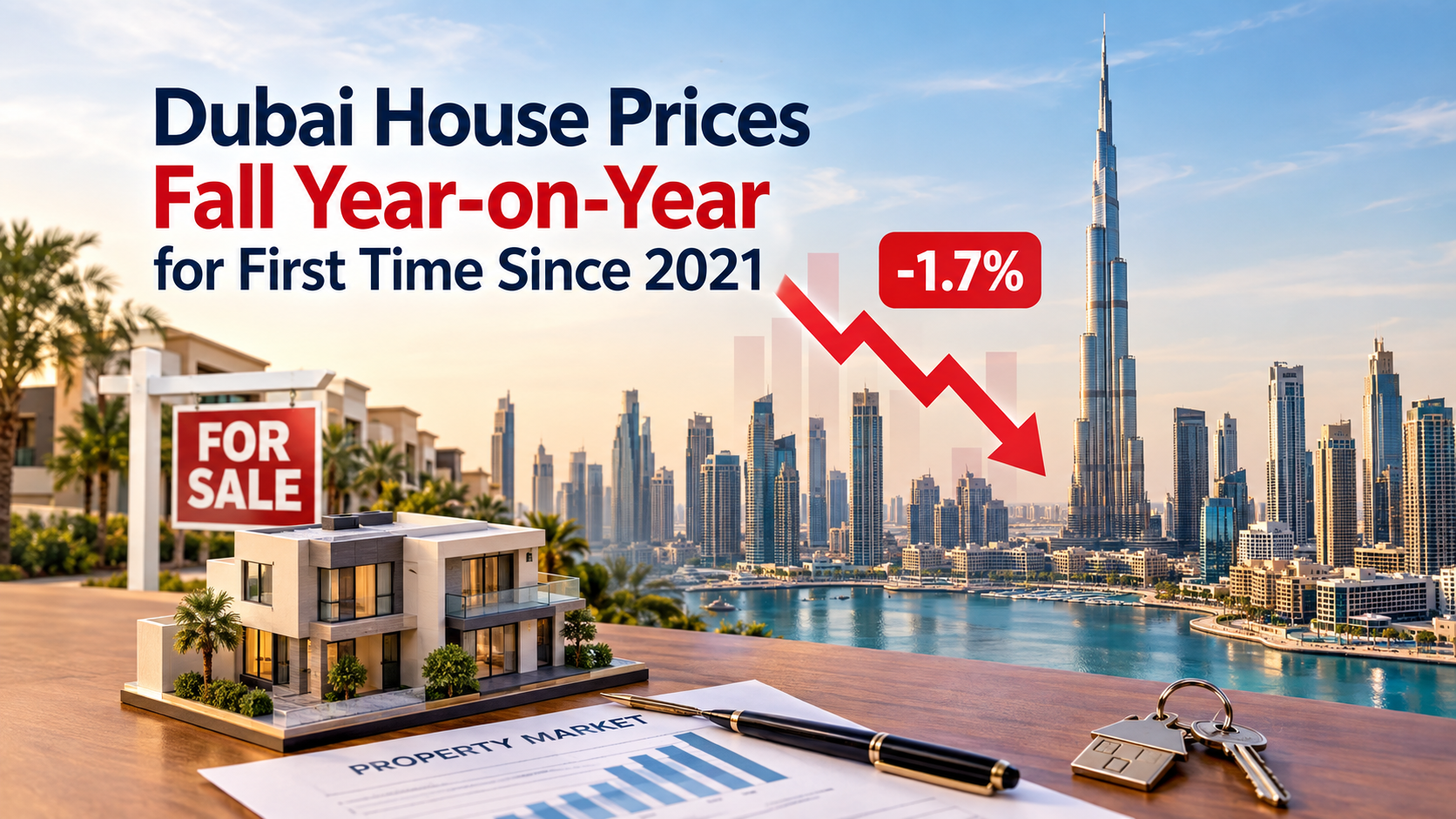
Dubai’s residential property market has reached an important turning point, with average house prices falling year-on-year for the first time since February 2021. According to data from property consultancy Cavendish Maxwell, average residential sales prices declined 1.7% year-on-year in August 2026, reaching approximately AED 1,636 per square foot.
The decline comes after several years of strong price growth and record transaction activity, suggesting that Dubai’s property market may be entering a more mature phase. At the same time, transaction values remained substantial, highlighting that demand for Dubai real estate has not disappeared despite the moderation in prices.
Dubai Property Prices Decline 1.7% in August
The latest figures show that Dubai’s average residential sales price fell 1.7% compared with August 2025. Prices also declined by 1.3% over the latest three-month period.
The August decline is particularly significant because it represents the first annual fall in average residential prices since February 2021, when Dubai’s housing market was still dealing with the effects of the Covid-19 pandemic.
Cavendish Maxwell data puts the average residential price at AED 1,636 per square foot in August 2026. The change indicates that the extraordinary price growth experienced across Dubai during the post-pandemic property boom is beginning to moderate.
Dubai Property Sales Still Remain Strong
Despite falling prices, the market continues to generate substantial transaction activity.
Residential property sales reached approximately AED 23.4 billion in August, equivalent to roughly $6.4 billion. This demonstrates that a decline in average prices does not necessarily mean that buyers have left the market.
In fact, transaction values during the first eight months of 2026 reached almost AED 270 billion, underlining the continued scale of Dubai’s real estate market.
This distinction between prices and transaction values is important. A market can experience softer average prices while maintaining strong transaction volumes if buyers continue purchasing properties, particularly newly launched developments and off-plan units.
Off-Plan Property Continues to Dominate
One of the defining features of Dubai’s current property market is the strength of the off-plan segment.
Off-plan homes accounted for around 75% of residential transactions in August, according to the latest market data. This reflects continued developer activity and sustained interest from buyers seeking new developments.
The popularity of off-plan property also means that Dubai’s headline price statistics need to be interpreted carefully. The type, location and stage of development of properties sold in a particular month can influence average prices.
Nevertheless, the year-on-year decline reported by Cavendish Maxwell is an important indicator that the broader market is moving away from the rapid price appreciation seen in previous years.
Why Are Dubai House Prices Starting to Cool?
Several factors could explain the change in Dubai’s housing market.
The most important is the transition from an exceptionally strong growth cycle into a more mature phase. Dubai experienced substantial population growth, international investment and renewed demand for residential property following the pandemic.
That period resulted in significant increases in property values across many communities. As prices moved higher, affordability and buyer sensitivity naturally became more important.
The increase in available housing supply is another factor. A large pipeline of new residential developments is entering the market, giving buyers more choice and increasing competition between projects.
This does not necessarily indicate a property crash. Instead, it may represent a normalisation of market conditions following several years of unusually strong growth.
A More Mature Dubai Real Estate Market

Cavendish Maxwell describes the latest figures as evidence that Dubai’s residential market is transitioning into a more mature stage.
That transition could mean that investors need to focus less on broad market-wide price appreciation and more closely examine individual locations, developers and property types.
Prime areas with limited land availability may continue to behave differently from communities with significant new supply. Similarly, established villas, luxury properties and off-plan apartments may experience different levels of demand.
For investors, this makes property selection increasingly important.
What the Price Decline Means for Property Investors
For international investors, a 1.7% annual decline may initially appear concerning. However, it should be viewed within the wider context of Dubai’s property market.
A modest year-on-year decline following several years of strong appreciation is very different from a severe market correction. Dubai continues to attract international residents, businesses and investors, while its real estate sector remains one of the emirate’s major economic pillars.
For buyers, softer prices could potentially create opportunities to negotiate better terms, particularly in developments where supply is high or sellers are competing for demand.
Investors should nevertheless assess rental yields, service charges, location, developer reputation, completion timelines and long-term resale prospects rather than relying solely on headline price movements.
Dubai Property Market Is Cooling, Not Collapsing
The August figures should not automatically be interpreted as the beginning of a Dubai property crash.
Another independent residential price index also recorded annual declines in August, although its methodology produced a larger 2.6% year-on-year fall. That index uses a mix-adjusted methodology based on Dubai Land Department registered sales, illustrating why different market reports can produce different headline figures.
The broader message is nevertheless similar: Dubai residential prices are no longer rising at the pace seen during the recent property boom.
At the same time, billions of dirhams worth of property continue to change hands every month. Strong transaction values and continued off-plan demand suggest that the market remains active even as price growth moderates.
What Could Happen Next?
The coming months will be important for determining whether August’s decline represents a temporary adjustment or the beginning of a longer period of price stagnation.
If new supply continues entering the market while buyer demand becomes more selective, further downward pressure could emerge in some segments.
However, continued population growth, economic activity and international investment could provide support for the market. Dubai’s property sector is also highly segmented, meaning that some communities could continue recording price growth even if the emirate-wide average remains flat or negative.
Investors should therefore avoid treating the 1.7% decline as a uniform movement across every Dubai neighbourhood.
Final Thoughts
Dubai’s residential property market has reached a significant milestone. Average house prices fell 1.7% year-on-year in August 2026, marking the first annual decline since February 2021.
Yet the market remains highly active, with residential sales worth approximately AED 23.4 billion ($6.4 billion) recorded during the month and almost AED 270 billion in transactions during the first eight months of the year.
The latest data therefore points more towards market normalisation than an immediate collapse. After years of rapid appreciation, Dubai’s real estate sector appears to be entering a period in which supply, affordability and investment fundamentals will play a greater role in determining performance.
For buyers and investors, this changing environment could create opportunities—but careful due diligence and property-level analysis will become increasingly important.
Frequently Asked Questions
Did Dubai house prices fall in August 2026?
Yes. Average residential sales prices fell 1.7% year-on-year in August 2026, according to Cavendish Maxwell.
Why is the August decline significant?
It was the first year-on-year decline in Dubai’s average residential prices since February 2021.
How much were Dubai residential properties selling for in August 2026?
The average residential sales price was approximately AED 1,636 per square foot.
How much was Dubai’s residential property sales value in August?
Residential sales reached approximately AED 23.4 billion, or around $6.4 billion.
Does the price decline mean Dubai’s property market is crashing?
Not necessarily. Transaction activity remains substantial and off-plan properties continue to account for a large proportion of sales. The latest data is more consistent with a cooling or maturing market than an outright collapse.
Is Dubai still attractive for property investors?
Dubai remains an active international property market, but investors should increasingly evaluate individual developments, locations, rental yields, supply levels and long-term demand rather than assuming that prices across the entire emirate will continue rising at previous rates.
Sources: Cavendish Maxwell data as reported by Khaleej Times and Gulf Business, with additional comparison from PropertyIndex.