Dubai’s real estate sector is positioned for another expansionary phase in 2026, with sustained capital inflows, robust business formation, and structural demand supporting price growth across multiple asset classes. Market momentum is expected to remain strong, but commercial real estate—particularly Grade A office space—is forecast to outperform residential segments in both rental yield and capital appreciation.
Forecast models based on transaction velocity, pipeline absorption, and corporate leasing demand indicate:
-
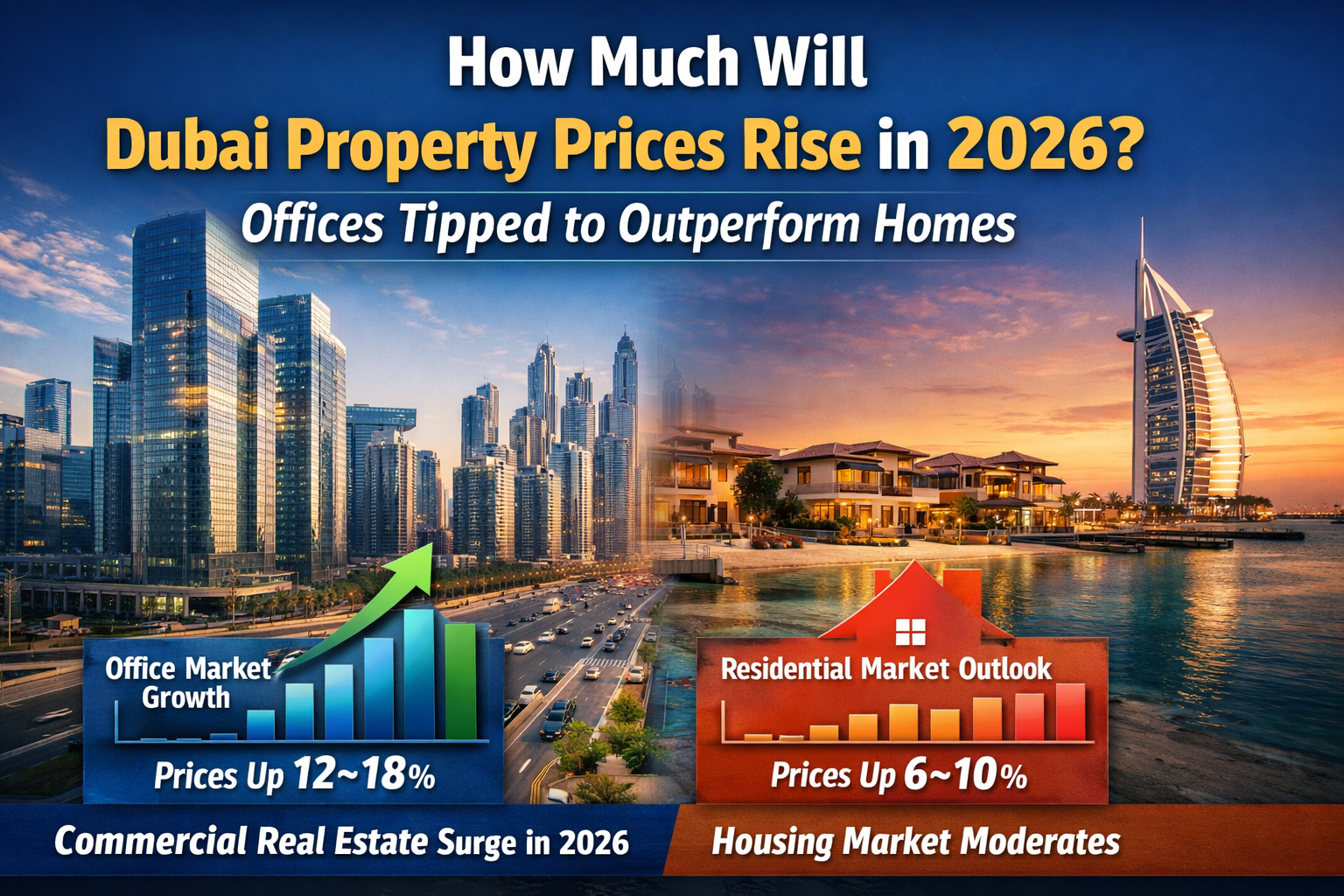
Office prices and rents: projected to rise 12%–18% year-on-year
-
Residential property prices: expected to increase 6%–10%, depending on location and asset quality
This divergence is driven by limited premium office supply, accelerating company relocations, and continued growth in financial services, technology, and regional headquarters setups.
Why Offices Are Expected to Outperform Homes in 2026
Severe Supply Constraints in Prime Office Districts
Dubai’s prime office corridors—DIFC, Downtown Dubai, Business Bay, and Sheikh Zayed Road—are experiencing near-capacity occupancy in Grade A towers. New completions remain limited relative to demand, creating:
-
Rapid rental escalations
-
Competitive lease negotiations
-
Increased investor acquisition activity
Many multinational firms now require larger contiguous office floors, modern sustainability certifications, and integrated business amenities—features available in only a small portion of the current stock.
Corporate Migration and Regional HQ Mandates
Policy incentives encouraging multinationals to establish regional headquarters in the UAE are driving long-term leasing commitments. These occupiers prioritize:
-
Premium office specifications
-
Central business district access
-
Proximity to transport and lifestyle hubs
As lease tenures lengthen and renewal rates rise, capital values for commercial assets are projected to climb faster than residential properties.
Higher Yield Compression in Commercial Assets
With residential yields stabilizing around 5%–7%, prime offices continue to deliver:
-
7%–9% net yields
-
Stronger rent escalation clauses
-
Longer tenant retention
Yield compression, combined with rising rents, directly increases asset valuations, reinforcing commercial property’s outperformance trajectory.
Residential Property Price Forecast: Steady but More Selective Growth
Luxury Segment: Resilient Yet Moderating
Ultra-prime communities such as Palm Jumeirah, Jumeirah Bay Island, Emirates Hills, and Bluewaters will continue attracting high-net-worth buyers. However, price growth is likely to normalize after recent record-breaking cycles.
Expected price increase:
-
Luxury villas and waterfront apartments: 7%–9%
Drivers include:
-
Continued wealth migration
-
Safe-haven investment appeal
-
Limited new ultra-luxury inventory
Yet affordability ceilings and selective buyer behavior are introducing more disciplined pricing dynamics.
Mid-Market and Affordable Housing: Volume-Driven Stability
Communities such as Jumeirah Village Circle, Dubai South, Arjan, and Town Square will benefit from:
-
First-time buyer demand
-
End-user-driven transactions
-
Mortgage-supported purchases
Projected growth:
-
5%–8% annual appreciation
Developers are delivering larger volumes of units in this segment, which helps stabilize pricing while maintaining consistent transaction activity.
Off-Plan Market: Strong Absorption, Controlled Price Growth
Off-plan sales will remain a major transaction driver, supported by:
-
Flexible payment plans
-
Attractive entry pricing
-
Infrastructure-led master communities
However, with significant supply scheduled for handover between 2026 and 2028, price appreciation is expected to remain measured rather than speculative.
Commercial Real Estate Segments Leading the Market
Grade A Office Towers
Top-performing assets will feature:
-
ESG-compliant designs
-
High-speed connectivity infrastructure
-
Integrated retail and dining components
Districts likely to see the strongest capital gains:
-
DIFC Gate District
-
Downtown commercial clusters
-
Select Business Bay waterfront towers
Business Parks and Free Zone Offices
Free zones supporting tech, logistics, and fintech sectors are expanding rapidly. Business parks offering:
-
Scalable office modules
-
On-site warehousing
-
Integrated licensing services
are achieving faster occupancy rates and rising asset values.
Co-Working and Managed Offices
Hybrid work models are sustaining demand for:
-
Flexible lease terms
-
Serviced office solutions
-
Plug-and-play corporate setups
This niche segment continues to generate premium rental rates per square foot, improving overall commercial portfolio returns.
Investment Strategy for 2026: Asset Allocation by Performance Potential
Capital Growth-Focused Investors
Recommended allocation:
-
60% commercial
-
40% residential
Target assets:
-
Prime office floors
-
Fully leased retail units in mixed-use developments
-
Boutique commercial buildings in emerging business districts
Income-Focused Investors
Preferred assets:
-
Long-term leased offices
-
Retail units with essential services tenants
-
Staff accommodation facilities near industrial zones
Expected returns:
-
Higher yield stability than residential rentals
-
Lower vacancy volatility
Residential Buyers Seeking Lifestyle and Stability
Ideal segments:
-
Waterfront apartments with limited resale inventory
-
Family villas near international schools
-
Transit-oriented communities near metro expansions
These assets deliver balanced capital preservation with moderate appreciation.
Infrastructure Expansion Supporting Property Values
Dubai’s 2026 growth outlook is reinforced by:
-
Metro network extensions
-
New commercial zoning clusters
-
Smart city infrastructure upgrades
These projects enhance:
-
Accessibility
-
Workforce mobility
-
Commercial density
Property located near transport and employment hubs is expected to outperform peripheral developments with weaker connectivity.
Foreign Investment and Regulatory Confidence
Dubai continues to benefit from:
-
100% foreign ownership structures
-
Long-term residency programs linked to property investment
-
Transparent land registry systems
This framework encourages institutional-grade investment inflows, particularly into income-generating commercial properties.
Additionally, global capital seeking diversification increasingly favors:
-
Stable currency environments
-
Tax-efficient jurisdictions
-
Politically neutral business hubs
These factors collectively elevate demand for commercial real estate as a strategic asset class.
Price Growth Summary: Expected Ranges for 2026
Office Properties
-
Capital appreciation: 12%–18%
-
Rental growth: 10%–15%
Luxury Residential
-
Capital appreciation: 7%–9%
-
Rental growth: 6%–8%
Mid-Market Residential
-
Capital appreciation: 5%–8%
-
Rental growth: 5%–7%
Retail in Mixed-Use Developments
-
Capital appreciation: 8%–12%
-
Rental growth: 7%–10%
These figures reflect structural demand patterns rather than speculative cycles, supporting sustainable market expansion.
Risk Factors and Market Stability Indicators
While growth remains robust, pricing will increasingly be driven by:
-
Asset quality differentiation
-
Developer credibility
-
Infrastructure proximity
Markets with heavy future supply pipelines may experience short-term absorption pressure, particularly in lower-demand residential micro-locations. In contrast, commercial assets with strong tenant covenants remain insulated from oversupply risks.
Financial system safeguards, escrow regulations, and staged construction releases continue to support market discipline.
Strategic Outlook: Offices as the 2026 Performance Leader
Dubai’s property market in 2026 is transitioning into a more institutionally driven growth phase, where commercial real estate takes precedence over speculative residential appreciation. Offices, business parks, and mixed-use commercial assets are positioned to deliver:
-
Faster price growth
-
Higher income stability
-
Stronger resale liquidity
Residential property remains an essential component of diversified portfolios, but performance will be increasingly location- and product-specific rather than market-wide.
For investors prioritizing return optimization, risk-adjusted income, and long-term capital security, commercial real estate stands as the dominant opportunity in Dubai’s 2026 property cycle.