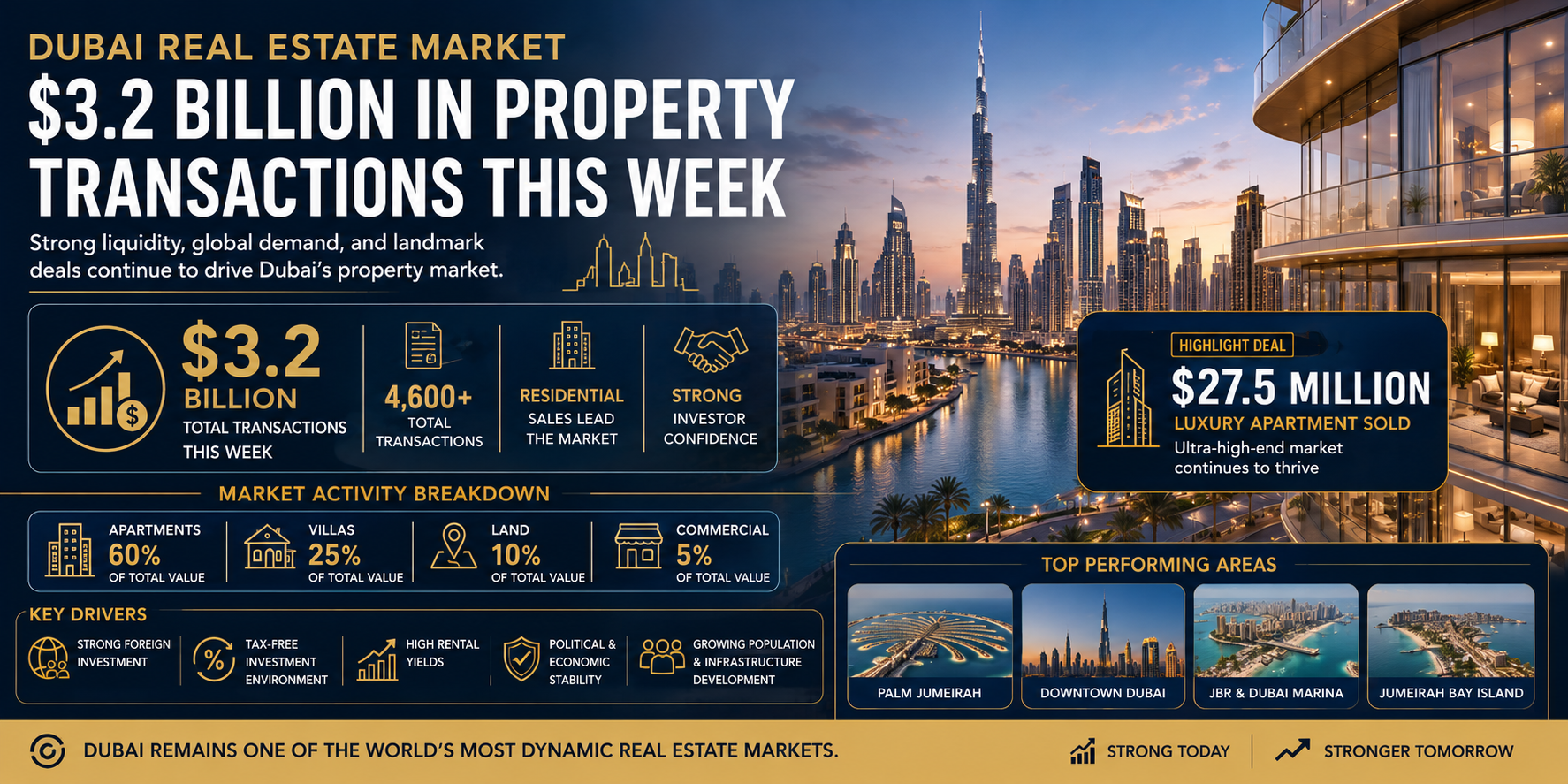
Dubai’s property market continues to demonstrate strong liquidity and investor appetite, with the latest weekly data showing $3.2 billion in total real estate transactions. This figure reflects a highly active market environment where both domestic and international buyers are consistently participating in residential and commercial deals. The volume of activity signals that Dubai remains one of the most dynamic real estate hubs globally.
Weekly reporting from the Dubai property sector has become an important benchmark for understanding short-term momentum. Unlike annual summaries, these snapshots reveal how quickly capital moves through the market. The most recent week highlights not only strong transaction value but also continued confidence in premium real estate segments.
Total transaction value and sales volume
The $3.2 billion figure includes thousands of property transactions across apartments, villas, land, and commercial units. A large portion of this value is concentrated in residential sales, particularly in high-demand communities and off-plan developments. This consistent flow of transactions indicates that liquidity is not restricted to luxury buyers but is spread across multiple price tiers.
Why weekly data matters in Dubai property market
Weekly real estate statistics are crucial because Dubai operates as a fast-moving investment market. Investors track short-term data to identify emerging price trends, demand surges, and developer activity. It also reflects how global capital reacts to macroeconomic conditions in real time, making Dubai one of the most closely watched property markets in the Middle East.
Breakdown of the $3.2 Billion Market Activity
The $3.2 billion transaction volume is not concentrated in a single segment but distributed across multiple categories, with residential real estate taking the lead. Apartments, villas, and off-plan developments form the backbone of this activity, showing that end-user demand and investor speculation both remain strong.
Residential sales dominance
Residential properties continue to dominate Dubai’s real estate ecosystem. Apartments and villas account for the majority of weekly transactions, driven by both expatriate buyers and international investors. Demand remains particularly strong in branded developments and waterfront communities, where lifestyle and capital appreciation potential are key drivers.
In many cases, residential transactions are fueled by long-term residency planning, especially among high-net-worth individuals seeking stability in politically neutral investment destinations. This structural demand provides resilience even during global economic uncertainty.
Mortgage and investment contributions
While cash purchases dominate the luxury segment, mortgage-backed transactions still play a significant role in overall market health. Financing activity indicates that end-users, not just institutional investors, are actively entering the market. This balance between cash and leveraged purchases contributes to market stability and reduces the risk of speculative bubbles.
Spotlight on the $27.5 Million Apartment Deal
Among the most notable highlights of the week is a $27.5 million apartment transaction, reflecting the strength of Dubai’s ultra-luxury real estate segment. High-value apartments continue to set new benchmarks in prime districts, especially in waterfront and skyline-focused developments.
Luxury deals of this scale are not isolated events; they are part of a broader trend where Dubai is increasingly competing with global luxury hubs such as London, New York, and Monaco. These transactions signal strong confidence among ultra-high-net-worth individuals who view Dubai as both a lifestyle destination and a wealth preservation hub.
Luxury property segment trends
The luxury segment in Dubai has evolved significantly over the past decade. Instead of being driven solely by investors, it now attracts end-users seeking second homes or primary residences. Properties above $10 million often include premium amenities, private access features, and iconic views, which significantly increase their value proposition.
Developers are also competing aggressively in this segment, introducing branded residences and architectural landmarks designed to attract global buyers. This has pushed average transaction values higher in prime zones.
Prime locations driving ultra-high-end sales
Locations such as Palm Jumeirah, Downtown Dubai, and Jumeirah Bay Island consistently dominate ultra-luxury sales. These areas offer exclusivity, waterfront access, and proximity to business districts. Scarcity of land in these zones also contributes to long-term price appreciation, making them attractive to long-term capital holders.
Key Drivers Behind Dubai Real Estate Growth
Dubai’s real estate expansion is not accidental; it is driven by structural economic policies, global investor migration, and strong urban development strategies. These factors combine to create sustained demand across multiple segments.
Foreign investor demand
One of the most significant contributors to Dubai’s real estate strength is foreign investment. Buyers from Europe, Asia, and the Middle East view Dubai as a safe haven for capital due to its political stability and strong legal framework. This international demand reduces reliance on local buyers and increases market resilience.
Foreign investors are particularly active in off-plan properties, where early entry prices and developer incentives create strong return potential. This has helped fuel continuous development cycles across the city.
Tax-free investment appeal
Dubai’s tax-free property ownership structure is another powerful attraction. There are no capital gains taxes on property sales, and rental yields remain among the highest globally. This creates a compelling investment environment compared to major global cities where taxation significantly reduces net returns.
As a result, many investors treat Dubai real estate not just as a property market but as a wealth optimization strategy.
Comparison With Previous Weeks
When compared with earlier weeks, the $3.2 billion transaction level indicates stable performance rather than volatility. While some weeks may show higher spikes due to mega-deals, the consistency of crossing multi-billion-dollar thresholds suggests sustained market depth.
Data from recent cycles shows that Dubai frequently records between $3 billion and $4 billion in weekly transactions, depending on the presence of ultra-luxury sales. This consistency reinforces the idea that the market is not driven solely by occasional high-value transactions but by continuous underlying demand.
Impact on Investors and Developers
The ongoing momentum in Dubai’s real estate sector has direct implications for both investors and developers. For investors, it presents opportunities for capital appreciation, rental income, and portfolio diversification. For developers, it signals strong absorption rates for new projects and encourages continued land acquisition and project launches.
Short-term opportunities
Short-term investors often benefit from off-plan appreciation cycles and resale arbitrage opportunities. The presence of high-value transactions also helps set new price benchmarks, which can increase valuations in surrounding developments.
Long-term market outlook
Long-term, Dubai’s real estate market is expected to remain growth-oriented due to population expansion, infrastructure investment, and global capital inflows. Mega-projects and urban expansion plans continue to support sustained demand across residential and commercial sectors.
Risks and Market Considerations
Despite strong performance, the market is not without risks. Rapid price increases in certain segments can lead to affordability challenges and speculative pressure. Additionally, global economic shifts, interest rate fluctuations, and geopolitical conditions can influence short-term demand.
However, the diversified nature of Dubai’s buyer base helps mitigate extreme volatility. The presence of both end-users and investors creates a more balanced ecosystem compared to purely speculative markets.
Conclusion
Dubai’s real estate sector maintaining $3.2 billion in weekly transactions, including a $27.5 million apartment deal, reflects a mature yet highly active property market. The combination of strong foreign investment, luxury demand, and consistent residential activity continues to position Dubai as a global real estate powerhouse. While high-value deals attract attention, the broader market depth is what sustains long-term growth and stability.
FAQs
1. Why does Dubai publish weekly real estate transaction data?
Weekly data provides real-time insight into market activity, investor sentiment, and liquidity trends.
2. What does the $3.2 billion figure include?
It includes residential sales, commercial deals, land transactions, and mortgage activity across Dubai.
3. What makes the $27.5 million apartment significant?
It highlights strength in the ultra-luxury segment and strong demand for prime waterfront properties.
4. Is Dubai real estate only driven by luxury buyers?
No, the market includes a mix of mid-range buyers, end-users, and institutional investors.
5. Is Dubai real estate still growing?
Yes, consistent multi-billion-dollar weekly transactions indicate sustained growth and strong investor confidence.