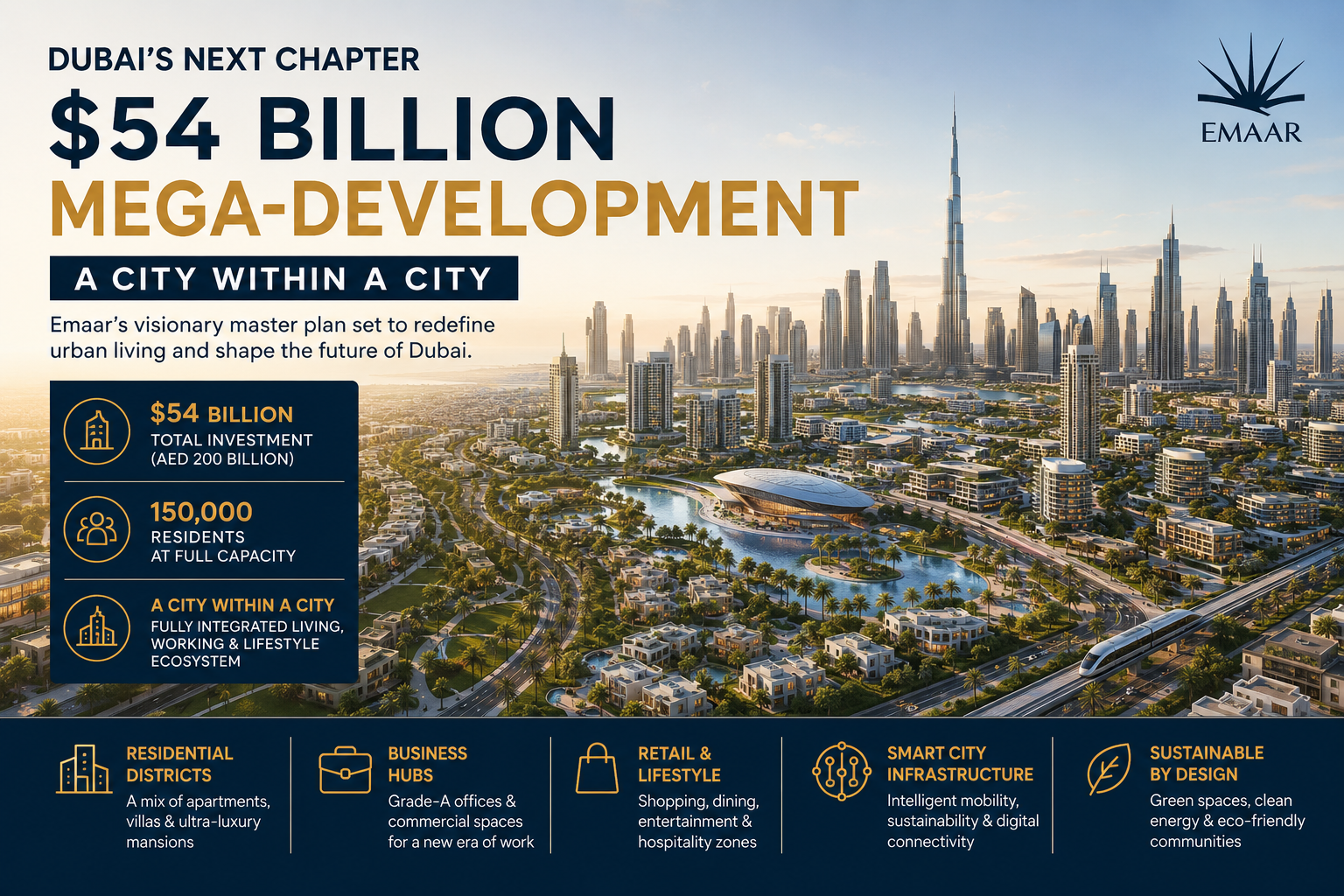
Dubai’s real estate landscape is once again entering a transformative phase as a major announcement emerges from one of the region’s most influential developers. A new $54 billion master-planned community is set to reshape how urban living is defined in the emirate. According to recent reports, the development is being positioned as a “city within a city,” designed to integrate residential, commercial, hospitality, and lifestyle components into a single interconnected ecosystem.
This announcement reinforces Dubai’s long-standing strategy of using large-scale real estate projects to drive economic diversification and global investment appeal. The timing is particularly significant as Dubai continues to experience strong property demand and rising population inflows. The project is not just about buildings; it is about redefining urban behavior, mobility, and livability within one of the fastest-growing global cities.
What makes this initiative especially notable is its ambition. Rather than expanding an existing district, it appears to introduce an entirely new urban core. This reflects a shift in Emaar’s development philosophy—from iconic landmarks to fully integrated urban systems.
What Makes This $54bn Project Significant
Scale and Investment Value
The project is valued at approximately $54 billion (around AED 200 billion), placing it among the largest real estate developments ever proposed in the region. This figure alone signals the magnitude of ambition involved, surpassing typical master-planned communities and entering the realm of full urban districts.
Unlike conventional developments, this is structured as a long-term, multi-phase transformation of land into a self-sustaining ecosystem. It combines residential towers, villas, commercial hubs, and cultural districts under one master plan. This level of integration requires not just architectural planning but also deep infrastructure alignment with government mobility and utilities planning.
Population Capacity and Urban Impact
The development is expected to accommodate nearly 150,000 residents once fully completed. This effectively positions it as a mid-sized city within Dubai itself. The inclusion of such a large residential base implies parallel development of schools, healthcare facilities, transport systems, and community services.
From an urban planning perspective, this scale introduces new density dynamics in Dubai’s real estate map. It also redistributes population clusters away from traditional hubs like Downtown Dubai and Dubai Marina, easing pressure on established districts while expanding the city’s geographic footprint.
Emaar’s Role in Shaping Dubai
Legacy of Iconic Developments
The developer behind this mega project, Emaar Properties, is already responsible for some of Dubai’s most recognizable landmarks, including Burj Khalifa and Downtown Dubai. Over the past two decades, the company has consistently shaped the skyline and global perception of the city.
Its projects have historically functioned as anchor developments that redefine entire districts. This new announcement continues that legacy but on a significantly larger and more complex scale. Instead of a single landmark, it introduces a fully integrated urban fabric.
Position in UAE Real Estate Market
Emaar remains one of the most dominant players in the UAE property sector, particularly in the off-plan and master-planned community segments. Its reputation is closely tied to delivery timelines, architectural quality, and long-term value appreciation.
Recent market performance indicates strong investor confidence in Dubai’s property sector overall, and Emaar continues to benefit from this trend. However, the scale of this new project introduces additional expectations regarding execution speed, infrastructure coordination, and demand absorption.
Core Features of the Mega-Development
Residential Districts
The residential component is expected to include a mix of high-rise apartments, luxury villas, and ultra-premium mansions. The design philosophy emphasizes diversity in housing typologies to attract different income segments and lifestyle preferences.
The inclusion of villas and mansions suggests a focus on high-net-worth individuals, while mid-rise apartment clusters cater to professionals and families. This mix is essential for maintaining long-term community balance and economic sustainability.
Commercial and Business Hubs
The project will also integrate Grade-A office spaces and business districts. This aligns with Dubai’s broader ambition to decentralize business activity from traditional commercial centers.
By embedding workplaces within residential clusters, the development supports hybrid living models where commuting distances are minimized. This is increasingly relevant in global urban planning trends where work-life integration is prioritized.
Retail, Hospitality, and Lifestyle Zones
Retail and hospitality zones are expected to play a central role in activating the community. These areas typically include shopping boulevards, hotels, entertainment venues, and cultural spaces.
Such integration ensures continuous economic activity within the district, even outside working hours. It also enhances tourism potential, allowing the development to function as both a residential hub and a visitor destination.
Smart City Infrastructure
A defining feature of modern Emaar projects is the integration of smart systems. The mega-development is expected to include intelligent mobility systems, digital infrastructure, and sustainable utilities management.
These technologies support energy efficiency, traffic optimization, and enhanced security systems. In large-scale urban environments, such integration is not optional—it is essential for operational efficiency.
Design Philosophy Behind the Project
“City Within a City” Concept
The central idea behind this development is the creation of a fully self-contained urban ecosystem. This includes residential, commercial, educational, healthcare, and recreational components within one boundary.
This approach reduces dependency on external infrastructure and allows residents to access most daily needs within the same district. It reflects a global shift toward mixed-use mega communities rather than isolated zoning.
20-Minute City Model
The project is also expected to follow the “20-minute city” principle, where essential services are accessible within a short walk or drive.
This model improves livability, reduces traffic congestion, and enhances sustainability. It also aligns with Dubai’s broader urban development strategy focused on efficiency and quality of life.
Economic Impact on Dubai
Foreign Investment Attraction
Large-scale developments like this serve as powerful magnets for foreign direct investment. Dubai’s real estate sector has consistently attracted global capital due to tax advantages, infrastructure quality, and regulatory stability.
A project of this magnitude strengthens investor confidence and reinforces Dubai’s position as a global property hub. It also creates secondary investment opportunities in construction, logistics, and services.
Job Creation and GDP Contribution
During construction and operational phases, the project is expected to generate significant employment opportunities across multiple sectors. These include engineering, architecture, retail management, hospitality, and facility operations.
Such developments contribute directly to Dubai’s GDP through construction output, real estate transactions, and long-term economic activity within the community.
Comparison with Other Mega Projects
Dubai is already home to several large-scale developments, but this project stands apart due to its scale and integration level.
Unlike earlier projects that focused on landmarks or single districts, this development combines multiple urban functions into a single continuous ecosystem. It is closer in concept to building a full city extension rather than a neighborhood expansion.
Investor Sentiment and Market Reaction
Initial market sentiment around the announcement has been largely positive, reflecting continued confidence in Dubai’s real estate growth trajectory. The property sector remains one of the strongest contributors to Dubai’s non-oil economy.
However, analysts also note that execution risk increases significantly with scale. Delivery timelines, infrastructure coordination, and demand absorption will be critical factors in determining long-term success.
Strategic Timing of the Launch
The timing of this announcement aligns with a broader wave of property expansion in Dubai. The city has experienced sustained demand from international investors, particularly in the luxury and off-plan segments.
Launching a mega-project at this stage reinforces confidence in long-term growth and signals that developers are planning beyond short-term market cycles.
Sustainability and Future Urban Planning
Modern developments in Dubai are increasingly aligned with sustainability principles. Energy efficiency, green spaces, and smart mobility systems are expected to be core components of this project.
Environmental planning is no longer optional in large-scale developments. It directly impacts long-term operational costs, livability, and regulatory compliance.
Challenges and Risks
Despite its promise, the project faces several challenges:
- Execution complexity due to massive scale
- Dependency on long-term market demand
- Infrastructure synchronization with government systems
- Potential oversupply risk in certain segments
- Global economic fluctuations affecting investment flows
Large developments historically require phased delivery over many years, and maintaining momentum is critical.
Conclusion
The $54 billion mega-development by Emaar represents one of the most ambitious urban projects in Dubai’s modern history. It extends beyond real estate into the realm of city-building, combining residential, commercial, and lifestyle components into a single integrated ecosystem.
If executed successfully, it will not only reshape Dubai’s physical landscape but also redefine global expectations of urban living. The project reflects confidence in the city’s continued expansion and its role as a global investment hub.
FAQs
1. What is the value of Emaar’s new Dubai mega-development?
The project is valued at approximately $54 billion (AED 200 billion), making it one of the largest urban developments in the region.
2. How many residents will the project accommodate?
It is expected to house around 150,000 residents once fully completed.
3. What type of facilities will be included?
The development will include residential units, villas, offices, retail zones, hotels, schools, healthcare facilities, and recreational spaces.
4. Why is this project important for Dubai?
It strengthens Dubai’s position as a global real estate hub and supports long-term urban expansion and economic diversification.
5. Who is developing the project?
The project is being developed by Emaar Properties, one of the UAE’s leading real estate developers.