Introduction to Dubai South Real Estate Boom
Dubai’s property market is no stranger to rapid cycles of expansion, but the recent surge in Dubai South real estate activity signals something deeper than a short-term spike. The district is no longer just a peripheral development; it is becoming a core investment corridor tied directly to aviation, logistics, and long-term urban expansion. The combination of affordability, infrastructure, and mega-project visibility has turned it into a magnet for both regional and international investors.
At the center of this momentum sits Dubai South, a master-planned district designed to integrate residential communities, business hubs, and global logistics infrastructure. Its transformation is closely linked with one of the most ambitious infrastructure developments in the world, the expansion of Al Maktoum International Airport.
What’s Driving the 36% Surge in Property Sales
Airport expansion impact
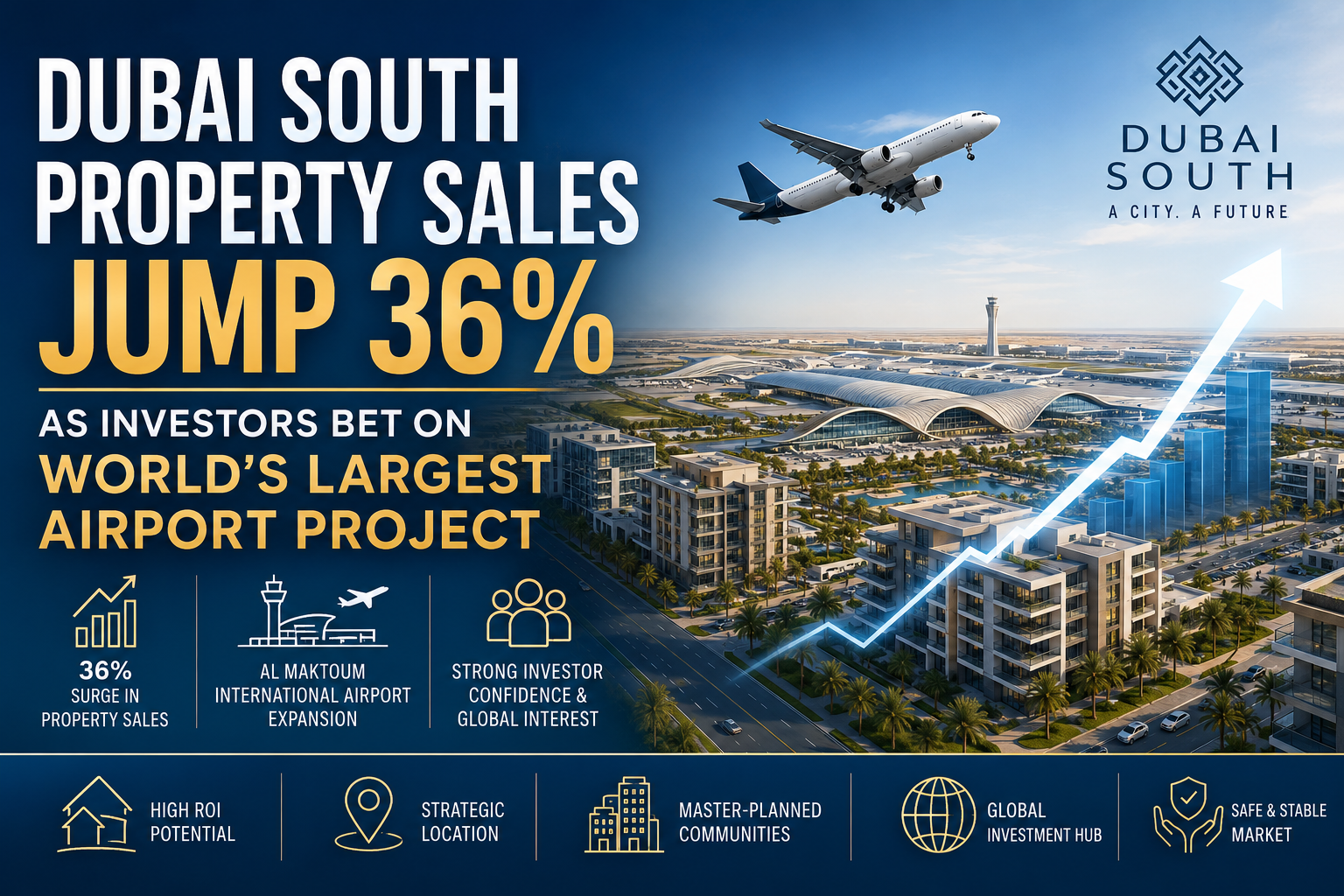
The biggest catalyst behind the surge is the massive expansion of Al Maktoum International Airport, which is expected to become one of the world’s largest aviation hubs once fully operational. Investors typically react early to infrastructure megaprojects, and Dubai South is now experiencing that classic “pre-completion growth wave.”
Historical investment patterns show that properties near major transport hubs tend to appreciate significantly before completion. This is driven by expectations rather than current utility. In Dubai South’s case, the airport narrative is acting as a long-term pricing anchor for developers and buyers alike.
Investor sentiment shift
Another key factor is changing global investor sentiment. Dubai has increasingly been viewed as a stable, high-growth real estate destination, especially compared to slower markets in Europe and North America. This has pushed capital into emerging districts rather than saturated prime locations.
Al Maktoum International Airport Mega Project
Scale and future capacity
The airport expansion is not a minor upgrade—it is a full-scale aviation transformation project. Once completed, it is projected to handle hundreds of millions of passengers annually, positioning it as a global aviation super-hub.
This scale is critical because it fundamentally changes the economic geography of Dubai’s southern corridor. Areas that were once considered “far” are now becoming central nodes in a future airport-city ecosystem.
Economic multiplier effect
Large airports act as economic engines. They generate demand for:
- Housing for workers and professionals
- Logistics and warehousing facilities
- Hospitality and retail ecosystems
- Long-term rental housing markets
Dubai South sits directly inside this multiplier zone, making it a structural beneficiary rather than a speculative play.
Dubai South as a Master-Planned City
Residential + logistics integration
Unlike older districts in Dubai, Dubai South is designed as an integrated ecosystem. Residential communities are built alongside logistics zones, commercial hubs, and free zones. This reduces commuting friction and enhances live-work efficiency.
Expo City synergy
The legacy of Expo 2020 continues to influence development patterns. The nearby Expo City Dubai acts as a secondary demand driver, attracting businesses, startups, and institutional investors into the broader southern corridor.
Market Performance Trends in 2026
Off-plan dominance
A defining characteristic of the current market cycle is the dominance of off-plan sales. A significant portion of transactions in Dubai South is driven by developers launching new projects with flexible payment plans.
This reflects investor preference for:
- Lower entry prices
- Higher projected capital appreciation
- Installment-based affordability
Transaction growth patterns
Recent data shows Dubai South consistently ranking among the top-performing zones in Dubai, with rising monthly transaction volumes and strong developer activity. The 36% growth rate is not isolated—it is part of a sustained multi-month trend driven by infrastructure optimism.
Price Trends and ROI Potential
Entry-level pricing structure
Dubai South remains significantly more affordable than established Dubai districts. Entry-level apartments and townhouses typically start in the mid-to-upper affordability range, depending on proximity to key nodes.
This pricing gap is one of the primary reasons investors are rotating capital from saturated areas into this corridor.
Rental yields overview
Rental yields in Dubai South are generally considered strong compared to global benchmarks. Investors are attracted by:
- Relatively low acquisition cost
- Strong tenant demand from airport and logistics workforce
- Long-term appreciation expectations
Why Global Investors Are Entering Dubai South
Safe-haven appeal
Dubai has increasingly positioned itself as a global safe-haven market for real estate capital. Political neutrality, strong regulatory frameworks, and investor-friendly policies make it attractive for cross-border investment flows.
Long-term appreciation logic
Most capital entering Dubai South is not short-term speculative money. It is structured around a 10–15 year infrastructure cycle, where value is expected to compound as the airport becomes fully operational and surrounding ecosystems mature.
Risks and Market Corrections
Oversupply concerns
One of the key risks is supply concentration. Large-scale master plans often release multiple phases simultaneously, which can temporarily outpace absorption rates.
This means investors must be selective about:
- Developer reputation
- Project location within Dubai South
- Delivery timelines
Short-term volatility factors
Macro events such as geopolitical tensions or interest rate fluctuations can temporarily impact transaction volumes. However, long-term infrastructure-driven markets tend to recover faster due to underlying demand fundamentals.
Comparison with Other Dubai Hotspots
Dubai Marina vs Dubai South
Dubai Marina represents a mature, high-density waterfront market with premium pricing. Dubai South, in contrast, offers:
- Lower entry cost
- Higher long-term growth potential
- Infrastructure-driven upside
Business Bay vs Dubai South
Business Bay is a central business district with strong rental demand. Dubai South, however, is positioned for future expansion rather than current saturation, making it more suitable for long-horizon investors.
Future Outlook 2026–2035
Airport completion timeline impact
As the airport expansion progresses, Dubai South is expected to transition from an emerging district into a fully established urban hub. This transition typically leads to:
- Higher property valuations
- Increased rental demand
- Institutional investor participation
Population growth expectations
The district is designed to accommodate large population inflows tied to aviation, logistics, and service industries. This creates a built-in demand base that supports long-term housing stability.
Conclusion
The 36% surge in Dubai South property sales reflects more than just market momentum—it signals a structural shift in Dubai’s real estate geography. As investors position themselves ahead of the Al Maktoum International Airport expansion, Dubai South is evolving into one of the most strategically important growth corridors in the region. Its combination of affordability, infrastructure alignment, and long-term planning makes it a focal point for global capital seeking sustainable appreciation rather than short-term gains.
FAQs
1. Why are property sales increasing in Dubai South?
The increase is mainly driven by the Al Maktoum Airport expansion and strong investor confidence in long-term infrastructure growth.
2. Is Dubai South a good investment in 2026?
Yes, it is considered a high-potential long-term investment due to affordability and major infrastructure projects.
3. What is the main project boosting Dubai South?
The expansion of Al Maktoum International Airport, expected to become one of the world’s largest airports.
4. Are rental yields strong in Dubai South?
Yes, yields are generally competitive compared to global markets, driven by tenant demand from logistics and aviation sectors.
5. What are the risks of investing in Dubai South?
Key risks include oversupply, project delays, and short-term market volatility.