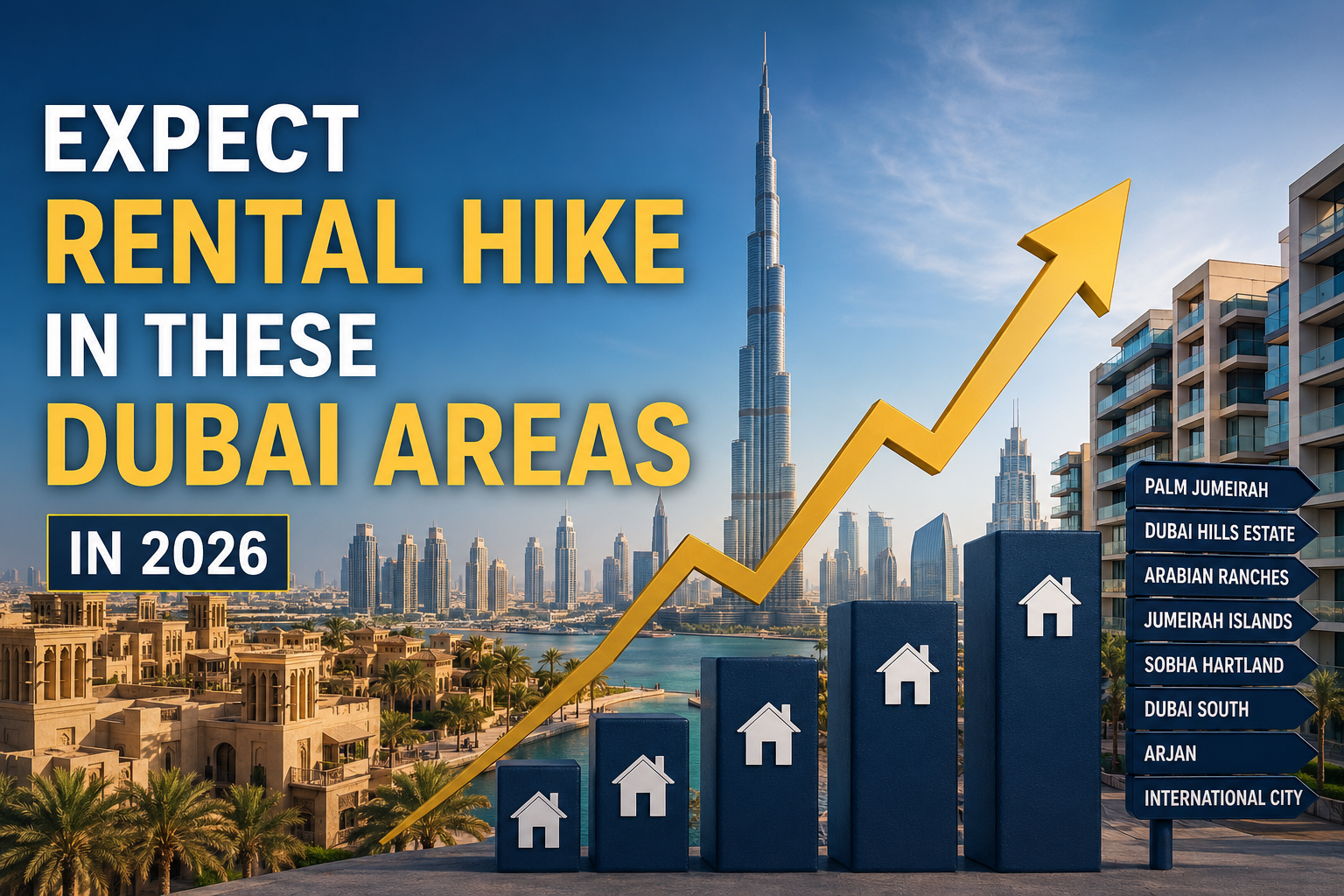
Dubai’s rental market is entering a more mature phase in 2026, but that does not mean rents will move in the same direction across every community. After several years of substantial rental growth, the market is now becoming more balanced as new residential supply gives tenants greater choice. However, areas with limited supply, strong lifestyle appeal and persistent demand could continue to experience rental increases.
Recent market data shows that Dubai rents have softened modestly in some segments, while remaining significantly above pre-boom levels. By May 2026, average rents had declined 1.1% over the previous three months, yet remained almost 9% higher year-on-year. At the same time, luxury properties in prime locations continued to benefit from strong demand.
This means the Dubai rental market in 2026 is increasingly location-specific. Tenants in some apartment-heavy communities may gain more negotiating power, while residents seeking premium villas, waterfront homes and established family communities could still face higher rental costs.
Dubai Rental Market Outlook for 2026
The biggest change in Dubai’s rental market is the shift from exceptionally rapid growth towards normalisation. Property Finder’s latest forecast indicates that apartment-heavy districts are likely to experience flatter rental growth during the second half of 2026 because additional housing supply is increasing competition between landlords.
The supply pipeline is important because approximately 170,000 homes were expected to be completed in Dubai during 2026, with apartments accounting for the majority. This additional inventory is likely to reduce rental pressure in some apartment communities, including areas where substantial new developments are being handed over.
However, supply is not evenly distributed across Dubai. Communities with established infrastructure, limited premium stock and strong tenant demand can remain more resilient.
Palm Jumeirah Could See Continued Rental Pressure
Palm Jumeirah remains one of Dubai’s strongest luxury rental markets because of its beachfront lifestyle, global reputation and limited availability of comparable waterfront properties.
According to Bayut’s H1 2026 rental-market analysis, overall apartment rents on Palm Jumeirah increased by 5.31%, while one-bedroom apartments recorded a 3.16% increase. The villa market has been even more notable, with four-bedroom Palm Jumeirah villas recording a 9.64% increase.
The combination of scarce waterfront inventory and demand from affluent residents makes Palm Jumeirah one of the communities where rental increases could remain more visible in 2026.
For tenants, the main risk is that premium villas and high-quality apartments can command a substantial rental premium when landlords have access to strong demand from high-net-worth individuals and corporate executives.
Dubai Hills Estate Remains a Strong Family Rental Market
Dubai Hills Estate is another community to watch for rental growth in 2026. Its appeal comes from a combination of modern residential stock, green spaces, schools, retail facilities and family-oriented amenities.
Bayut reported an overall increase in villa rental performance in Dubai Hills Estate during H1 2026, with particularly strong demand for larger five-bedroom homes. Four-bedroom villas also continued to attract tenants seeking park and golf-course views.
The community’s position within Dubai’s established luxury residential market means demand can remain relatively resilient even as the broader apartment market becomes more competitive.
This does not mean every Dubai Hills property will experience a rent increase. Property quality, location within the community, condition and current lease value remain important factors. Nevertheless, premium villas are among the property types that could remain exposed to upward rental pressure.
Arabian Ranches Could Remain Resilient
Arabian Ranches continues to appeal to families looking for larger homes, established landscaping and a suburban lifestyle while remaining within Dubai.
The community recorded an overall rental increase in Bayut’s H1 2026 data, with positive movement across four-, five- and six-bedroom villas. Property Finder’s Q3-Q4 2026 outlook also identifies established villa communities such as Arabian Ranches as more resilient than apartment-heavy districts facing greater new supply.
This makes Arabian Ranches particularly relevant for tenants considering a villa renewal. A well-maintained home in a desirable location may continue to command stronger rental demand than comparable properties in communities where new inventory is arriving rapidly.
Jumeirah Islands Could See Further Rental Growth
Jumeirah Islands is another premium villa community worth watching in 2026. Its appeal is closely linked to privacy, larger homes and an established luxury residential environment.
Bayut identified Jumeirah Islands as the leading performer in the ultra-luxury villa category during H1 2026, supported by strong demand for four-bedroom villas.
The community’s limited supply characteristics are important. Unlike apartment-heavy areas receiving significant volumes of new units, established villa communities can be less exposed to immediate supply-driven rental competition.
As a result, tenants looking for larger homes in premium family communities could face continued upward pressure on rents where demand exceeds the available quality stock.
Sobha Hartland Is One of the Apartment Areas to Watch
Not all potential rental increases are concentrated in villas. Sobha Hartland has also demonstrated positive rental momentum in 2026.
Bayut’s H1 report recorded an overall rental increase of 6.45% for Sobha Hartland, with one-bedroom apartments increasing by 3.35%.
The community benefits from its location, modern housing stock and proximity to major employment and lifestyle destinations. These characteristics can support tenant demand, particularly among professionals seeking newer residences in centrally positioned communities.
However, tenants should distinguish between established buildings with strong occupancy and properties competing directly with newly handed-over units. New supply could moderate rental growth in parts of the market later in 2026.
Arjan Could Experience Selective Rental Growth
Arjan presents a more complicated picture. The community recorded a 3.43% overall rental increase in Bayut’s H1 2026 data, supported by demand for one- and two-bedroom apartments.
At the same time, Property Finder highlights Arjan as one of the areas where major handovers are reshaping rental benchmarks. New supply can create additional choices for tenants, potentially limiting how aggressively landlords can raise rents.
Therefore, the most realistic outlook is selective rental growth rather than a blanket increase across Arjan. High-quality, well-located and competitively priced units may perform better than older or less differentiated properties.
International City Is Showing Rental Momentum
International City remains important to Dubai’s affordable rental market, particularly for tenants seeking studios and one-bedroom apartments at comparatively accessible prices.
Bayut reported a 4.25% overall rental increase in International City during H1 2026, driven by stronger demand for studios and one-bedroom apartments.
The community demonstrates how rental pressure can emerge outside Dubai’s luxury segment. Population growth and demand for affordable housing can support rents even when premium districts experience slower growth.
For investors, this also makes affordable communities relevant because rental performance depends not only on headline property prices but also on tenant affordability and occupancy demand.
Dubai South Villa Rents Could Rise in Selected Segments
Dubai South is another community where rental performance varies significantly by property type.
While the area is receiving additional residential supply, Bayut reported a 5.27% increase in three-bedroom villa rents during H1 2026.
Property Finder, however, notes that major handovers in Dubai South are contributing to changing regional rental benchmarks.
This creates a mixed outlook. New apartment supply may give tenants more choice, but villas with attractive layouts, community amenities and convenient access to major employment and transport hubs can continue to command stronger rents.
Why Are Some Dubai Areas More Likely to See Rental Hikes?
Rental increases in Dubai are primarily driven by the interaction between tenant demand, available supply, property quality and location.
Areas with limited high-quality inventory can experience stronger rental pressure when population growth and household formation increase demand. Waterfront communities and established villa neighbourhoods are particularly relevant because new supply cannot always replicate their location, views, plot sizes or lifestyle characteristics.
Dubai’s population growth also continues to underpin housing demand. However, the large volume of new homes expected to enter the market during 2026 means that rental growth should become more moderate than during the previous cycle.
This is why the 2026 market should not be viewed as one in which every Dubai landlord can simply increase rent.
RERA Rules Will Limit Unrestricted Rent Increases
A potential rental hike does not automatically mean that a landlord can increase the rent by any amount.
Dubai’s rental framework uses the RERA Smart Rental Index to determine permissible increases based on factors including the existing rent relative to market levels and property characteristics. Property Finder reports that landlords must generally notify tenants of a proposed increase at least 90 days before the lease expires.
Tenants should therefore check their property’s applicable rental benchmark before accepting a proposed increase. Market asking rents alone do not necessarily determine the legally permissible renewal increase.
What This Means for Dubai Tenants in 2026
Tenants approaching lease renewal should pay close attention to their specific community rather than relying on Dubai-wide rental headlines.
If the property is located in a supply-constrained villa or waterfront community, the landlord may have stronger market conditions behind a renewal proposal. In contrast, tenants in apartment-heavy areas receiving substantial new supply may have more alternatives and greater negotiating power.
Property Finder’s latest outlook indicates that increased supply is already giving tenants more leverage in some areas, with landlords using incentives such as flexible payment arrangements, rent-free periods and upgraded amenities to maintain occupancy.
This makes 2026 an increasingly segmented rental market. The strongest negotiating strategy will depend on the building, unit type, location and comparable rental transactions.
What Dubai Landlords Should Expect
Landlords should also avoid assuming that rents will rise indefinitely.
The current market rewards properties that offer genuine value. Well-maintained homes in desirable communities can continue to attract tenants, while properties priced significantly above comparable units may face longer vacancy periods.
The growth of new residential supply means landlords increasingly need to balance rental increases against occupancy risk. A slightly lower rent from a reliable tenant may be financially preferable to a higher asking rent followed by extended vacancy and leasing costs.
Dubai Rental Market Outlook for the Rest of 2026
The remainder of 2026 is likely to produce a more differentiated rental market. Apartment-heavy communities facing significant new supply may experience stabilisation or modest corrections, while premium waterfront locations and established villa communities could remain comparatively resilient.
Among the areas showing the strongest evidence of rental momentum are Palm Jumeirah, Dubai Hills Estate, Arabian Ranches, Jumeirah Islands, Sobha Hartland, Arjan, International City and selected villa segments in Dubai South. Their performance is not identical, but each has recorded rental strength in at least some property categories during the first half of 2026.
The key takeaway for tenants and investors is that Dubai’s rental market is no longer simply a story of citywide rent increases. Property type, supply pipeline and community-level demand are becoming increasingly important.
Conclusion
Dubai’s rental market in 2026 is moving into a more balanced phase, but rental hikes have not disappeared. Instead, they are becoming increasingly concentrated in communities where demand remains strong and quality supply is limited.
Palm Jumeirah, Dubai Hills Estate, Arabian Ranches and Jumeirah Islands stand out in the villa and premium segments, while Sobha Hartland, Arjan and International City have shown rental momentum in selected apartment categories. Dubai South presents a more mixed picture because new supply is simultaneously creating opportunities for tenants.
For renters, the most important step is to evaluate the property’s current market position before renewing. For landlords and investors, the focus should be on occupancy, tenant demand, property quality and the impact of new supply rather than assuming that previous years’ rental growth will continue at the same pace.
Ultimately, Dubai rental hikes in 2026 are likely to be selective rather than universal. The communities with the strongest demand, most attractive lifestyle propositions and tightest supply are likely to remain the areas where tenants feel the greatest rental pressure.
Frequently Asked Questions
Will Dubai rents increase in 2026?
Dubai rents are expected to become more moderate during 2026, but selected communities and property types can still record increases. Recent data shows strong rental performance in several premium villa communities and selected apartment areas, while some apartment-heavy districts are moving towards stabilisation.
Which Dubai areas are most likely to see rental hikes in 2026?
Areas showing notable rental momentum include Palm Jumeirah, Dubai Hills Estate, Arabian Ranches, Jumeirah Islands, Sobha Hartland, Arjan and International City. Rental performance varies by property type and individual building.
Are Dubai apartment rents going up in 2026?
Some apartment communities have recorded increases, but the overall apartment market is becoming more competitive because of new supply. Property Finder expects flatter rental growth in several apartment-heavy districts during Q3 and Q4 2026.
Are villa rents more resilient than apartment rents in Dubai?
In several communities, yes. Established villa areas such as Arabian Ranches and Dubai Hills Estate have demonstrated stronger resilience, partly because premium family-oriented villa supply is more constrained than the supply of apartments in some parts of Dubai.
Can a Dubai landlord increase rent by any amount?
No. Rent increases are subject to Dubai’s rental regulations and the applicable RERA Smart Rental Index. Tenants should check the permitted increase for their property and ensure that the required notice period has been followed.
What should tenants do before renewing a Dubai rental contract?
Tenants should compare their current rent with recent market transactions, check the applicable RERA rental benchmark, review competing properties in the same community and negotiate based on market conditions. In areas receiving substantial new supply, tenants may have stronger bargaining power.