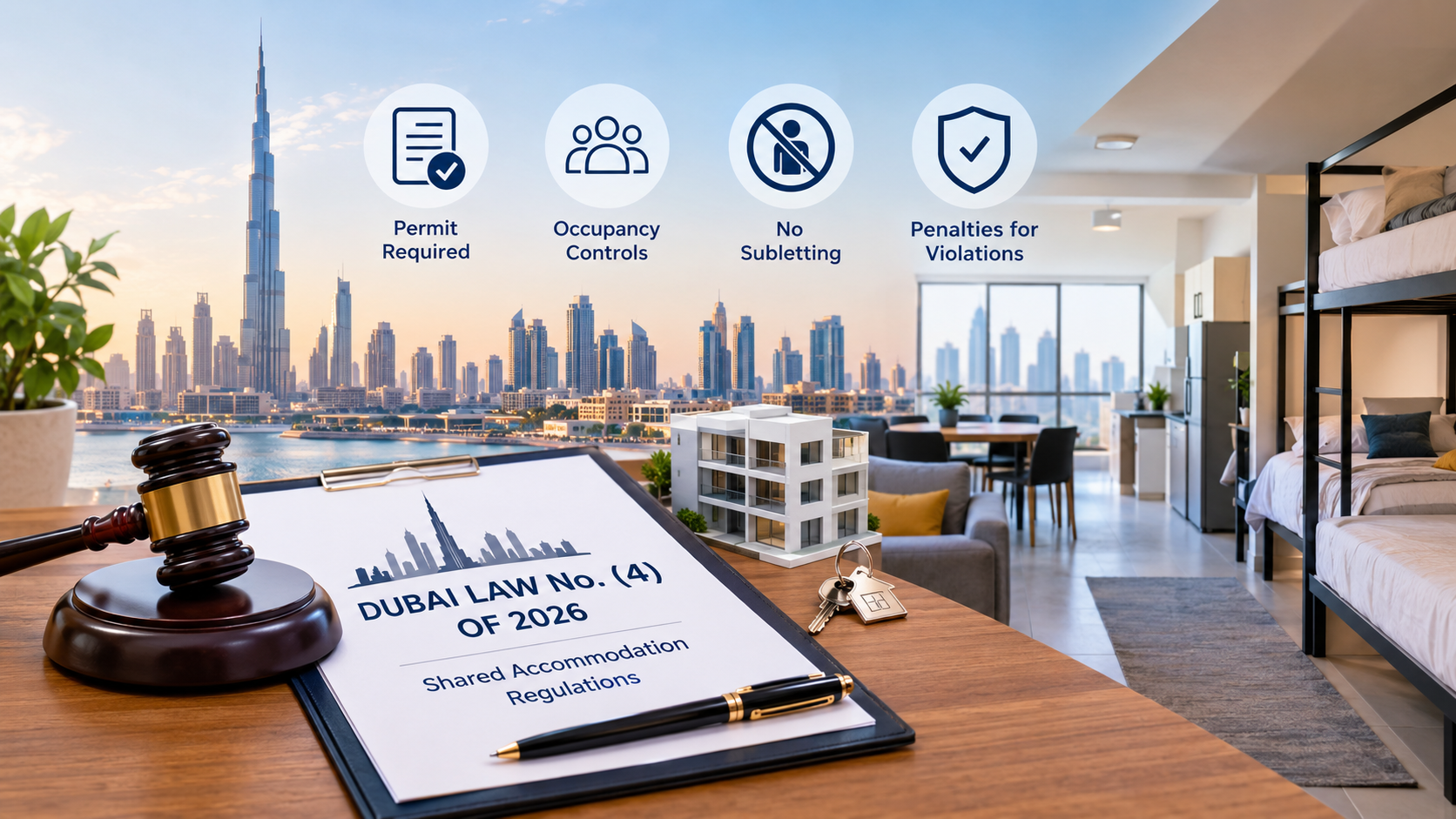
Dubai has introduced a comprehensive regulatory framework for shared accommodation, bringing apartment sharing, bed-space arrangements and other forms of shared housing under clearer official controls.
Dubai Law No. (4) of 2026, which regulates the management and occupancy of shared housing, officially came into effect on 26 August 2026, 180 days after its publication in the Official Gazette. The law applies across Dubai, including private development zones and free zones, while collective labour accommodation is excluded.
The new framework is particularly important for tenants, property owners and businesses involved in shared accommodation because it introduces permit requirements, occupancy controls, restrictions on subletting and substantial penalties for violations.
What Is Shared Housing Under Dubai’s New Law?
Shared housing generally refers to accommodation where individuals or families occupy designated spaces within a property while sharing facilities such as kitchens, bathrooms, dining areas or other common spaces.
The regulations cover several types of properties, including:
- Apartments
- Detached houses
- Residential complexes
- Mixed-use buildings
- Townhouses
- Multi-storey buildings
However, not every arrangement involving more than one household automatically falls under the same rules. For example, arrangements involving separate, self-contained portions of a property may require assessment based on how the spaces and facilities are actually used. Dubai Municipality is the authority responsible for determining where and under what conditions properties can be designated for shared housing.
Shared Housing Permits Are Now Required
One of the biggest changes is the introduction of a formal permit system.
A property cannot be designated for shared housing without obtaining the required permit. Dubai Municipality is responsible for regulating the sector, while the Dubai Land Department (DLD) manages the electronic shared housing registry and related tenancy and management information.
Permits are generally valid for one year and can be renewed. The law also allows a two-year permit to be issued at the owner’s request. Renewal applications must be submitted at least 30 days before the permit expires.
This means landlords and operators who previously managed shared properties informally now need to ensure that their properties and operating arrangements comply with the new framework.
New Rules for Landlords
Property owners have greater responsibilities under the new system.
Before offering a property as shared accommodation, owners need to ensure that it meets the applicable technical, safety and occupancy requirements and has the necessary permit.
Dubai Municipality will establish requirements covering matters such as:
- Maximum occupancy
- Space allocated to each resident
- Shared facilities
- Building standards
- Fire safety
- Health and sanitation
- Security
- Electrical requirements
The municipality can also determine which areas of Dubai are suitable for shared accommodation, taking into account factors such as population density, infrastructure, urban planning and the character of residential neighbourhoods.
For landlords, this makes proper planning and compliance increasingly important before converting a conventional residential property into shared accommodation.
Tenants Can No Longer Sublet Shared Housing
One of the most significant changes for renters concerns subletting.
Under Law No. (4) of 2026, tenants cannot sublease their allocated room, bed space or another part of a shared accommodation unit to someone else.
Only the property owner or an authorised establishment can legally lease shared accommodation to residents. An authorised company may either manage the property on behalf of the owner or lease the property from the owner for the purpose of legally subleasing it.
This directly affects informal arrangements where a tenant rents an apartment and then advertises individual rooms or bed spaces through social media, WhatsApp groups or personal networks.
A renter should therefore establish who legally owns or manages the property and who is authorised to receive rent before paying a deposit or moving in.
Rules for Shared Housing Operators
Businesses operating shared accommodation must also comply with the new regulatory framework.
Licensed operators can manage properties on behalf of owners or lease approved properties for subsequent leasing to residents. Their operations must comply with the relevant licensing, permit, safety and occupancy requirements.
The law gives authorities the ability to take enforcement measures against operators that fail to comply. These measures can include suspension of the activity for up to six months, cancellation of permits and, where applicable, revocation of commercial licences.
This creates a more formal distinction between legitimate shared-housing operators and individuals informally renting out rooms or bed spaces.
Occupancy Limits and Space Requirements
Overcrowding is one of the central issues addressed by the new law.
Dubai Municipality has authority to establish the maximum number of residents permitted in a property, the space allocated to each resident and the facilities that must be available.
Existing Dubai regulations have also required minimum living space standards for shared accommodation, with reporting citing at least five square metres of living space per resident under existing requirements.
For property owners, simply having enough bedrooms does not necessarily mean a property can accommodate an unlimited number of residents. Occupancy must comply with the applicable approved standards.
What Happens to Unauthorised Partitions?
Unauthorised partitions are another important consideration.
Dividing bedrooms, living areas or balconies with makeshift materials can create safety concerns, particularly when partitions affect fire safety or escape routes. The National reported that wooden or non-fire-rated gypsum-board partitions cannot be used to divide areas of a home without the required approval from Dubai Municipality.
Landlords and operators should therefore review existing partitions and alterations before applying for or renewing shared-housing permits.
New Shared Housing Rental Index
Another important development is the planned creation of a dedicated rental index for shared housing.
The Dubai Land Department is responsible for establishing and periodically updating the index based on the specifications and characteristics of shared housing units. The new system is intended to provide a more structured basis for rental information in this segment.
DLD is also responsible for specifying information to be included in shared-housing lease and management contracts and preparing standardised contract templates.
This could make the shared accommodation market more transparent as the regulatory system develops.
What Tenants Should Check Before Renting Shared Accommodation
Tenants looking for a room or bed space in Dubai should take additional precautions under the new framework.
Before making a payment, prospective residents should check:
- Who owns the property?
- Who is legally managing or leasing the accommodation?
- Is the property approved for shared housing?
- Is the operator properly authorised?
- How many residents are permitted?
- Does the accommodation have appropriate safety standards?
- Who will receive the rent and deposit?
- Is there a proper written agreement?
Tenants should be particularly cautious about advertisements offering extremely crowded rooms or bed spaces through informal social media channels.
A social media advertisement alone does not establish that the person offering the accommodation has legal authority to rent it.
Fines Can Reach AED 1 Million
The new law introduces significant financial penalties.
Violations can result in fines ranging from AED 500 to AED 500,000. If the same violation is repeated within one year, the fine can be doubled, subject to a maximum of AED 1 million.
Authorities can also impose additional measures depending on the circumstances, including:
- Suspending shared-housing activities
- Cancelling permits
- Revoking commercial licences
- Disconnecting public utilities until violations are corrected
- Ordering the evacuation of units that fail to meet permit requirements
The Dubai Rental Disputes Centre has jurisdiction over disputes relating to rights and obligations under the law and its associated decisions.
One-Year Compliance Period for Existing Properties
The new regulations do not require every existing shared-housing property to become compliant overnight.
Owners and establishments that were already operating shared accommodation before the law took effect have one year from 26 August 2026 to bring their properties and operations into compliance. This means the current compliance period runs to 26 August 2027, subject to any permitted extension.
Dubai Municipality may grant a one-time extension where permitted under the law.
This transition period gives existing landlords and operators time to review their properties, occupancy arrangements, permits, contracts and safety requirements.
How the New Law Could Affect Dubai’s Rental Market
Dubai’s shared accommodation sector has become an important part of the city’s rental market, particularly for residents seeking more affordable accommodation.
The new regulations do not prohibit shared housing. Instead, they establish a formal framework around where it can operate, who can provide it, how many people can live in a property and what standards the accommodation must meet.
For tenants, the changes could mean greater emphasis on documented rental arrangements and authorised providers.
For landlords, compliance may require changes to occupancy levels, property layouts and management arrangements.
For professional operators, the regulations create a clearer legal framework but also introduce additional responsibilities and compliance requirements.
What Dubai Landlords and Operators Should Do Now
With the compliance period already underway, owners and operators should consider reviewing their shared accommodation properties rather than waiting until the deadline approaches.
A practical compliance review should include:
- Confirming whether the property is eligible for shared housing
- Checking the applicable permit requirements
- Reviewing maximum occupancy
- Measuring resident space
- Inspecting partitions and alterations
- Reviewing fire and electrical safety
- Confirming sanitation and shared facilities
- Checking operator licensing
- Reviewing tenancy and management contracts
- Ensuring tenants are not being allowed to sublet unlawfully
Because implementing procedures and executive requirements can develop over time, owners should verify the latest requirements with the relevant Dubai authorities before making structural or commercial decisions.
Frequently Asked Questions
Is shared housing illegal in Dubai in 2026?
No. Shared housing is not prohibited. Dubai Law No. (4) of 2026 establishes a regulatory framework requiring approved properties, permits, occupancy controls and compliance with technical and safety requirements.
Can a tenant rent out their room to another person?
Under the new shared-housing law, tenants cannot sublease their allocated accommodation or another part of the shared unit. Shared accommodation can be leased by the owner or an authorised establishment.
What is the maximum fine for violating the law?
Fines can range from AED 500 to AED 500,000. A repeated violation within one year can result in the fine being doubled, up to AED 1 million.
When did Dubai’s shared housing law take effect?
Law No. (4) of 2026 came into force on 26 August 2026, 180 days after publication in the Official Gazette.
Do existing shared accommodation properties have time to comply?
Yes. Existing owners and establishments have one year from the law’s effective date to bring their properties and operations into compliance, with a possible one-time extension under the law.
Does the law apply to Dubai free zones?
Yes. The law applies to real estate in Dubai, including private development zones and free zones. Collective labour accommodation is excluded from this particular law.
Final Thoughts
Dubai’s 2026 shared housing law represents a significant formalisation of the emirate’s shared accommodation market. The new framework places greater emphasis on permits, authorised operators, occupancy limits, safety standards and documented rental arrangements.
For tenants, checking the legitimacy of a shared accommodation provider is increasingly important. For landlords and operators, the priority should be bringing existing properties and management practices into compliance during the transition period.
As Dubai continues to develop its rental market, the new shared-housing framework is likely to play an important role in balancing affordable accommodation options with safety, transparency and property-management standards.