Dubai’s residential property market is showing renewed signs of resilience as ready home sales rebound, highlighting continued demand for completed properties across the emirate. The latest market development comes as buyers increasingly look beyond new launches and off-plan projects towards homes that can be occupied, rented or acquired as income-producing assets immediately.
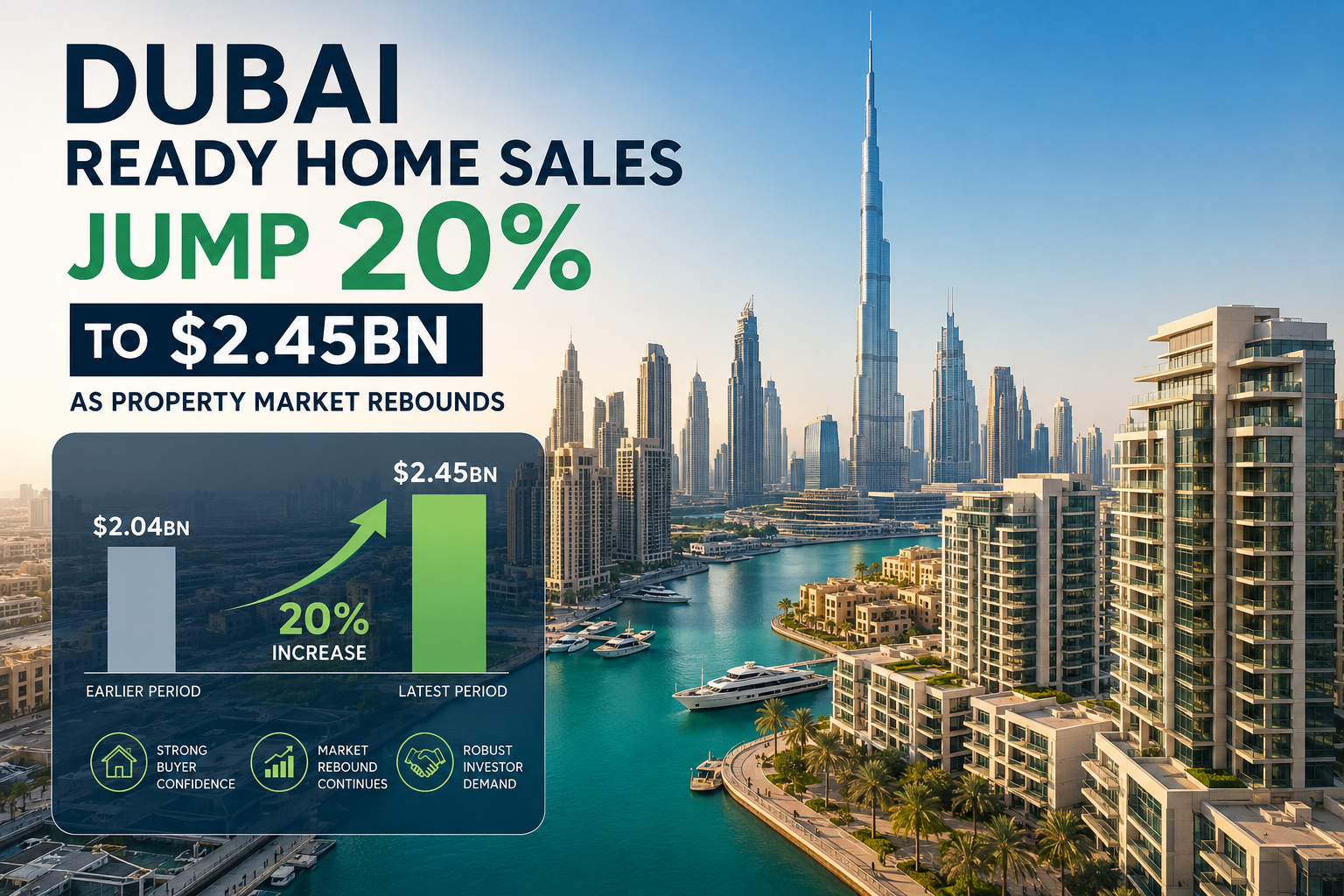
The reported 20% increase in Dubai ready home sales to approximately $2.45 billion is significant because the ready-property segment has faced greater pressure than the off-plan market during periods of uncertainty. A recovery in completed-home transactions therefore provides an important indication that buyer confidence is returning to the secondary residential market.
Dubai’s wider property sector has remained active despite changing market conditions. According to the Dubai Land Department, total real estate transactions reached AED252 billion in Q1 2026, representing a 31% year-on-year increase in value, while transaction volumes rose 6%.
The recovery in ready homes needs to be viewed within this wider context. Rather than signalling that every segment is moving upwards at the same pace, the latest figures suggest that Dubai’s property market is becoming more selective, with buyers concentrating on locations, property types and pricing that offer tangible value.
What Are Ready Homes in Dubai?
Ready homes are residential properties that have already been completed and are available for immediate occupation or investment. They include completed apartments, villas and townhouses that can be purchased directly from an existing owner or, in some cases, from a developer with completed inventory.
This makes ready property different from off-plan real estate, where a buyer purchases a property before construction is complete.
For investors, the distinction is particularly important. A ready property can potentially generate rental income shortly after completion, while an off-plan investment generally requires the buyer to wait for construction and handover before the property can be occupied or leased.
The immediate usability of ready homes can therefore become particularly attractive when buyers are prioritising income visibility, physical ownership and reduced construction-related uncertainty.
Why the 20% Increase in Ready Home Sales Matters
The reported rise in ready-home sales is important because Dubai’s residential market has been heavily influenced by off-plan transactions in recent years.
Cavendish Maxwell data reported that off-plan transactions accounted for a dominant share of Dubai residential activity during the first four months of 2026. More than 42,500 off-plan properties were purchased during that period, representing around 74% of residential sales.
Against that background, stronger activity in completed homes suggests that buyers are not relying exclusively on developer launches.
Instead, some investors and end users appear to be reassessing the advantages of purchasing existing properties in established communities.
This can include immediate rental potential, established infrastructure, known service charges, existing tenant demand and the ability to physically inspect the property before completing the purchase.
Dubai Property Market Is Entering a More Selective Phase
The latest rebound does not necessarily mean that Dubai has returned to the extraordinary growth conditions seen during the earlier stages of the property boom.
The market is becoming more balanced.
Dubai recorded almost 79,200 residential transactions worth AED221.3 billion during H1 2026, according to Cavendish Maxwell data reported by Gulf News. However, residential sales were around 14% lower in volume and 15.7% lower in value compared with H1 2025.
This combination of strong absolute activity but weaker year-on-year comparisons is important.
It indicates that Dubai remains one of the world’s most active residential property markets, while also moving through a period of normalisation after several exceptionally strong years.
For investors, this can create a different type of opportunity. Instead of simply buying into a rising market, buyers may increasingly need to assess individual communities, rental yields, property quality, developer reputation and long-term demand.
Why Buyers Are Returning to Completed Properties
Several factors can explain the renewed interest in ready homes.
Immediate Occupation and Rental Income
One of the clearest advantages of a ready property is immediacy.
An investor purchasing a completed apartment can potentially rent it soon after the transaction, subject to the necessary procedures. This can make ready property attractive to buyers who want rental income rather than waiting several years for an off-plan development to reach completion.
For owner-occupiers, the benefit is even more straightforward. A completed property allows buyers to move into an established community without waiting for construction.
Greater Certainty About the Property
Off-plan property can offer attractive payment plans and potentially significant capital appreciation, but it involves future delivery.
A ready home provides greater certainty because buyers can inspect the actual apartment, villa or townhouse before purchasing.
They can assess the view, finishing quality, building condition, facilities, surrounding environment and accessibility.
This transparency can become increasingly valuable when buyers become more cautious about investment decisions.
Established Communities Remain Attractive
Established Dubai communities often benefit from mature infrastructure and existing demand.
Areas such as Business Bay, Downtown Dubai, Dubai Marina, Palm Jumeirah, Jumeirah Village Circle and Dubai Hills Estate have established residential ecosystems, including retail, schools, restaurants, transport connections and leisure facilities.
Ready-property buyers can therefore assess the performance of a location based on real market conditions rather than relying entirely on projected future development.
Dubai’s Overall Property Market Remains Resilient
The ready-home recovery is occurring against a backdrop of substantial activity across Dubai’s wider real estate sector.
The Dubai Land Department reported that the emirate’s real estate transactions reached AED252 billion during Q1 2026, up 31% year on year. Real estate investments reached AED173 billion across 57,744 transactions during the quarter.
These figures demonstrate that international and domestic investors continue to allocate substantial capital to Dubai property.
Dubai’s appeal is supported by several structural factors, including population growth, international business activity, tourism, infrastructure investment and its position as a global hub for entrepreneurs and high-net-worth individuals.
However, the market is no longer simply a story of rising prices. Increasing supply and changing buyer behaviour are becoming equally important.
New Housing Supply Could Change Buyer Negotiating Power
One of the biggest developments affecting Dubai real estate in 2026 is the arrival of additional housing stock.
Approximately 24,800 homes were added to Dubai during H1 2026, representing an increase of almost 38% compared with the same period a year earlier, according to Cavendish Maxwell data reported by Gulf News.
Greater supply gives buyers more choice.
It can also increase competition between sellers, particularly when multiple similar apartments or villas are available within the same community.
For investors, this means purchasing decisions should increasingly consider the future supply pipeline rather than focusing only on historical price growth.
A property that performs well today may face stronger competition from newly completed buildings tomorrow.
Ready Homes Versus Off-Plan Property in Dubai
The choice between ready and off-plan property depends heavily on an investor’s objectives.
Ready homes generally appeal to buyers seeking immediate possession, established rental demand and greater certainty about the physical asset.
Off-plan properties can appeal to investors seeking flexible payment structures, early-stage pricing and potential capital appreciation before completion.
Neither strategy is automatically superior.
The most suitable option depends on factors such as investment horizon, available capital, financing requirements, expected rental yield, location and risk tolerance.
The growing ready-home market suggests that some buyers are now placing a greater premium on certainty and immediate usability.
Which Dubai Locations Could Benefit From Ready-Home Demand?
Demand for completed properties is likely to remain strongest in locations where residential infrastructure and tenant demand are already established.
Business Bay
Business Bay continues to benefit from its central location, proximity to Downtown Dubai and strong appeal among professionals and investors.
The area’s mix of residential towers, offices, restaurants and retail makes it one of Dubai’s most recognisable investment destinations.
Downtown Dubai
Downtown Dubai remains one of the emirate’s most internationally recognised residential locations. Its proximity to the Burj Khalifa, Dubai Mall and major business districts supports both owner-occupier and investment demand.
Ready apartments in established buildings can offer buyers a clearer picture of rental performance and building quality.
Dubai Marina
Dubai Marina has a mature waterfront residential market supported by tourism, expatriate demand and lifestyle-driven buyers.
Completed apartments can appeal to investors seeking established rental markets rather than emerging communities.
Palm Jumeirah
Palm Jumeirah remains a premium residential destination where limited waterfront supply supports demand for high-quality completed properties.
The segment is particularly relevant to high-net-worth buyers seeking lifestyle assets and long-term wealth preservation.
Dubai Hills Estate
Dubai Hills Estate has emerged as a major family-oriented residential destination, supported by schools, retail, green spaces and access to major parts of Dubai.
Its combination of apartments, villas and townhouses provides investors with exposure to different segments of the residential market.
What the Ready-Home Rebound Means for Property Investors
For investors, the reported 20% increase in ready home sales provides an important signal: liquidity and buyer interest are not limited to newly launched developments.
Completed properties can become increasingly attractive when investors prioritise real rental income, established communities and shorter investment cycles.
However, investors should avoid treating market-wide growth as a guarantee of individual property performance.
Two apartments in the same city can produce very different investment outcomes depending on their location, building quality, service charges, rental demand, purchase price and future competing supply.
The key question is therefore not simply whether Dubai property prices are rising.
It is whether the specific property being purchased can maintain demand and generate an attractive risk-adjusted return.
Rental Yields Remain an Important Consideration
Dubai’s rental market remains a major component of its residential investment proposition.
A ready property allows investors to analyse actual rental transactions and comparable properties within the same building or community.
This provides a more reliable basis for calculating potential gross rental yield.
Investors should consider the relationship between purchase price and achievable annual rent, while also accounting for service charges, maintenance, vacancy periods, property management costs and transaction expenses.
A property with strong headline rental income may not necessarily produce the best net return once all ownership costs are considered.
Dubai’s Property Market Is Moving From Momentum to Fundamentals
The most important change taking place in Dubai real estate is the transition from momentum-driven buying towards more fundamentals-based decision-making.
During a strong property boom, investors can sometimes focus primarily on expected capital appreciation.
As the market matures, other factors become increasingly important.
Location quality, rental demand, infrastructure, supply levels, building reputation, service charges, resale liquidity and realistic pricing can all influence long-term performance.
The reported rise in ready-home sales fits into this broader shift.
Buyers appear to be showing renewed interest in assets where value can be assessed through existing market evidence.
What Could Drive Dubai Real Estate Growth From Here?
Dubai’s long-term property outlook continues to benefit from structural economic and demographic factors.
Population growth is one of the most important drivers because additional residents create demand for housing across different price segments.
International investment is another major factor. Dubai continues to attract entrepreneurs, executives, investors and high-net-worth individuals looking for business opportunities and residential assets.
Government infrastructure projects and economic diversification also support the property sector by strengthening employment, tourism and business activity.
At the same time, increasing housing supply could moderate price growth and provide buyers with greater choice.
This combination could lead to a healthier and more sustainable property market rather than the extreme price acceleration seen during previous phases of the cycle.
Risks Dubai Property Investors Should Watch
Despite the positive signs, investors should remain aware of market risks.
The first is oversupply. Thousands of new homes entering the market can increase competition between landlords and sellers.
The second is price normalisation. After several years of strong appreciation, certain properties may experience slower growth or corrections.
The third is regional and global uncertainty. Changes in economic conditions, interest rates, geopolitical developments and international investor sentiment can influence property transactions.
The fourth is rental yield compression. If property prices increase faster than rents, investment yields can fall.
For this reason, investors should assess both capital appreciation and income performance before purchasing.
Is Dubai Ready Property a Good Investment in 2026?
Dubai ready property can remain attractive in 2026, particularly for investors who prioritise immediate ownership, established rental demand and tangible assets.
The reported 20% increase in ready-home sales to $2.45 billion provides evidence of renewed activity in a segment that had faced considerable competition from off-plan projects.
However, the broader market data suggests that Dubai is also entering a more measured phase.
Residential transaction values were lower year on year in H1 2026, while new housing supply increased substantially.
This means investors should be selective rather than assuming that every property will deliver the same returns.
The strongest opportunities are likely to be found where purchase prices remain realistic, tenant demand is durable, supply is manageable and the property offers a clear long-term use case.
The Future of Dubai Ready Home Sales
The rebound in Dubai ready home sales highlights an important evolution within the emirate’s residential property market.
Off-plan projects are likely to remain a major source of transaction activity, but completed homes are regaining attention because they provide immediate possession, established communities and greater visibility over rental and resale performance.
As more housing enters the market, buyers are likely to become increasingly sophisticated. Instead of purchasing solely because prices are rising, investors will increasingly compare properties based on yield, location, quality, liquidity and long-term fundamentals.
Dubai’s property market therefore appears to be moving towards a more mature phase where quality and value matter as much as market momentum.
For investors considering Dubai real estate in 2026, the latest ready-home sales figures are encouraging. But the strongest strategy is not simply to follow the market rebound. It is to identify properties with sustainable demand, sensible pricing and strong fundamentals that can perform across different market conditions.
Frequently Asked Questions About Dubai Ready Home Sales
What are ready homes in Dubai?
Ready homes are completed residential properties that are available for immediate occupation, rental or resale. They can include apartments, villas and townhouses.
Why are Dubai ready home sales increasing?
The reported increase reflects renewed buyer interest in completed properties, where investors can inspect the physical asset, assess existing rental demand and potentially generate income sooner than with an off-plan purchase.
Is ready property better than off-plan property in Dubai?
Neither option is universally better. Ready property can provide greater certainty and immediate rental potential, while off-plan property may offer flexible payment plans and potential capital appreciation before completion.
Is Dubai real estate still attractive in 2026?
Dubai remains a highly active real estate market, although conditions are becoming more selective. Strong transaction volumes, international demand and population growth continue to support the sector, while increasing supply and market normalisation require investors to conduct more careful due diligence.
Which Dubai areas are popular for ready properties?
Business Bay, Downtown Dubai, Dubai Marina, Palm Jumeirah and Dubai Hills Estate are among the established areas that attract residential and investment demand. The most suitable location depends on budget, property type, rental strategy and investment objectives.
Should investors buy Dubai property during a market rebound?
A market rebound can create opportunities, but investors should focus on individual property fundamentals rather than headline market growth. Purchase price, rental yield, service charges, supply pipeline, location and resale liquidity should all be assessed before committing capital.
Final Thoughts
The reported 20% rise in Dubai ready home sales to $2.45 billion is an important indicator of renewed activity within the completed-property segment. It also demonstrates that Dubai’s residential market is evolving beyond its strong reliance on off-plan transactions.
With substantial investment continuing across the emirate, a growing population and thousands of new homes entering the market, Dubai’s property sector is likely to remain highly competitive.
For buyers and investors, the opportunity lies in identifying the right property rather than simply entering the market. Ready homes with strong locations, proven rental demand, attractive pricing and sustainable long-term fundamentals could benefit as Dubai’s property market moves into its next stage of growth and maturity.