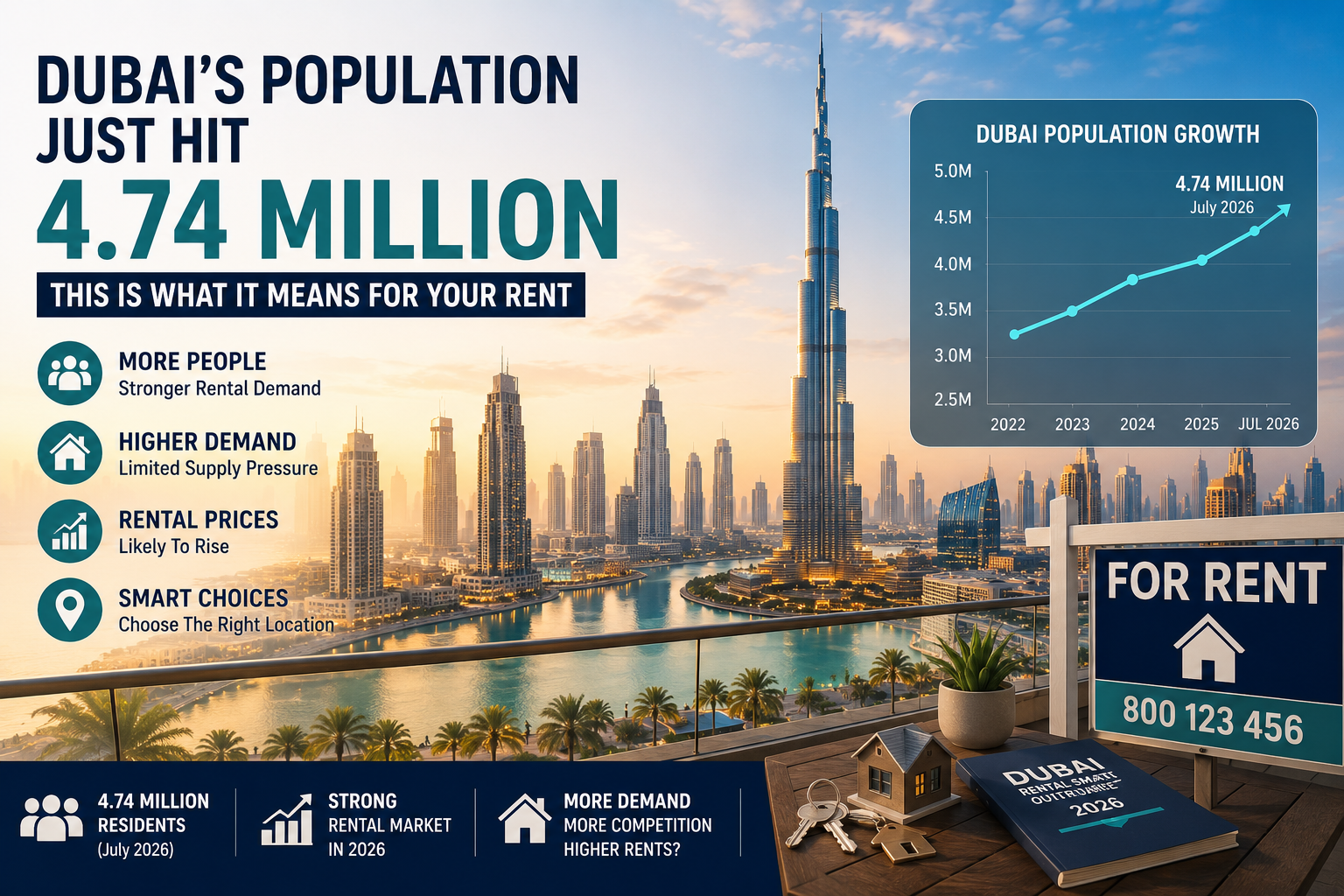
Dubai’s population has reached another major milestone, crossing 4.74 million residents in July 2026 after adding more than 161,000 people since the beginning of the year. The rapid population growth is putting renewed attention on one of the biggest concerns for residents and investors: what happens to Dubai rents when more people compete for homes?
The latest population figures reinforce Dubai’s position as one of the world’s fastest-growing international cities. At the end of 2025, the emirate had approximately 4.58 million residents, representing 7.5% annual population growth. By 30 July 2026, the population had climbed to 4,741,335. (WAM)
For tenants, this could mean continued pressure on rental prices, particularly in popular communities where demand is already strong. For landlords and property investors, however, sustained population growth can create a powerful demand engine.
The bigger question is whether Dubai’s expanding housing supply can keep pace with the number of people arriving.
Dubai Population Growth Is Accelerating
Dubai’s population growth has become an increasingly important driver of its real estate market.
Official figures show that Dubai added approximately 332,000 residents during 2025, taking its year-end population to 4.58 million. That represented a 7.5% increase compared with the previous year. (Digital Dubai)
The momentum has continued into 2026.
More than 161,000 additional residents were recorded during the first seven months of the year, pushing the population beyond 4.74 million by 30 July. The figure is particularly significant because it came despite temporary population fluctuations earlier in the year. (The National)
Dubai is also dealing with a much larger daytime population. Government figures indicate that the number of people physically present in the emirate during the day can reach approximately 6.39 million, including commuters, tourists and other temporary visitors. (WAM)
That matters for the wider economy because population growth is not only about residential demand. More people require homes, offices, retail, restaurants, schools, healthcare, transportation and entertainment.
Why Population Growth Usually Supports Rental Demand
The relationship between population and rental demand is relatively straightforward.
When more people move into a city, the number of households looking for accommodation generally increases. If housing supply does not expand at the same pace, landlords gain pricing power and rents can rise.
Dubai has a particularly large rental market because of its international workforce and highly mobile expatriate population.
Many new arrivals initially rent rather than purchase a property. International professionals, business owners, executives and families may rent for several years before deciding whether buying makes financial or lifestyle sense.
This creates a continuous source of tenant demand.
The latest data already suggests that Dubai’s rental market remains highly active. Dubai Land Department reported that registered tenancy contracts increased by 6% in volume and 17% in value during 2025, reaching 1.38 million contracts worth AED126.4 billion. New tenancy contracts increased by 10% to more than 513,000. (Dubai Land Department)
The population increase therefore arrives against an already active rental market.
Does 4.74 Million People Mean Higher Rents?
Not necessarily everywhere, but the population trend creates an important upward pressure.
Rent increases depend on the balance between new housing supply and new housing demand.
If Dubai adds 200,000 residents but delivers enough homes to accommodate them comfortably, rental growth could moderate.
If population growth consistently exceeds the number of suitable homes available in the right locations and price brackets, rental competition can intensify.
This is why population growth should not be viewed in isolation.
Investors and tenants should also examine:
- New residential completions
- Upcoming apartment and villa supply
- Occupancy rates
- Rental transaction volumes
- Average rental values
- Community-level demand
- Infrastructure improvements
- Employment growth
The combination of these factors provides a much clearer picture of where rents are heading.
Dubai’s Rental Market Has Already Shown Strong Momentum
The latest population figures are not the only indication that rental demand remains strong.
Dubai Land Department reported that the value of rental contracts reached AED32.2 billion in Q1 2026, with 118,385 new rental contracts and 135,607 renewal contracts. (Dubai Land Department)
The high number of renewals is particularly important.
When tenants renew their leases, it suggests that many households are choosing to remain in Dubai rather than leave or relocate elsewhere. Strong renewal activity can provide landlords with greater confidence in maintaining occupancy.
At the same time, continued new-contract activity shows that fresh demand is entering the market.
Together, these indicators point towards a rental sector supported by both existing residents and new arrivals.
Which Dubai Tenants Are Most Exposed to Rising Rents?
Not every tenant will experience the same level of rental pressure.
The greatest exposure is likely to be in highly desirable communities where demand is consistently strong and available inventory is limited.
Prime and lifestyle-focused areas can attract international professionals and higher-income tenants who are prepared to pay more for location, amenities and convenience.
Meanwhile, more affordable communities may experience a different dynamic.
If rents rise sharply in central Dubai, tenants may increasingly look towards emerging neighbourhoods where apartments offer better value.
This can create a ripple effect across the wider rental market.
The Dubai Rental Ripple Effect
Dubai’s rental market is highly interconnected.
Suppose rents in a popular central community increase substantially. A tenant who cannot justify the higher cost may move to a nearby or more affordable area.
That additional demand can then push rents higher in the alternative community.
As more residents move outward in search of value, previously overlooked areas can experience stronger occupancy, higher rental transactions and increased investor interest.
This is one reason population growth can influence property markets beyond the most expensive neighbourhoods.
Affordable Areas Could Become Increasingly Important
The population reaching 4.74 million could strengthen the case for Dubai’s affordable and mid-market residential communities.
Not every new resident has the budget for a luxury apartment in Downtown Dubai, Dubai Marina or Palm Jumeirah.
As housing costs increase, households become more sensitive to the relationship between rent and commuting time.
Communities offering larger apartments, newer buildings and reasonable access to employment centres can therefore become increasingly attractive.
This could support rental growth in areas that historically traded at a discount to Dubai’s prime neighbourhoods.
For investors, this is important because the greatest percentage rental growth may not always occur in the most expensive communities.
More Population Also Means More Housing Supply
Dubai is not ignoring the demand challenge.
The emirate continues to approve and deliver large residential developments across multiple communities.
The growth of Dubai’s off-plan property market has also created a significant pipeline of future homes. New projects across master-planned communities are expected to add substantial residential inventory over the coming years.
That additional supply could eventually moderate rental growth.
However, timing matters.
A property scheduled for completion several years from now does not solve a rental shortage today.
The critical issue is whether new housing is being delivered at the same pace and in the same locations where people want to live.
Could New Supply Stop Rents From Rising?
Yes, and this is the biggest factor that could prevent runaway rental growth.
If developers deliver a large volume of apartments and villas while population growth slows, tenants could gain greater negotiating power.
Landlords may then need to offer incentives, improve properties or keep rents competitive to maintain occupancy.
This could create a more balanced rental market.
Dubai’s property market is therefore moving through a period where two forces are competing:
Demand: population growth, employment creation, business expansion and international migration.
Supply: new apartments, villas and master-planned communities entering the market.
The direction of rents will ultimately depend on which side grows faster.
Population Growth Is Good News for Property Investors — With a Caveat
From an investor’s perspective, sustained population growth is generally positive.
A growing population creates a larger potential tenant base. More tenants can support occupancy, rental income and, in certain locations, capital appreciation.
But investors should avoid assuming that population growth automatically means every Dubai property will outperform.
A poorly located apartment with excessive competing supply may struggle even when the city’s overall population is growing.
A well-positioned property in a supply-constrained community may perform much better.
The investment decision therefore needs to move from “Is Dubai’s population growing?” to “Which communities are capturing the population growth?”
What Does Population Growth Mean for Dubai Landlords?
For landlords, the current environment can be favourable.
Strong tenant demand can reduce vacancy periods and support rental income. However, landlords also need to account for Dubai’s rental regulations and the formal mechanisms governing rent increases.
A landlord cannot simply increase rent by any amount whenever demand rises.
Dubai’s regulatory framework, tenancy contracts and rent-increase rules remain important considerations when assessing rental income.
This means population growth creates market pressure, but the actual rent a landlord can charge remains subject to the applicable regulations and contractual framework.
What Does It Mean for Tenants?
For tenants, the population milestone is a reason to plan ahead rather than panic.
If you are approaching lease renewal, monitor comparable properties in your community and understand the applicable rental rules.
If your current neighbourhood is becoming increasingly expensive, consider whether moving slightly farther from the city centre could deliver better value.
Dubai’s expanding transport network can also make emerging communities more practical.
The arrival of new metro infrastructure, road improvements and intercity rail connectivity could gradually make it easier for residents to live farther from traditional employment centres.
Should You Renew Your Dubai Rental or Move?
For many tenants, this will be the most practical question.
A decision to renew should consider more than the headline rent.
Calculate the total annual housing cost, including parking, service-related charges where applicable, commuting expenses and utilities.
Then compare that figure with alternative properties in nearby communities.
A slightly cheaper apartment may not actually be cheaper if it adds a long and expensive daily commute.
Conversely, paying a premium for a centrally located property may not be worthwhile if remote or hybrid working allows you to live farther away.
Population Growth Could Reshape Dubai’s Rental Map
One of the most interesting consequences of Dubai’s population expansion could be the continued evolution of its residential geography.
As the population grows, the city will need more housing across different price categories.
This could accelerate the development of emerging communities and strengthen demand outside Dubai’s traditional hotspots.
Areas with new schools, retail centres, offices, transport links and recreational facilities may become increasingly attractive as residents look for complete communities rather than simply cheap accommodation.
Over time, this can create new rental hotspots.
Infrastructure Will Be Critical
Dubai’s ability to accommodate millions of residents depends heavily on infrastructure.
Transport connectivity is particularly important.
As new metro stations, roads and other transport projects improve accessibility, residents gain more flexibility about where they live.
This can reduce the pressure on a small number of central communities and distribute demand across a wider geographic area.
For property investors, infrastructure should therefore be considered alongside population statistics.
A fast-growing neighbourhood with poor connectivity may not immediately attract the same demand as a similarly priced area with excellent transport access.
What Could Happen to Dubai Rents Over the Next Few Years?
The most likely scenario is continued rental growth, but at a potentially more uneven pace across different communities.
Population growth remains a major demand driver, while the UAE’s strong economic activity continues to attract businesses, workers and international residents.
At the same time, Dubai’s large development pipeline means additional housing will continue entering the market.
This could prevent the market from experiencing unlimited rent increases.
Instead, the rental market may become increasingly segmented.
Prime locations with strong demand and limited availability could maintain pricing power, while areas receiving significant new supply may experience slower rental growth.
Is Dubai Still Affordable for Renters?
Affordability is becoming an increasingly important issue.
Dubai offers a wide range of housing, but rapid population growth and strong demand can put pressure on household budgets.
For some residents, the solution may be moving to a different community rather than leaving Dubai entirely.
The emirate’s extensive road network and expanding public transport system provide residents with more options than simply choosing between central luxury neighbourhoods and distant suburbs.
The growth of the rental market may therefore encourage more tenants to prioritise value, space and connectivity.
What 4.74 Million Means for Dubai Property Investors
For investors, the population milestone is a strong signal that underlying housing demand remains substantial.
The increase from approximately 4.58 million residents at the end of 2025 to more than 4.74 million by July 2026 represents rapid growth in a relatively short period. (Khaleej Times)
That creates potential opportunities in:
Rental apartments: Strong population growth can support occupancy and rental demand.
Affordable housing: New arrivals may prioritise reasonably priced homes with good connectivity.
Family communities: Larger households can create demand for villas, townhouses and larger apartments.
Transit-oriented developments: Properties benefiting from improved connectivity could attract residents seeking shorter commutes.
Emerging communities: Areas with relatively low entry prices and improving infrastructure may benefit as population growth spreads outward.
However, investors should assess supply carefully before purchasing.
The Biggest Question Is Supply Versus Demand
The headline figure of 4.74 million residents is impressive, but it should not be interpreted as a guarantee of higher rents.
The real estate market is ultimately governed by supply and demand.
If population growth continues at a rapid pace while housing completions remain insufficient in high-demand areas, rental prices could remain under pressure.
If developers deliver enough new homes and population growth moderates, rental growth could slow.
The most important indicator to watch is therefore not simply Dubai’s population clock.
It is the relationship between population growth, household formation and new housing deliveries.
Final Outlook: What Does 4.74 Million Mean for Your Rent?
Dubai’s population reaching 4.74 million is more than a demographic milestone. It is a significant indicator for the emirate’s housing market.
The latest figures show that Dubai continues to attract residents at a rapid pace, while official rental data confirms strong activity across the leasing sector. (Dubai Land Department)
For tenants, the immediate takeaway is that rental competition is unlikely to disappear quickly. Popular communities could continue experiencing pricing pressure, particularly where available housing remains limited.
For landlords, sustained population growth provides a strong underlying demand base, although rental increases remain subject to Dubai’s regulatory framework.
For investors, the biggest opportunity may be identifying where the next wave of residents will live, rather than simply focusing on where residents live today.
Dubai’s population growth is changing the city’s real estate landscape. As millions more people live, work and invest in the emirate, rental demand will continue to be one of the most important forces shaping property values.
In short, 4.74 million residents means more households, more competition for desirable homes and potentially higher rents — but the communities that combine affordability, connectivity, amenities and limited supply are likely to be the biggest winners.
Frequently Asked Questions
Is Dubai’s population really 4.74 million?
Yes. Dubai’s real-time population reached approximately 4.741 million on 30 July 2026, according to population data reported from Dubai’s official population monitoring system. (Khaleej Times)
Why is Dubai’s population growing so quickly?
Dubai continues to attract international professionals, entrepreneurs, investors, businesses and families. Economic growth, employment opportunities, infrastructure, tourism and its position as a global business hub all contribute to population growth.
Will Dubai rents increase because the population has reached 4.74 million?
Population growth creates upward pressure on rental demand, but it does not guarantee rent increases across every community. The ultimate impact depends on population growth relative to new housing supply.
Which Dubai areas could see higher rental demand?
Areas with strong employment access, good transport connectivity, established amenities and limited available housing are likely to remain attractive. Emerging communities can also benefit if they provide better value for money than established locations.
Should tenants expect higher rents in 2026?
Tenants should expect continued competition in many parts of Dubai, although the level of rental growth will vary by community and property type. Dubai Land Department data indicates that the rental market remained active during the first quarter of 2026. (Dubai Land Department)
Is Dubai still a good market for property investors?
Dubai’s population growth, economic expansion and active rental market can create attractive conditions for investors. However, investors should evaluate individual properties based on rental yield, purchase price, supply pipeline, location, tenant demand and long-term capital-growth potential.
Could new housing supply bring Dubai rents down?
Yes. A substantial increase in residential supply could moderate rental growth or give tenants greater negotiating power. The effect will depend on where new properties are delivered and whether supply keeps pace with population and household growth.
How does population growth affect Dubai property prices?
Population growth can support property prices by increasing housing demand. If demand consistently exceeds supply, both rents and sale prices can benefit. However, the impact varies significantly between communities.
What should tenants do if their Dubai rent becomes too expensive?
Tenants can compare alternative communities, negotiate where possible, review their renewal options and consider areas with better rent-to-commute ratios. Moving to an emerging neighbourhood with good transport connectivity can sometimes provide better value without sacrificing accessibility.