
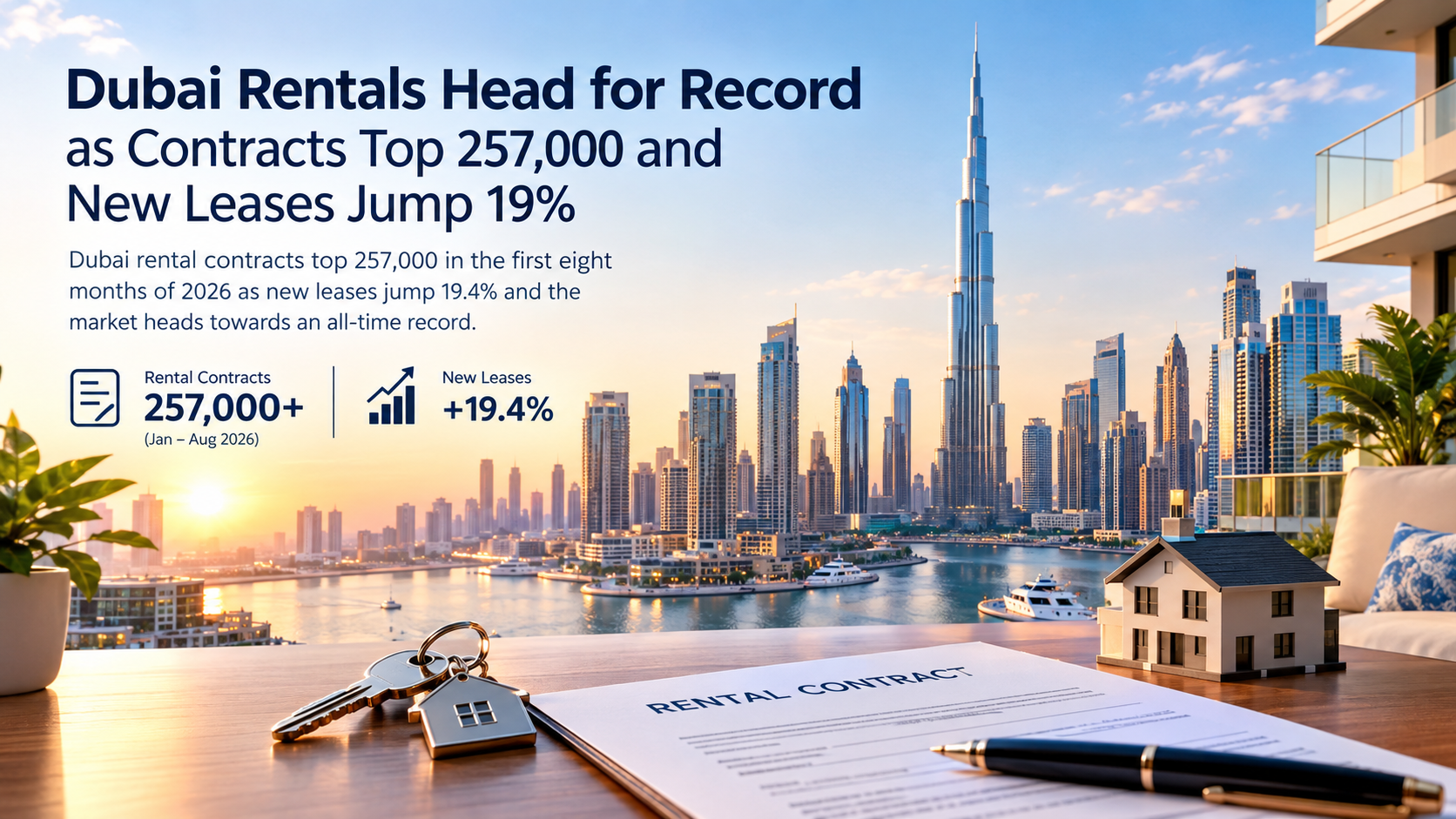
Dubai’s rental market is continuing to demonstrate strong activity in 2026, with rental contracts surpassing 257,000 during the first eight months of the year. The increase has been supported by a significant rise in new lease registrations, signalling sustained demand from residents, professionals and businesses relocating to the emirate.
New leases reportedly increased by 19.4%, putting Dubai’s rental market on track for another potential annual record as population growth, employment opportunities and continued investor activity keep demand elevated.
Dubai Rental Contracts Surpass 257,000
The latest rental activity highlights the depth of demand across Dubai’s residential property market. More than 257,000 rental contracts were recorded between January and August 2026, putting the emirate on a trajectory towards an all-time high.
The volume is particularly significant because Dubai’s rental market has expanded alongside the emirate’s wider population and economic growth. New residents continue to arrive for employment, investment and business opportunities, while existing residents are increasingly looking for homes that match changing lifestyle and household requirements.
The strong contract volumes also demonstrate that renting remains an important part of Dubai’s housing market, despite the continued growth of property ownership and off-plan investment.
New Rental Leases Rise 19.4%
One of the most important indicators behind the market’s performance is the 19.4% increase in new leases.
New contracts provide a useful measure of fresh demand because they represent tenants entering new rental agreements rather than simply renewing existing contracts. The rise therefore suggests that a substantial number of residents are actively moving into new properties or relocating within Dubai.
This activity can be linked to several factors, including population growth, new employment opportunities, household formation and the continued attractiveness of Dubai as an international business and lifestyle destination.
At the same time, recent rental data indicate that tenants are becoming more selective in some areas. A September market monitor found that rental registrations were still increasing, while achieved rents in several major apartment corridors were below year-earlier levels.
Population Growth Continues to Support Rental Demand
Dubai’s expanding population remains one of the fundamental drivers of the rental market.
As more people move to the emirate, additional housing is required across different price points. New residents often begin by renting before considering property ownership, creating consistent demand for apartments, villas and townhouses.
The growth of employment in sectors such as technology, finance, tourism, professional services and real estate is also contributing to housing demand. Dubai’s status as a regional business hub means that companies continue to attract employees from both the UAE and overseas.
This creates a recurring cycle: population growth increases household formation, which supports rental demand and encourages landlords and developers to bring additional housing stock to the market.
Rental Demand Is Not Uniform Across Dubai
Although the overall rental market remains active, performance differs significantly between communities and property types.
Popular established neighbourhoods continue to attract tenants because of their connectivity, amenities and proximity to employment centres. Areas such as Dubai Marina, Business Bay, Jumeirah Village Circle and Dubai Silicon Oasis remain important rental markets, while emerging communities are gaining attention as new infrastructure and residential developments come online.
However, recent transaction data suggest that tenants have gained some negotiating power in certain segments. Rentinit reported that asking rents for apartments were considerably higher than recently achieved transaction levels, particularly for larger units.
This means landlords increasingly need to price properties according to actual market transactions rather than relying solely on advertised asking rents.
Renewals Still Form a Major Part of the Market

The surge in new leases does not mean renewals have disappeared. Existing tenants continue to represent a substantial share of Dubai’s rental activity.
Recent market data showed that new leases accounted for 50.2% of registered Ejari contracts in August, meaning renewals represented roughly half of registered rental demand.
This balance is important for understanding the market. New leases demonstrate continuing population mobility and fresh demand, while renewals indicate that many existing residents remain committed to staying in Dubai.
For landlords, retaining a reliable tenant can also reduce vacancy periods, marketing costs and potential turnover expenses.
Rental Prices Enter a More Competitive Phase
While rental contract volumes are rising, the market is not necessarily experiencing the same level of price growth everywhere.
Recent data indicate that Dubai’s average rent per square metre has moderated from its 2025 peak. Several major residential corridors, including Dubai Marina, Business Bay, Jumeirah Village Circle and Dubai South, recorded declines in rental rates during 2026.
This creates an interesting dynamic: transaction volumes can remain strong even while rental price growth moderates.
For tenants, this could mean more opportunities to negotiate, particularly in buildings or communities where supply has increased. For landlords, competitive pricing and property quality are becoming increasingly important when attracting new tenants.
New Supply Could Shape the Next Stage of the Market
Dubai continues to add residential supply, with numerous apartment and villa developments progressing across the emirate.
New supply can help accommodate population growth and reduce pressure on tenants, particularly in communities experiencing rapid development. It can also give renters more choice between newly completed properties and established homes.
However, the impact of new supply will depend on location, affordability, amenities and connectivity. Prime communities with strong infrastructure can continue to experience high demand even as additional units enter the market.
The rental market is therefore likely to become increasingly segmented, with the strongest properties maintaining demand while less competitive units face greater pressure to offer attractive rents or incentives.
What the Record Rental Activity Means for Investors
For property investors, the rise in rental contracts provides evidence of continued underlying demand for residential real estate in Dubai.
High rental transaction volumes can support investment strategies focused on rental income, particularly in locations with strong tenant demand and good occupancy prospects.
However, investors should look beyond headline rental growth. Purchase price, service charges, maintenance costs, vacancy risk, expected rental yield and future supply all need to be considered before acquiring an investment property.
The current market also highlights the importance of choosing the right community. A property in an area with strong employment connectivity, transport links, schools, retail facilities and lifestyle amenities may have better long-term tenant appeal.
What the Market Means for Tenants
For tenants, the current environment presents both opportunities and challenges.
The increase in new leases confirms that demand remains strong, but moderating rents in several locations may provide more negotiating power than tenants had during the strongest phase of Dubai’s rental boom.
Tenants searching for a new home should therefore compare recently registered rents, available listings and comparable properties before agreeing to a lease.
Larger apartments may offer particularly interesting opportunities because recent market data show a wider gap between asking and achieved rents for two- and three-bedroom properties.
Dubai Rental Market Outlook for 2026
With more than 257,000 rental contracts recorded in the first eight months of 2026, Dubai is moving towards what could become another record year for leasing activity.
The 19.4% rise in new leases is particularly significant because it points to continuing fresh demand rather than growth being driven solely by renewals.
At the same time, the market appears to be entering a more balanced phase. Rental transaction volumes remain strong, but pricing has softened in several major communities, giving tenants more room to negotiate while encouraging landlords to adopt more realistic pricing strategies.
For Dubai, this combination could prove healthy for the long-term development of the rental market. Continued population growth and economic expansion can support demand, while new residential supply and greater tenant choice may prevent excessive rental inflation.
Final Thoughts
Dubai’s rental market remains one of the most active components of the emirate’s real estate sector. More than 257,000 contracts in eight months, combined with a 19.4% increase in new leases, demonstrates that demand for rental housing remains substantial.
The next phase, however, is likely to be defined less by rapidly rising rents and more by market segmentation, tenant choice and realistic pricing. As Dubai continues to attract residents and businesses, communities offering strong connectivity, quality housing and competitive rents are likely to remain among the biggest beneficiaries.
For investors, landlords and tenants alike, understanding actual transaction data—not just advertised prices—will be increasingly important as Dubai’s rental market approaches another potential record year.


