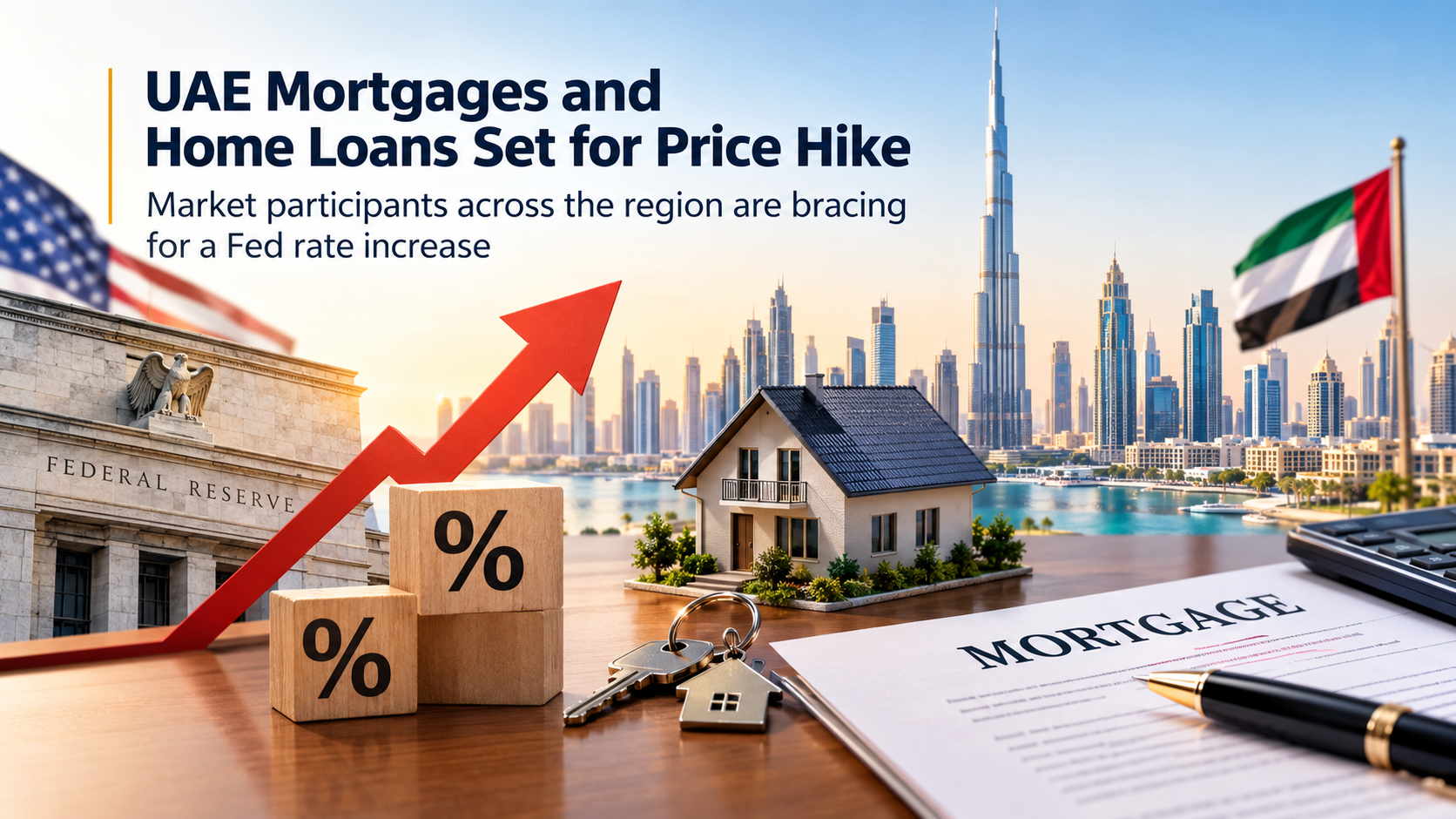
The UAE mortgage market is facing renewed pressure as financial markets prepare for an expected US Federal Reserve interest rate increase. For homeowners, prospective buyers and property investors, the move could translate into higher borrowing costs, particularly for mortgages linked to variable interest rates.
Markets are currently pricing in a 25-basis-point increase by the Federal Reserve, which would take the US federal funds rate to around 3.75% to 4%. The expected move comes amid renewed inflation concerns, higher energy prices and uncertainty across global markets.
Because the UAE dirham is pegged to the US dollar, changes in US monetary policy have an important influence on UAE interest-rate conditions. The Central Bank of the UAE has historically moved its benchmark rates in line with the Federal Reserve, meaning changes in US rates can eventually feed through to local borrowing costs.
Why UAE Mortgage Rates Could Rise
The relationship between the Federal Reserve and UAE borrowing costs is particularly important for borrowers with variable-rate mortgages.
Many UAE mortgage products use a structure where the initial rate is fixed for a specific period before moving to a variable rate linked to EIBOR plus a bank margin. ADCB, for example, currently offers both hybrid and variable mortgage structures, with variable rates linked to the relevant EIBOR plus a margin.
When benchmark rates rise, banks can face higher funding costs. This can eventually result in higher rates for new mortgages and, depending on the terms of an existing loan, higher monthly repayments for borrowers.
The impact will not necessarily be identical across all UAE banks. Lenders have their own funding structures, margins, customer pricing and promotional offers. Recent market analysis has also highlighted that UAE banks are increasingly managing rate movements through their own margins, while Dubai’s property market has a significant cash-buyer component.
What It Means for Existing Mortgage Holders
Existing homeowners should first determine whether their mortgage is fixed, variable or approaching the end of its fixed-rate period.
Borrowers on fixed rates may not immediately see a change in their monthly payments. However, those whose fixed period is ending could face a higher rate when their mortgage moves to a variable structure.
For variable-rate borrowers, changes in benchmark rates can have a more direct effect on monthly repayments.
Even a relatively small increase can become significant over a long mortgage term because interest is calculated over many years. This makes the choice between fixed, variable and hybrid mortgage structures increasingly important for UAE homeowners.
New Homebuyers Could Face Higher Financing Costs
For people planning to purchase property in Dubai or Abu Dhabi, higher mortgage rates could affect affordability.
A higher interest rate means that the same property price can require a larger monthly payment. Some buyers may therefore reassess their budgets, increase their down payment or consider a lower-priced property.
The UAE mortgage market already has different financing limits depending on the buyer’s status and property. For example, ADCB currently advertises financing of up to 80% of property value for expatriates and up to 50% for non-residents, subject to its lending conditions.
This means that buyers should consider not only the advertised mortgage rate but also the required down payment, processing fees, valuation costs, insurance requirements and the total cost of borrowing.
Potential Impact on Dubai Real Estate
Higher mortgage costs could influence the behaviour of financed buyers in Dubai’s property market.
Cash buyers are less directly affected by mortgage-rate changes, while buyers relying heavily on financing may become more sensitive to monthly repayments. This could create differences in demand between cash purchasers and mortgage-funded buyers.
However, interest rates are only one factor influencing Dubai real estate. Population growth, rental demand, new property launches, investor activity, supply, employment conditions and international capital flows can also affect the market.
Recent analysis suggests that Dubai’s market has become relatively less dependent on mortgage-funded purchases because of the importance of cash buyers and strong resident demand.
UAE Borrowers Should Watch EIBOR
For anyone with a variable-rate UAE mortgage, EIBOR is an important benchmark to monitor.
A mortgage may be structured around EIBOR plus a fixed bank margin. If the benchmark increases, the effective borrowing rate can rise even when the bank’s margin remains unchanged.
Borrowers should therefore look beyond promotional mortgage rates and check exactly how their rate is calculated.
Before taking a new mortgage, buyers should ask their lender:
- Is the rate fixed, variable or hybrid?
- How long does the fixed period last?
- Which EIBOR tenor is used?
- What margin is added to EIBOR?
- What happens when the fixed period ends?
- Are there early-settlement or refinancing charges?
- What is the total cost of the mortgage over the agreed term?
Could Mortgage Rates Rise Further?
That will depend heavily on the Federal Reserve’s future decisions and the direction of inflation.
Current market expectations point towards a 25-basis-point Fed increase, but the path after that remains uncertain. Markets are watching inflation, energy prices, economic growth and the Fed’s updated projections for clues about whether additional increases could follow.
For UAE borrowers, this means the cost of financing could remain sensitive to changes in US monetary policy.
At the same time, the UAE banking sector does not price every mortgage in exactly the same way. Competition between lenders and individual borrower circumstances can influence the final rate offered.
What Buyers and Investors Should Do Now
Prospective buyers should calculate affordability using more than the current advertised rate. A mortgage that appears affordable at today’s rate should also be tested against a higher rate to understand how monthly repayments could change.
Existing borrowers can review their mortgage terms and determine when their current fixed period ends. Comparing refinancing options may also become relevant if another lender offers more favourable terms.
For property investors, financing costs should be incorporated into rental yields and projected returns. A higher mortgage payment can reduce the cash flow generated by an investment property, particularly where rental income is already close to the property’s financing costs.
The Bigger Picture
The expected US rate increase highlights how closely UAE borrowing conditions remain connected to global monetary policy.
For UAE homeowners and property buyers, the immediate concern is not simply whether rates rise, but how those changes affect monthly mortgage payments, purchasing power and investment returns.
With markets already preparing for a higher-rate environment, buyers should carefully compare mortgage structures and understand the terms attached to variable-rate financing. At the same time, the strength of the UAE property market will continue to depend on a much broader combination of economic, demographic and investment factors.
For anyone considering a property purchase in Dubai or elsewhere in the UAE, understanding the financing structure can be just as important as choosing the property itself.