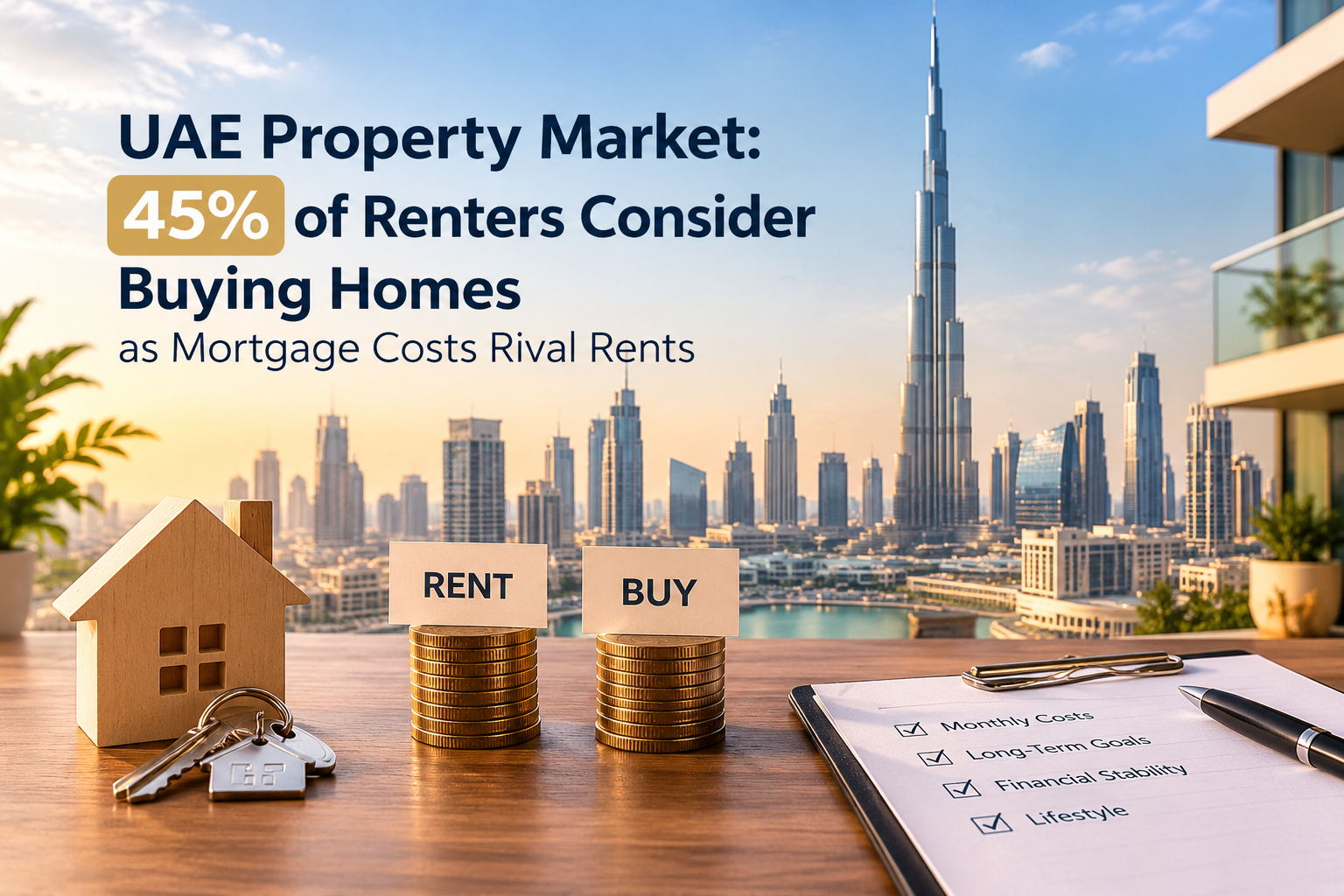
The UAE property market is witnessing a growing shift in how residents approach their housing decisions, with more renters exploring the possibility of becoming homeowners. As rental payments and monthly mortgage instalments become comparable in some communities, buying a property is increasingly part of the conversation for residents planning to stay in the Emirates for the long term.
A recent survey by Bayut and dubizzle, reported in October 2026, found that 45% of surveyed UAE renters had considered moving from renting to owning a home. The survey also found that 18% were actively comparing home-buying options, while 26% said they might consider purchasing once they had saved enough for the down payment and initial expenses.
The findings highlight an important development in the UAE real estate sector: residents are increasingly evaluating homeownership not only as a lifestyle choice but also as a potential long-term financial strategy.
For buyers considering Dubai, the key question is whether purchasing a home makes financial sense compared with continuing to rent.
UAE Renters Are Increasingly Considering Homeownership
For many years, renting has been the preferred option for expatriates and professionals who wanted flexibility while living in the UAE. However, changing housing costs and longer-term residency plans are encouraging more residents to assess the benefits of owning property.
According to the survey, among renters currently comparing buying options, 52% identified their intention to remain in the UAE for the long term as their main motivation. Meanwhile, 34% said mortgage instalments and rental payments were beginning to appear comparable.
These findings suggest that the decision to buy is influenced by two important considerations: financial affordability and the desire for residential stability.
Residents who expect to remain in Dubai for several years may find ownership attractive because it allows them to establish a permanent home while potentially building equity over time. Instead of making rental payments without acquiring ownership, buyers can gradually repay their mortgage and build an interest in a tangible asset.
Nevertheless, buying is not automatically cheaper than renting. Property prices, interest rates, down payments, service charges and maintenance expenses all influence the final decision.
Why Mortgage Payments Are Being Compared With Rent
The growing interest in homeownership reflects a practical change in how residents evaluate their monthly housing expenses.
In certain Dubai neighbourhoods, the estimated mortgage payment on a suitable property may be close to the rent for a comparable home. This can encourage renters to investigate whether purchasing a property is financially achievable.
However, the comparison requires careful analysis.
A rental payment generally covers the right to occupy a property under a tenancy agreement. A mortgage payment includes interest and principal repayments, with the principal portion contributing to the buyer’s equity. Homeowners must also account for other expenses that renters may not pay directly.
These can include:
- Property registration and transfer fees.
- Mortgage arrangement and valuation fees.
- Annual service charges for apartments and managed communities.
- Maintenance, repairs and insurance.
- Potential changes in mortgage interest rates.
- The opportunity cost of committing savings to a down payment.
Buyers should compare the complete cost of ownership with the cost of renting rather than focusing exclusively on the monthly instalment.
For some households, purchasing may provide a stronger long-term financial position. For others, renting may remain more suitable because it requires less upfront capital and provides greater flexibility.
Is Buying Property in Dubai Better Than Renting in 2026?

There is no universal answer to the rent-versus-buy question. The right choice depends on an individual’s financial circumstances, housing requirements and expected length of stay in Dubai.
1. Buying Can Help Build Long-Term Equity
One of the primary advantages of homeownership is the potential to build equity through mortgage repayments.
As the principal balance decreases, the homeowner generally increases their ownership stake in the property. If the property’s market value also appreciates, the owner’s equity may grow further.
However, property appreciation is not guaranteed. Market prices can fluctuate, and selling a property involves transaction costs that should be considered when calculating potential returns.
For residents planning to remain in Dubai over a longer period, evaluating both mortgage repayment and possible capital appreciation can help determine whether buying fits their financial goals.
2. Renting Offers Greater Flexibility
Renting can be appropriate for residents whose employment, family circumstances or future location remains uncertain.
Tenants can generally relocate when their tenancy arrangements permit, without having to sell a property or manage a mortgage. Renting also avoids the need to commit a substantial amount of capital to a down payment.
This flexibility may be particularly valuable for newly arrived expatriates, professionals expecting career changes or households that have not yet identified their preferred neighbourhood.
3. Ownership May Offer Greater Housing Stability
Homeownership can provide greater control over a living space and reduce dependence on annual rental negotiations, although mortgage obligations and other ownership costs remain.
Residents who intend to establish long-term roots in Dubai may value the ability to select a property that suits their family, lifestyle and future plans.
The decision becomes more compelling when the buyer has sufficient savings, stable income and a realistic understanding of the total financial commitment.
Which Dubai Communities Should Prospective Buyers Consider?
Dubai offers a broad range of residential communities, from established urban districts to emerging suburban neighbourhoods. Buyers should compare locations according to affordability, transport connections, facilities, property type and long-term suitability.
The following communities may be worth researching, depending on the buyer’s budget and requirements.
Jumeirah Village Circle (JVC)
Jumeirah Village Circle attracts residents looking for apartments and selected townhouse options within a community setting. Its residential mix makes it worth considering for first-time buyers comparing different property sizes and price points.
Prospective purchasers should examine building quality, service charges, parking, access to main roads and the availability of everyday facilities before choosing a property.
Dubai South
Dubai South is a developing district that appeals to buyers interested in planned residential communities and connections to the wider southern Dubai area.
It may suit some households seeking a longer-term residential option, but buyers should assess commuting requirements, currently available facilities and the timing of planned infrastructure improvements.
Dubai Silicon Oasis
Dubai Silicon Oasis combines residential developments with business and technology-related activity. Apartments and family-oriented housing options can appeal to professionals who want access to workplaces, schools and daily amenities.
Comparing individual buildings, maintenance standards and transport requirements is essential when evaluating properties in the area.
Dubai Hills Estate
Dubai Hills Estate offers apartments, villas and townhouses in a master-planned community with parks, retail facilities and access to healthcare and educational services.
It may appeal to families and buyers prioritising lifestyle amenities. However, purchasers should compare property prices, ongoing ownership costs and their overall affordability before making a decision.
Town Square Dubai
Town Square Dubai offers residential apartments and townhouses in a community-oriented setting. Buyers looking for family facilities, outdoor spaces and a suburban lifestyle may wish to include it in their research.
The suitability of the area depends on commute times, transport arrangements, property specifications and the buyer’s budget.
Important: These are communities to investigate, not a ranking of the most affordable locations. Property prices, rents and mortgage costs vary by development, unit size, condition and financing terms.
How Much Money Do You Need to Buy a Home in Dubai?
The initial cost of purchasing a home is often one of the biggest barriers for renters considering a move into ownership.
Even when a mortgage payment appears comparable to rent, buyers must usually save a substantial amount before completing the purchase.
For eligible expatriate buyers purchasing a property valued below AED 5 million, the applicable minimum down payment is generally 20% for a first residential property under the UAE Central Bank’s mortgage framework. Actual financing eligibility depends on the buyer’s circumstances, lender requirements and applicable regulations.
For example, consider an illustrative property priced at AED 1.5 million.
| Purchase component | Illustrative amount |
|---|---|
| Property price | AED 1,500,000 |
| 20% down payment | AED 300,000 |
| Remaining 80% mortgage | AED 1,200,000 |
| Dubai Land Department transfer fee at 4% | AED 60,000 |
| Minimum illustrative total before other costs | AED 360,000 |
This example assumes that the buyer qualifies for 80% financing and that the 4% Dubai Land Department transfer fee is calculated on the full purchase price. It excludes mortgage registration, bank fees, valuation, agency commission where applicable and other transaction costs.
The actual amount required may therefore be higher. Buyers should also retain sufficient savings for emergencies rather than committing all available cash to the purchase.
Before beginning a property search, prospective homeowners should request a mortgage eligibility assessment and establish a realistic purchasing budget.
What Should Buyers Check Before Taking a Mortgage?
A mortgage is a long-term financial commitment, so buyers should evaluate more than the initial interest rate or advertised monthly repayment.
Compare mortgage offers
Different lenders may offer different interest rates, fees, repayment periods and eligibility criteria. Compare the total borrowing cost and understand whether the proposed rate is fixed for a defined period or variable.
Calculate the full monthly ownership cost
Include the mortgage instalment, service charges, utilities, maintenance allowances and any other recurring expenses associated with the property.
Understand the down payment requirements
Confirm the amount required from personal savings and ensure that the funds are available before committing to a purchase.
Check property documentation
Verify ownership, title documentation, outstanding obligations and any applicable developer or community requirements. Off-plan buyers should also review the purchase agreement and the relevant payment schedule.
Consider how long you plan to stay
Buying can involve significant upfront transaction costs. Residents who may relocate soon should consider whether the expected period of ownership justifies those expenses.
Assess affordability under different scenarios
Consider whether the household could continue meeting repayments if interest rates increased, income declined or unexpected expenses arose.
Taking these steps helps buyers make informed decisions rather than purchasing solely because a mortgage quotation appears similar to their current rent.
What Does This Trend Mean for Dubai’s Property Market?
The growing interest among renters has implications for both residential buyers and the wider real estate sector.
First, it may expand the pool of potential end-users. Residents who previously viewed property ownership as a distant goal may begin exploring smaller apartments, emerging communities or properties that better match their budgets.
Second, demand may become more closely linked to affordability. Buyers will continue to compare mortgage terms, upfront costs and the practical benefits of individual locations.
Third, the trend may encourage property developers and real estate professionals to provide clearer information about purchase costs, financing considerations and the differences between ready and off-plan properties.
However, survey responses represent interest and intentions rather than completed transactions. Not everyone considering a purchase will qualify for a mortgage or proceed with a purchase. Savings requirements, interest rates, property prices and personal circumstances can all influence conversion from renter to homeowner.
The survey results should therefore be understood as an indication of changing consumer attitudes, not a guarantee of future property-price growth.
How Arthur Mackenzy Properties Can Help You Explore Homeownership
Moving from renting to owning a property requires a clear understanding of the available options and the financial responsibilities involved.
Arthur Mackenzy Properties can help prospective buyers explore residential opportunities in Dubai according to their budget, preferred location, lifestyle and investment objectives.
Whether you are searching for a first apartment, a family townhouse or a long-term residential property, a structured search can help you compare suitable options and identify the factors that matter most.
Before making a decision, buyers should establish their mortgage eligibility, calculate their upfront costs and compare the total cost of ownership against their current rental expenses.
The goal is not simply to purchase a property. It is to choose a home that remains financially manageable and appropriate for your long-term plans.
Conclusion
The finding that 45% of surveyed UAE renters have considered homeownership highlights a growing willingness to explore alternatives to renting. For many residents, the combination of long-term plans in the Emirates and mortgage payments that can rival rental costs has made buying a home a more immediate consideration.
Dubai offers a diverse range of residential opportunities, but the right choice depends on affordability, location, financing and the length of time a buyer expects to remain in the property.
Renting continues to offer flexibility, while buying can provide an opportunity to build equity and establish a long-term home. Neither option is automatically superior in every situation.
For residents considering their next move, comparing real property costs and securing appropriate financial advice are essential first steps towards a confident decision.
Explore your property options with Arthur Mackenzy Properties and take a practical first step towards homeownership in Dubai.
Frequently Asked Questions
1. What percentage of UAE renters are considering buying a home?
A Bayut and dubizzle survey reported in October 2026 found that 45% of surveyed renters had considered moving from renting to owning a home. The finding reflects survey participants’ reported intentions, not completed property purchases.
2. Is buying a property in Dubai cheaper than renting?
It depends on the property price, mortgage terms, down payment, service charges and maintenance costs. In some cases, mortgage payments may be comparable to rent, but buyers must also account for upfront expenses and ongoing ownership obligations.
3. How much deposit is required to buy property in Dubai?
Eligible expatriate buyers purchasing a first residential property below AED 5 million generally need a minimum 20% down payment under the applicable mortgage framework. Requirements vary according to eligibility, lender assessment and property circumstances.
4. Which Dubai areas should first-time buyers consider?
Jumeirah Village Circle, Dubai South, Dubai Silicon Oasis, Town Square Dubai and Dubai Hills Estate are examples of communities worth researching. Buyers should compare actual property prices, service charges, transport access and facilities rather than relying on location names alone.
5. Can expatriates buy property in Dubai?
Yes. Foreign nationals can purchase freehold property in designated areas of Dubai, subject to the applicable rules and transaction requirements.
6. What costs should buyers consider besides their mortgage?
Additional costs may include the down payment, Dubai Land Department transfer fee, agency commission where applicable, mortgage arrangement and registration fees, valuation, service charges, maintenance and insurance.
7. Is buying a home a good long-term investment?
It can be suitable for some buyers, particularly those with a long-term horizon and manageable financing. However, property values can rise or fall, and returns depend on purchase price, ongoing expenses, market conditions and the property’s eventual resale value.
8. Should I buy a property or continue renting in Dubai?
Compare your expected length of stay, savings, income stability, financing eligibility and complete housing costs. Renting may suit residents who need flexibility, while buying may be appropriate for those seeking long-term stability and potential equity growth.