Dubai’s luxury real estate market is continuing to demonstrate remarkable resilience and growth in 2026, reinforcing the emirate’s position as one of the world’s leading destinations for high-net-worth individuals (HNWIs), investors and luxury property buyers.
The latest market data shows that demand at the very top end of Dubai’s residential sector remains exceptionally strong. While the broader property market is moving towards a more mature phase, the luxury and ultra-luxury segments continue to outperform, supported by international wealth migration, limited prime inventory, Dubai’s tax environment and its growing reputation as a global lifestyle hub.
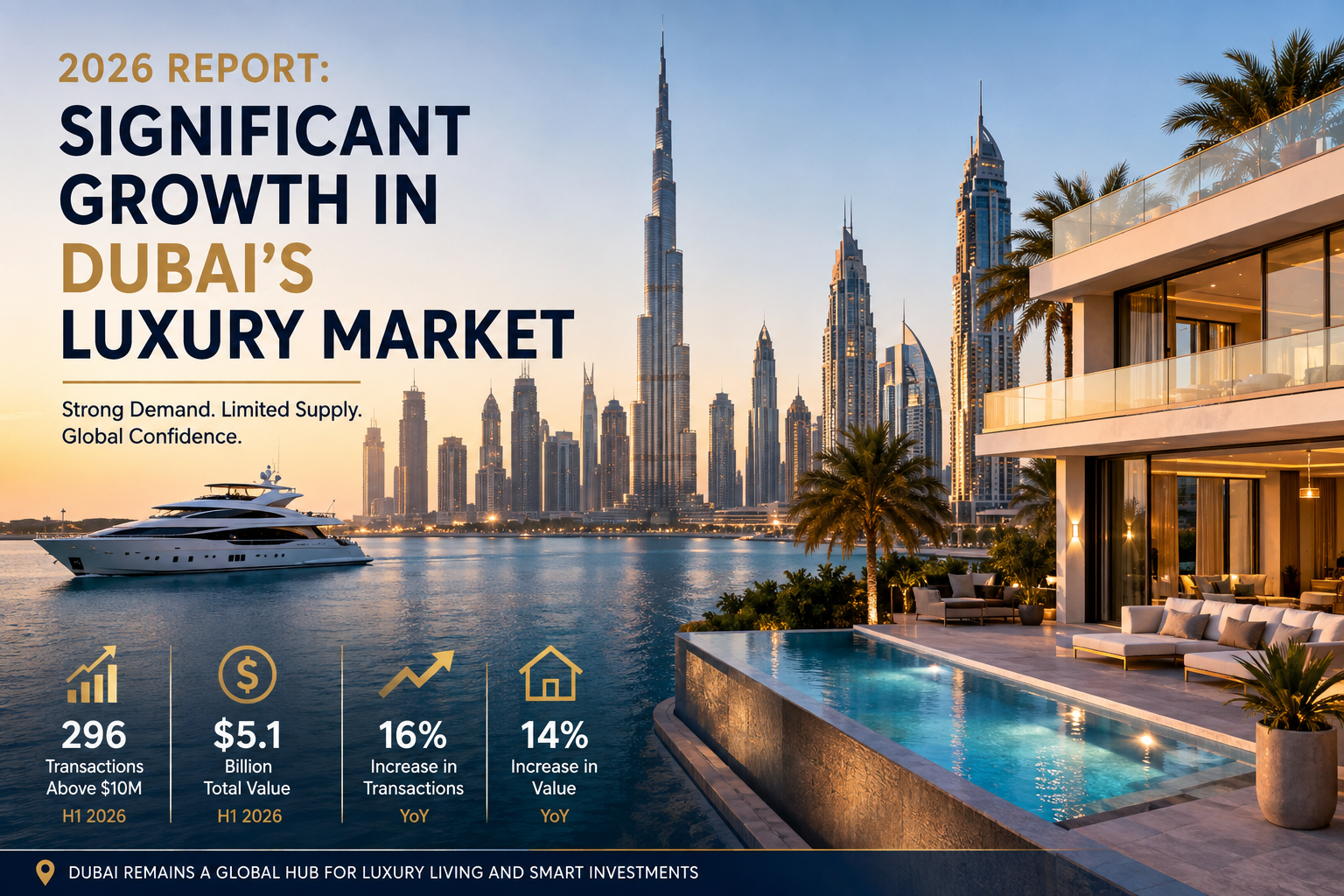
According to Knight Frank, Dubai recorded 296 residential transactions above US$10 million during the first half of 2026, with the total value reaching approximately US$5.1 billion. The number of transactions was up 16% year on year, while transaction value increased by 14%.
Dubai’s Luxury Market Reaches New Heights in 2026
The first six months of 2026 produced another record performance for Dubai’s ultra-luxury residential market.
Knight Frank reported 165 homes worth more than US$10 million sold in Q1 2026, followed by another 131 transactions in Q2. The second quarter also included 26 properties selling for more than US$25 million, highlighting the depth of demand at the highest end of the market.
This performance is particularly significant because it comes against a backdrop of geopolitical uncertainty and changing global investment conditions. Rather than disappearing, demand from wealthy international buyers has increasingly focused on high-quality properties in established global wealth centres such as Dubai.
Knight Frank’s global super-prime analysis found that Dubai recorded 193 US$10 million-plus transactions worth an estimated US$3.43 billion in Q1 2026, representing a 74% year-on-year increase in transaction volume.
Why Are Wealthy Buyers Choosing Dubai?
Dubai’s luxury property boom is being driven by a combination of economic, lifestyle and investment factors.
For international HNWIs, property is increasingly about more than capital appreciation. Wealthy buyers are looking for cities that provide a combination of security, connectivity, lifestyle, business opportunities, taxation advantages and high-quality residential options.
Dubai performs strongly across these categories.
The emirate has developed into a major international wealth hub, attracting entrepreneurs, investors, executives, family offices and internationally mobile individuals. Its global airport connectivity, luxury hospitality sector, premium retail offering and expanding infrastructure have further strengthened its appeal.
Knight Frank notes that Dubai has remained the busiest luxury homes market globally since the end of 2022. Before the regional conflict in 2026, prime residential prices had increased by 25.1% over the preceding year, demonstrating the strength of the market leading into the current period.
Prime Properties Continue to Outperform
One of the clearest trends emerging from Dubai’s residential market is the widening performance gap between luxury and mainstream properties.
Knight Frank reported that Dubai recorded 205,400 residential transactions in 2025, an 18% increase from 2024, while total transaction value climbed 25% to AED 544.2 billion. Prime property values exceeded AED 4,300 per square foot, showing that higher-value assets were driving a disproportionate share of market growth.
This suggests that Dubai’s property market is becoming increasingly segmented.
Mainstream residential prices are expected to grow at a slower rate as additional supply enters the market. Prime and ultra-prime properties, however, benefit from a different set of market dynamics, particularly scarcity and international demand.
Knight Frank expects prime residential prices to rise by around 3% during 2026, compared with approximately 1% growth for the mainstream market.
Scarcity Is Supporting Luxury Property Values
Limited availability of exceptional properties is another important factor behind Dubai’s luxury market growth.
Ultra-high-net-worth buyers generally have different purchasing priorities from mainstream investors. They are often less sensitive to small price changes and more focused on location, architecture, privacy, views, amenities, brand reputation and exclusivity.
This creates strong demand for properties that cannot easily be replicated.
Prime waterfront villas, branded residences, penthouses and large luxury homes in prestigious communities can therefore command substantial premiums when supply is limited.
Knight Frank’s 2026 global prime property research also highlights scarcity as an increasingly important feature of luxury markets worldwide. Affluent buyers are showing a strong preference for high-quality, move-in-ready properties because they want to minimise renovation risk and transaction complexity.
Branded Residences Strengthen Dubai’s Luxury Appeal
Branded residences have become an increasingly important component of Dubai’s premium property sector.
These developments combine residential ownership with the service standards and branding associated with luxury hotels, hospitality groups and global lifestyle brands.
For international buyers, this model can offer an attractive combination of property ownership, professional management, premium amenities and global brand recognition.
The broader global branded-residence sector is also expanding rapidly. Knight Frank projects that there could be more than 1,000 live branded-residence schemes worldwide by 2030.
Dubai is particularly well positioned to benefit from this trend because of its established luxury hospitality industry and strong international buyer base.
International Wealth Continues to Flow Into Dubai
International wealth migration remains one of the strongest structural drivers behind Dubai’s luxury market.
The city has attracted buyers from the Middle East, Europe, India, China and other international markets. Knight Frank’s July 2026 analysis highlighted Dubai’s ability to attract highly mobile wealth through a combination of lifestyle appeal, infrastructure and a favourable regulatory and taxation environment.
For many wealthy individuals, Dubai property can therefore form part of a broader global wealth and residency strategy.
Rather than purchasing a home purely as a traditional investment, some buyers are looking for a combination of capital preservation, lifestyle flexibility, rental potential and access to Dubai’s international business ecosystem.
Luxury Villas and Waterfront Homes Remain Highly Desirable
Although Dubai has historically been known for its high-rise apartments, the luxury segment has increasingly benefited from strong demand for villas and large private residences.
Prime villa communities offer greater privacy, larger floor plans, private outdoor spaces and access to premium amenities. Waterfront properties are particularly attractive because genuinely scarce beachfront and marina-front inventory cannot easily be increased.
Locations such as Palm Jumeirah, Emirates Hills, Jumeirah Bay Island and Dubai Hills Estate continue to attract affluent buyers seeking prestigious addresses and high-quality residential environments.
The strongest demand tends to be concentrated around properties that combine location, privacy, views, architectural quality and lifestyle amenities.
Dubai’s Luxury Market Is Becoming More Sophisticated
The rapid growth of Dubai’s luxury property market does not mean that every premium property will automatically deliver strong returns.
As the market matures, buyers are becoming more selective.
Engel & Völkers reported that Dubai recorded 80,509 residential property sales worth AED 226.5 billion in H1 2026, making it the second-strongest first half on record by sales value. It also reported 320 transactions above US$10 million during the first half, although its methodology differs from Knight Frank’s figures.
This growing sophistication means investors are increasingly evaluating developers, construction quality, location, service levels, liquidity, rental demand and long-term resale potential rather than simply purchasing because a property is marketed as “luxury.”
What Does the 2026 Luxury Market Mean for Investors?
The performance of Dubai’s luxury market presents several important considerations for investors.
First, quality is becoming more important than quantity. With a significant amount of new residential supply expected to enter the market, properties with genuine scarcity and differentiated features could perform better than generic luxury developments.
Second, location remains critical. Prime waterfront and established luxury communities are likely to retain their appeal because they offer characteristics that cannot easily be reproduced.
Third, international demand remains fundamental. Dubai’s luxury market is not dependent solely on local buyers. Its global appeal provides a broader pool of potential purchasers.
Finally, investors need to distinguish between headline luxury marketing and genuine prime assets. A high price tag does not necessarily make a property a prime investment.
Is Dubai’s Luxury Property Boom Sustainable?
The answer is increasingly dependent on the quality of individual assets rather than the market as a whole.
Dubai’s residential market has experienced several years of rapid expansion, and analysts expect overall price growth to moderate as additional supply reaches the market.
However, the underlying structural drivers remain strong. Knight Frank identifies population growth, wealth migration, economic diversification and international HNWI demand as important factors supporting Dubai’s property market.
The luxury segment also has an additional advantage: scarcity.
While developers can introduce large numbers of new apartments, genuinely exceptional waterfront homes, trophy residences and ultra-prime properties remain limited.
That distinction could become increasingly important as Dubai moves into the next stage of its property cycle.
Dubai Luxury Real Estate Outlook for 2026 and Beyond
Dubai’s luxury market has entered 2026 from a position of considerable strength.
Record transaction activity above the US$10 million threshold, continued international demand and the expansion of branded and ultra-prime developments all point towards a market that remains highly attractive to wealthy buyers.
At the same time, investors should expect a more selective environment. The rapid price appreciation seen during previous phases of the cycle may not continue indefinitely, particularly as new supply increases.
The opportunity is therefore shifting from simply owning property in Dubai to identifying the right property in the right location at the right price.
For HNWIs and international investors, Dubai remains one of the world’s most compelling luxury property markets. Its combination of global connectivity, lifestyle infrastructure, wealth migration and limited supply of genuinely prime assets should continue to support the upper end of the market.
Frequently Asked Questions
Is Dubai’s luxury property market growing in 2026?
Yes. Dubai’s luxury residential market has recorded significant growth in 2026. Knight Frank reported 296 transactions above US$10 million during H1 2026, worth approximately US$5.1 billion.
How much did Dubai’s US$10 million-plus property market grow in 2026?
The value of US$10 million-plus residential transactions increased by 14% year on year during H1 2026, while the number of transactions increased by 16% compared with H1 2025.
Why is Dubai attractive to luxury property investors?
Dubai offers international connectivity, a developed luxury lifestyle ecosystem, strong infrastructure, a favourable taxation environment and access to a growing pool of internationally mobile wealthy buyers.
Are Dubai luxury properties a good investment in 2026?
Prime Dubai properties can offer attractive long-term investment potential, but performance varies significantly by location, developer, property quality and entry price. Investors should conduct detailed due diligence rather than relying solely on the property’s luxury positioning.
Which type of Dubai luxury property is most in demand?
Ultra-prime villas, waterfront residences, branded residences, penthouses and properties in established premium communities are among the strongest areas of luxury demand.
Will Dubai luxury property prices continue rising?
Current market forecasts suggest continued positive growth, although at a more moderate pace. Knight Frank expects prime residential prices to rise by around 3% during 2026.
What is the future of Dubai’s luxury real estate market?
The outlook remains positive, particularly for scarce, high-quality assets. International wealth migration, population growth, economic diversification and continued HNWI demand are expected to remain important market drivers.