Dubai has built its reputation on ambitious infrastructure, record-breaking architecture and large-scale master-planned communities. That strategy is continuing, with a new generation of megaprojects expected to reshape the emirate’s skyline, transport network, tourism sector and real estate market over the coming years.
The next phase is broader than simply building taller towers. Dubai is investing in airports, metro infrastructure, artificial islands, entertainment destinations, waterfront communities and new urban districts. These projects are also closely linked to the emirate’s long-term growth plans and its ambition to remain one of the world’s leading destinations for business, tourism and investment. (Property Finder)
For property investors, these developments are particularly important because major infrastructure and destination projects can influence population growth, connectivity, tourism demand, rental markets and the value of surrounding real estate.
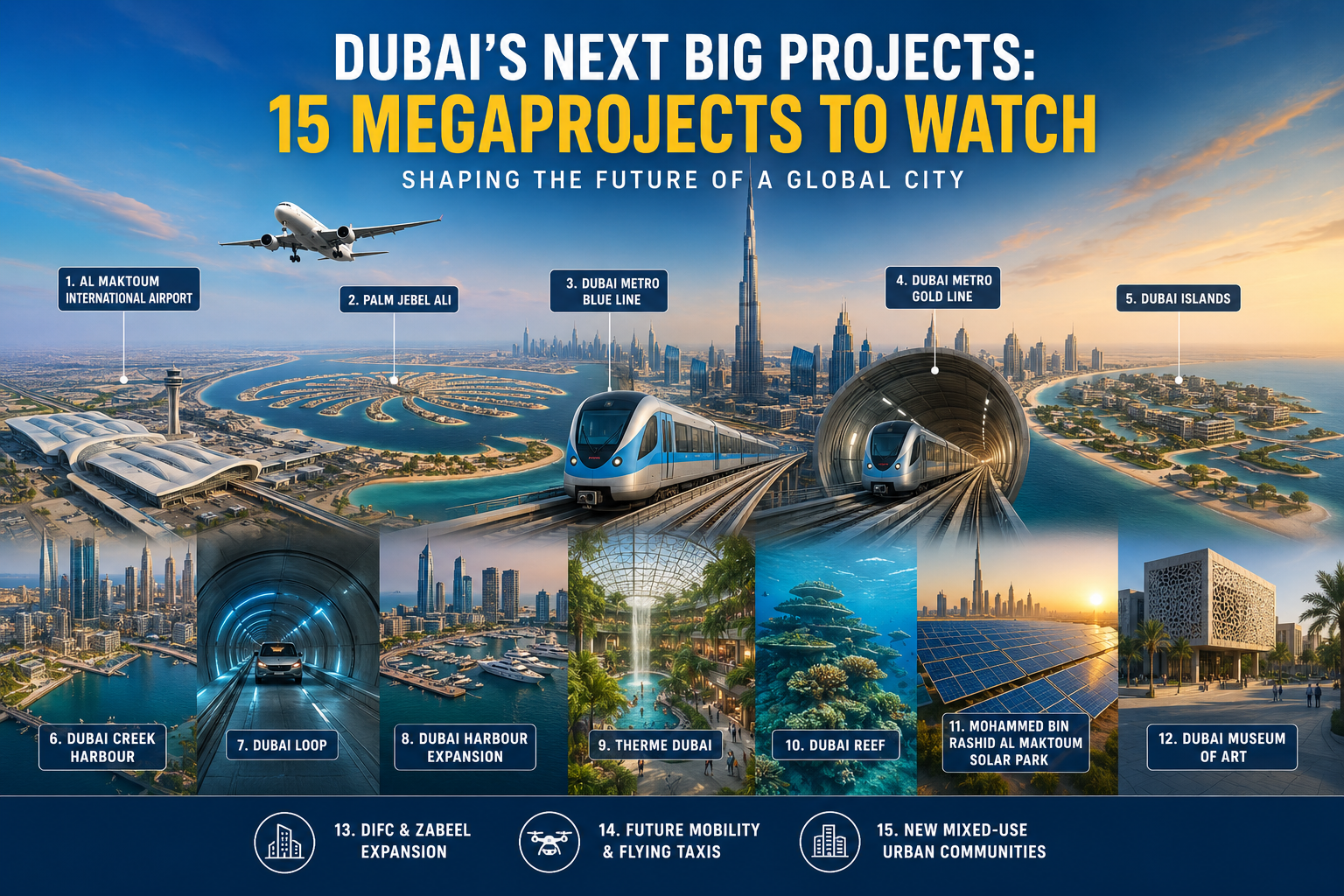
Here are 15 Dubai megaprojects worth watching.
1. Al Maktoum International Airport
Perhaps the biggest infrastructure project on Dubai’s horizon is the expansion of Al Maktoum International Airport (Dubai World Central).
The airport is planned to become the world’s largest aviation hub, with eventual capacity of up to 260 million passengers annually. The masterplan includes two passenger terminals, seven concourses, five parallel runways and more than 430 aircraft stands. (The National)
The project is also expected to accelerate development around Dubai South, transforming the southern part of the emirate into a major aviation, logistics, residential and commercial centre.
For property investors, the airport could be particularly significant because infrastructure on this scale can create new employment centres and stimulate demand for housing, hospitality and commercial space.
2. Palm Jebel Ali
Dubai is bringing another Palm-shaped development to life with Palm Jebel Ali.
The seven-island development is planned to be significantly larger than Palm Jumeirah, stretching approximately 13.4 kilometres and providing around 90 kilometres of beachfront. The project is expected to include thousands of homes alongside hotels, resorts and leisure destinations. (The National)
The development is being delivered in phases, with new residential releases already attracting substantial interest.
Palm Jebel Ali could eventually create an entirely new luxury waterfront market in Dubai, extending the emirate’s premium coastal property offering beyond established destinations such as Palm Jumeirah.
3. Dubai Metro Blue Line
Dubai’s transport network is entering another major expansion phase with the Dubai Metro Blue Line.
The AED20.5 billion project will cover approximately 30 kilometres, including underground and elevated sections, with 14 stations. It will connect important districts including Dubai Creek Harbour, Dubai International City, Dubai Silicon Oasis and Mirdif. (PDD Portal)
The Blue Line is scheduled to open in September 2029 and is expected to serve a population of roughly one million under Dubai’s long-term urban planning strategy.
Its impact will extend beyond transportation. Better metro connectivity could make previously less-connected residential districts more attractive to residents, businesses and investors.
4. Dubai Metro Gold Line
Dubai has already announced another major addition to its metro network: the Gold Line.
The AED34 billion project will stretch 42 kilometres and include 18 stations, making it Dubai’s first fully underground metro line. It is scheduled to open on September 9, 2032. (Public Debt Management Office)
The line will connect areas including Al Ghubaiba, Mina Rashid, City Walk, Business Bay, Meydan, Mohammed Bin Rashid City, Jumeirah Village Circle and Jumeirah Golf Estates.
The project is expected to serve more than 55 development projects and potentially benefit over 1.5 million people by 2040. (PDD Portal)
For Dubai real estate, this is an important development because transport infrastructure can significantly alter accessibility and investment patterns.
5. Dubai Islands
Formerly known as Deira Islands, Dubai Islands is emerging as one of Dubai’s major waterfront masterplans.
The destination comprises five islands covering approximately 17 square kilometres, with around 20 kilometres of beaches. (Arabian Business)
Residential communities, hotels, resorts, retail destinations and leisure facilities are planned across the development.
Nakheel is continuing to invest heavily in infrastructure, including a recently awarded AED527 million contract covering infrastructure and utilities works. (Arabian Business)
Dubai Islands could become an important new waterfront district as Dubai continues expanding its tourism and residential coastline.
6. Dubai Creek Harbour
Dubai Creek Harbour is another major urban transformation project that is expected to play a significant role in the emirate’s future.
The waterfront masterplan combines residential communities, retail, hospitality, public spaces and commercial development around Dubai Creek.
Its location also makes it strategically important for connectivity, particularly as the Dubai Metro Blue Line will connect the area with other major parts of the city. (PDD Portal)
The combination of waterfront living and improved public transport could strengthen Creek Harbour’s position as one of Dubai’s major residential and lifestyle destinations.
7. Dubai Loop
One of the more futuristic projects on the list is the Dubai Loop, an underground transportation concept designed to provide fast point-to-point mobility beneath the city.
The initial phase is planned to cover approximately 6.4 kilometres with four stations, with a longer-term concept extending to around 22.2 kilometres and 19 stations. (Gulf News)
The system is designed around electric vehicles travelling through dedicated underground tunnels.
If expanded successfully, the Dubai Loop could become another layer of Dubai’s mobility infrastructure, complementing the existing metro and future Blue and Gold lines.
8. Dubai Harbour Expansion
Dubai Harbour has become one of the emirate’s leading maritime and lifestyle destinations, and further development is expected to strengthen its role in Dubai’s tourism and luxury real estate ecosystem.
The wider waterfront area is positioned around premium residences, hotels, restaurants, marinas and leisure facilities.
Its proximity to major coastal destinations and Dubai’s luxury residential market makes the district one to monitor as the emirate continues expanding its high-end tourism infrastructure.
9. Therme Dubai
Dubai is also moving into a new category of large-scale wellness and entertainment destinations with Therme Dubai.
The project is designed as a major year-round wellness and leisure destination, combining thermal experiences, relaxation, entertainment and indoor environments.
Its concept reflects Dubai’s broader strategy of creating attractions that can operate throughout the year despite the emirate’s extreme summer temperatures.
For the tourism sector, projects such as Therme Dubai could help diversify Dubai’s visitor experience beyond shopping, beaches and traditional attractions.
10. Dubai Reef
Not every major Dubai project is about skyscrapers or roads.
Dubai Reef is an environmental initiative designed to create one of the world’s largest marine reef developments.
The project aims to support marine biodiversity while also contributing to Dubai’s sustainability objectives.
Artificial reef infrastructure can provide marine habitats, improve ecological resilience and potentially support recreational and tourism activities.
It represents a broader shift in Dubai’s development strategy, where environmental infrastructure is increasingly becoming part of the city’s long-term urban planning.
11. Mohammed bin Rashid Al Maktoum Solar Park
Dubai’s sustainability ambitions are also reflected in the enormous Mohammed bin Rashid Al Maktoum Solar Park.
The project is one of the world’s largest renewable-energy developments and forms a major component of Dubai’s strategy to increase clean-energy generation.
Its importance extends beyond electricity production. Large-scale renewable infrastructure can support Dubai’s ambitions around sustainable buildings, electric mobility and lower-carbon economic growth.
12. Dubai Museum of Art
Dubai is also expanding its cultural infrastructure.
The planned Dubai Museum of Art is part of the emirate’s wider effort to strengthen its position as an international destination for art and culture.
Cultural institutions can have a significant economic impact because they attract visitors, create new destinations and stimulate surrounding hospitality, retail and residential development.
This fits into Dubai’s broader strategy of developing a city where business, tourism, entertainment, culture and residential communities increasingly overlap.
13. DIFC and Zabeel Expansion
The DIFC and Zabeel area is undergoing further development as Dubai strengthens its position as a global financial centre.
Expansion around Dubai International Financial Centre is expected to add more commercial, residential and lifestyle space while improving connections with surrounding districts.
As financial and professional services continue to attract international companies and high-income professionals, demand for nearby offices, luxury residences, restaurants and hospitality is likely to remain an important part of the area’s growth story.
14. Future Mobility and Flying Taxis
Dubai is also preparing for a future in which urban transportation extends beyond roads and conventional rail.
Flying taxis and vertiports are being developed as part of the emirate’s future mobility strategy, with the goal of reducing travel times between key destinations.
The technology could eventually connect airports, business districts, hotels and residential communities through aerial transport.
Although widespread adoption will depend on infrastructure, regulation, safety and commercial viability, Dubai’s willingness to invest in advanced mobility makes this an important project category to watch.
15. New Mixed-Use Urban Communities
Alongside its headline infrastructure projects, Dubai continues to build large-scale mixed-use communities combining residential, retail, office and leisure components.
Recent project activity shows the scale of Dubai’s ongoing development pipeline. A Dubai real estate project register recorded 373 registered launches since January 2026 as of August 24, illustrating how extensive the emirate’s development pipeline has become. (Dubai Real Estate Data)
Projects such as these are important because Dubai’s next growth cycle will not be defined by individual landmarks alone. It will increasingly be shaped by complete communities designed around where people live, work, shop and spend their leisure time.
What Dubai’s Megaprojects Mean for Property Investors
The most important point for property investors is that Dubai’s megaproject strategy is creating new centres of economic activity.
Transport projects such as the Blue and Gold Metro lines can improve accessibility. Airport expansion can create employment and logistics hubs. Waterfront developments can generate tourism and luxury residential demand, while cultural and entertainment projects can increase footfall and hospitality activity.
This means investors should look beyond the individual project itself and examine the surrounding ecosystem.
A new metro station, for example, can be more important to a residential investment than the headline architectural design of a nearby tower. Similarly, a new airport or tourism destination can create long-term demand for hotels, serviced apartments, rental properties and commercial space.
Dubai Is Building for the Next Decade
Dubai’s current megaproject pipeline demonstrates that the emirate is not simply expanding its skyline. It is building an interconnected urban ecosystem covering transport, aviation, tourism, real estate, sustainability, entertainment and culture.
The Dubai Metro Blue Line is already under construction, while the Gold Line has been approved and major airport expansion is progressing. Palm Jebel Ali and Dubai Islands are simultaneously opening new waterfront development corridors. (Public Debt Management Office)
For property buyers and investors, the biggest opportunity may therefore come from understanding where Dubai is going next, rather than focusing only on where demand is strongest today.
As these projects move from masterplans and construction sites into functioning communities, they could reshape Dubai’s property map for years to come.
FAQs
What are the biggest upcoming megaprojects in Dubai?
Some of the most significant include Al Maktoum International Airport, Palm Jebel Ali, Dubai Metro Blue Line, Dubai Metro Gold Line, Dubai Islands and Dubai Creek Harbour.
Which Dubai megaproject is most important for transport?
The Dubai Metro expansion is among the most important. The Blue Line will add 30 kilometres and 14 stations, while the AED34 billion Gold Line will add another 42 kilometres and 18 stations. (PDD Portal)
What is the biggest airport project in Dubai?
The expansion of Al Maktoum International Airport is the largest. Once fully developed, it is planned to handle up to 260 million passengers annually. (The National)
Is Palm Jebel Ali bigger than Palm Jumeirah?
Yes. Palm Jebel Ali is planned as a substantially larger waterfront development, spanning approximately 13.4 kilometres with around 90 kilometres of beachfront. (The National)
Will Dubai megaprojects affect property prices?
They can. New infrastructure and destination projects can improve connectivity, attract residents and tourists, create employment and increase demand for surrounding property. However, the impact varies by location, project delivery, supply and market conditions.
Why are Dubai megaprojects important for real estate investors?
Large infrastructure and masterplanned developments can create new investment corridors. Investors who identify areas before major infrastructure becomes operational may benefit from improving accessibility and growing demand, although future performance is never guaranteed.
What is the Dubai Metro Gold Line?
The Gold Line is a planned 42-kilometre, fully underground metro route with 18 stations. It is expected to open in September 2032 and will connect several major residential, commercial and development districts. (Public Debt Management Office)
What is the Dubai Metro Blue Line?
The Blue Line is a 30-kilometre metro expansion with 14 stations. It will connect areas including Dubai Creek Harbour, Dubai International City, Dubai Silicon Oasis and Mirdif and is scheduled to open in 2029. (PDD Portal)
What should investors consider before buying near a Dubai megaproject?
Investors should consider construction timelines, actual infrastructure completion, existing and planned property supply, rental demand, transport accessibility, developer reputation and the project’s long-term economic fundamentals rather than relying solely on projected capital appreciation.
Bottom line: Dubai’s next generation of megaprojects is likely to change not just the skyline but the geography of opportunity across the emirate. For real estate investors, understanding these infrastructure and masterplan developments could be just as important as analysing individual properties. (Engel & Völkers)