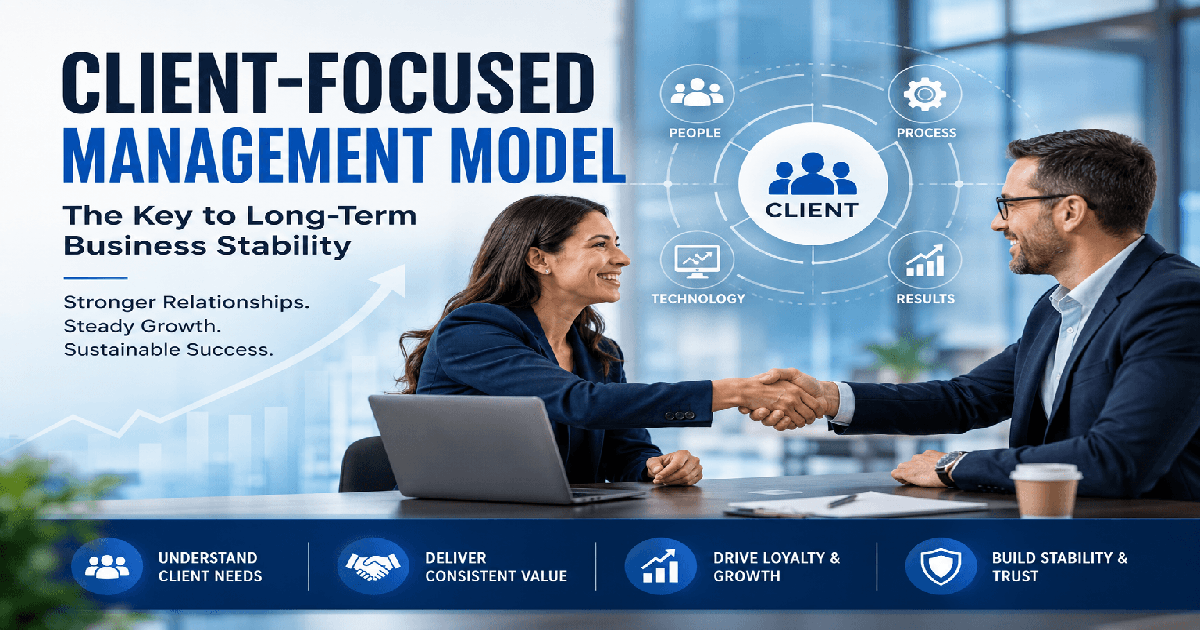
Every business owner wants the same thing: steady growth, reliable revenue, loyal customers, and fewer surprises. Yet many companies chase stability by cutting costs, tightening controls, and optimizing internal processes while forgetting the very people who pay the bills. That approach can work for a quarter or two, but it rarely creates durable success. Long-term stability comes from building a company that consistently understands, serves, and retains its clients.
A client-focused management model does exactly that. It aligns leadership, operations, technology, and employee behavior around delivering measurable value to customers. Instead of treating client service as a department, it turns customer success into the central operating principle of the organization. When this model is executed well, it strengthens retention, reduces churn, improves margins, and creates a business that can withstand economic uncertainty.
The business case has never been stronger. Research in 2026 shows that 80% of customers say experience is as important as products and services, and 86% are willing to pay more for a superior experience. At the same time, only 31% of customers describe themselves as “very loyal,” which means trust and consistency matter more than ever.
What a Client-Focused Management Model Really Means
A client-focused management model is a business framework where every major decision begins with a simple question: How will this affect the client? That question becomes the compass for strategy, pricing, operations, staffing, and technology investments. Rather than optimizing departments in isolation, the organization is designed around the customer journey from onboarding to renewal and referral.
Think of it like building a house around the people who live in it rather than around the convenience of the contractor. The rooms are arranged to fit real needs. The wiring, plumbing, and structure support comfort and durability. In the same way, a client-centered company structures processes to make interactions smoother, outcomes better, and relationships stronger over time.
From Transactional Thinking to Relationship Thinking
Transactional businesses focus on winning the next sale. Relationship-focused businesses focus on earning the next ten years. That shift changes everything. Sales teams stop overpromising. Support teams become proactive. Finance considers customer lifetime value rather than only immediate margin. Leadership starts measuring trust, satisfaction, and retention as seriously as revenue.
Why Stability Starts With the Customer
Customers are the source of cash flow, referrals, and market credibility. When they stay longer and buy more, revenue becomes predictable. When they leave quickly, growth becomes expensive and fragile. A stable business is not one that merely controls costs; it is one that keeps customers engaged and loyal.
Why Businesses Are Shifting to Customer-Centric Leadership in 2026
The marketplace in 2026 is faster, more transparent, and less forgiving. Customers can compare providers instantly, switch with minimal friction, and share experiences publicly. In this environment, businesses that ignore client needs are like ships sailing without a compass.
McKinsey & Company reports that organizations using a customer-back business model can unlock substantial profitability and operational gains by redesigning processes around customer value rather than internal silos.
Rising Customer Expectations
Modern clients expect:
- Fast response times
- Personalized communication
- Transparent pricing
- Consistent service across channels
- Proactive support
These are no longer premium features. They are baseline expectations.
Trust as a Competitive Advantage
In a world shaped by automation and AI, trust is the currency that matters most. Clients want speed, but they also want honesty, empathy, and accountability. Businesses that consistently deliver these qualities create a moat that competitors struggle to cross.
Core Pillars of a Client-Focused Management Model
The strongest client-centered organizations are built on four foundational pillars.
| Pillar | Purpose | Business Impact |
|---|---|---|
| Leadership Commitment | Makes customer value a strategic priority | Aligns the entire organization |
| Data-Driven Decisions | Uses customer insights and metrics | Improves accuracy and responsiveness |
| Empowered Employees | Enables frontline problem solving | Faster and better service |
| Continuous Feedback | Turns input into improvements | Increases satisfaction and loyalty |
Leadership Commitment
Customer-centricity starts at the top. Executives must reward behaviors that strengthen client relationships, not just short-term sales. When leadership models client-first thinking, it spreads throughout the company.
Data-Driven Decision Making
Customer feedback, churn analysis, and lifetime value metrics reveal where friction exists. Data transforms assumptions into actionable insight.
Empowered Employees
Frontline staff should not need five approvals to solve a simple problem. Empowerment increases speed and signals respect to clients.
Continuous Feedback Loops
The best organizations listen constantly and act visibly. When clients see their suggestions implemented, trust deepens.
How Client-Focused Management Creates Long-Term Stability
Stability is the natural outcome of a business that earns repeat trust.
Stronger Retention and Lower Churn
According to a 2026 B2B retention report, 43% of client churn occurs within the first 90 days. That makes onboarding and early engagement critical. Companies that guide clients successfully through this period significantly improve retention and profitability.
Predictable Revenue Growth
Recurring customers create smoother cash flow, better forecasting, and stronger valuations. They also cost less to serve than constantly acquiring new clients.
Brand Reputation and Referrals
Satisfied clients become advocates. Word-of-mouth referrals often bring higher-quality leads with lower acquisition costs.
Technology’s Role in Client-Centered Operations
Technology acts like the nervous system of a client-focused organization. It connects information, automates repetitive tasks, and helps teams respond intelligently.
CRM and Automation
Salesforce, HubSpot, and Zoho CRM centralize customer history, preferences, and interactions. Automation ensures no follow-up slips through the cracks.
Artificial Intelligence and Personalization
AI can summarize conversations, predict churn, and recommend next actions. But technology should enhance human relationships, not replace them. Customers still value empathy and judgment.
Measuring Success in a Client-Focused Organization
You cannot manage what you do not measure. Successful organizations track indicators that reflect relationship health.
Key Metrics That Matter
| Metric | What It Measures | Why It Matters |
|---|---|---|
| Retention Rate | Percentage of clients who stay | Core indicator of stability |
| Customer Lifetime Value (CLV) | Total profit per client | Guides investment decisions |
| Net Promoter Score (NPS) | Likelihood to recommend | Measures loyalty |
| Churn Rate | Percentage of clients lost | Reveals risk |
| Time to Value | Speed to client success | Critical during onboarding |
Together, these metrics tell the story behind revenue.
Common Mistakes That Undermine Stability
Many companies claim to be customer-focused but behave differently in practice.
Prioritizing Internal Efficiency Over Client Needs
A process may be efficient for the company yet frustrating for the client. Long forms, delayed approvals, and rigid policies can quietly erode trust.
Other common pitfalls include:
- Overpromising during sales
- Ignoring feedback
- Measuring only short-term revenue
- Underinvesting in onboarding
- Treating service teams as cost centers
Real-World Industries Benefiting From Client-Focused Management
The model works across sectors because every industry depends on trust and repeat business.
Financial Services, SaaS, and Professional Firms
Banks build loyalty through transparency and advisory relationships. SaaS companies reduce churn through customer success programs. Law firms, consultants, and agencies grow by consistently delivering results and responsiveness. The principles remain the same even when the products differ.
How to Implement a Client-Focused Management Model
Transforming into a client-focused organization is a strategic redesign, not a marketing slogan.
A Practical Step-by-Step Roadmap
- Map the complete client journey.
- Identify pain points and moments of friction.
- Define customer-centric KPIs.
- Align incentives across departments.
- Invest in CRM and analytics.
- Train employees in problem solving and empathy.
- Create structured onboarding.
- Review feedback monthly and act on it.
This roadmap turns abstract ideas into operational discipline.
Conclusion
A client-focused management model is one of the most reliable ways to build a resilient business. It reduces churn, improves revenue predictability, strengthens reputation, and aligns every part of the organization around the people who create value: your clients.
The concept is simple but powerful. When leaders make decisions from the customer’s perspective, employees are empowered to solve problems, and technology supports consistent service, stability becomes a byproduct rather than a struggle. Economic cycles will still come and go, competitors will emerge, and technology will continue to evolve. But companies that earn trust and deliver measurable client value are built on a foundation that lasts.
In the end, long-term stability is not about being the biggest company in the market. It is about becoming the company clients do not want to leave.
Frequently Asked Questions
What is a client-focused management model?
It is an operating approach where strategy, processes, and employee actions are organized around delivering long-term value to clients rather than optimizing internal departments in isolation.
How does customer-centric management improve stability?
It increases retention, reduces churn, generates referrals, and creates more predictable recurring revenue.
Which industries benefit most from this model?
All industries benefit, especially SaaS, banking, consulting, healthcare, and professional services where trust and repeat relationships are critical.
What technology supports client-focused management?
CRM platforms, analytics tools, customer feedback systems, and AI-driven automation help teams deliver personalized and proactive service.
What is the most important metric to track?
Retention rate is the clearest indicator because it reflects whether clients continue receiving enough value to stay.