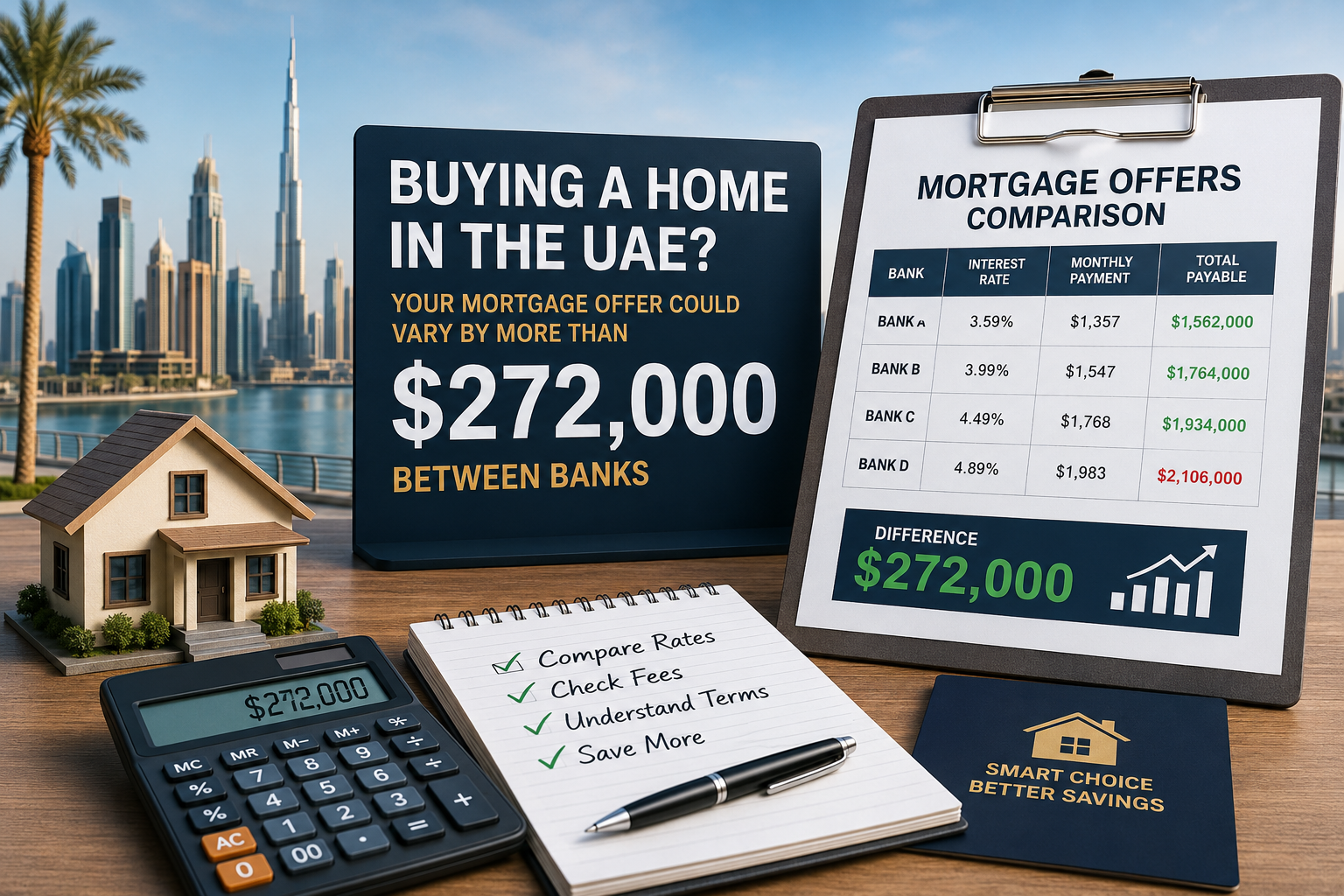
Buying a home in the UAE is one of the biggest financial decisions many residents and international investors will make. While property price, location and down payment usually receive the most attention, the UAE mortgage offer can have an equally significant impact on the total cost of ownership.
Different banks can assess the same borrower and property in very different ways. Mortgage rates, loan-to-value ratios, processing fees, fixed-rate periods, salary-transfer requirements and post-fixed rates can all change the amount a buyer ultimately pays.
This is why comparing several UAE home loan offers before committing to a lender can potentially save hundreds of thousands of dirhams over the life of a mortgage.
Why UAE Mortgage Offers Can Differ So Much
A mortgage is not simply about finding the bank advertising the lowest interest rate.
Banks assess borrowers according to their own lending criteria and risk appetite. Factors such as income, employer, nationality, residency status, credit history, existing liabilities, property value, loan size and whether the applicant transfers their salary can influence the final offer.
Current UAE mortgage comparisons show that headline rates can vary considerably between lenders and products. For example, June 2026 market data showed conventional mortgage rates ranging from around 3.78% upwards, while Islamic home-finance products were also competitively priced.
The difference of even a few tenths of a percentage point can become substantial when applied to a large mortgage over many years.
The $272,000 Difference: Why the Headline Matters
The $272,000 figure is roughly equivalent to AED 1 million, making it a useful way to understand the scale of the potential financial difference involved in UAE property financing.
However, buyers should not interpret the figure as meaning that every borrower will automatically save or lose $272,000 by choosing one bank over another. The actual difference depends on the loan amount, interest rate, tenure, fees and the period for which the mortgage is held.
The key lesson is that small differences in mortgage pricing can produce large differences in lifetime financing costs.
For example, market analysis indicates that an additional 0.50 percentage point on a AED 2 million mortgage could translate into roughly AED 150,000 to AED 250,000 of additional interest over a 25-year term, depending on the precise structure and assumptions.
That makes mortgage comparison an essential part of the UAE home-buying process.
UAE Mortgage Rates in 2026
The UAE mortgage market remains competitive, with banks offering different conventional and Islamic financing products.
Recent market comparisons have reported some conventional fixed rates below 4%, while Islamic home-finance rates have also been available around the high-3% range for certain qualifying borrowers.
However, these figures should be treated as indicative starting points rather than guaranteed offers.
A bank’s advertised rate may apply only to a specific borrower profile, loan-to-value ratio, property value, employment category or salary-transfer arrangement. Your personalised mortgage offer can therefore be higher or lower than the headline rate.
The Lowest Mortgage Rate Is Not Always the Cheapest Mortgage
One of the biggest mistakes UAE property buyers make is choosing a mortgage based entirely on the initial interest rate.
A mortgage advertised at 3.79% may appear more attractive than one at 3.99%. But if the first product has a higher reversion margin, larger processing fee or more expensive insurance, the difference in total cost may be much smaller than expected.
Likewise, a mortgage with a slightly higher initial rate could become cheaper over the long term if it offers a lower post-fixed margin and fewer fees.
Current UAE mortgage analysis highlights this distinction: the initial fixed rate is only one component of the overall financing cost, while the reversion rate, processing fee and early-settlement conditions can significantly influence the final cost.
What Is the Reversion Rate?
The reversion rate is the rate that generally applies after the initial fixed-rate period ends.
Many UAE mortgages eventually move to a variable structure linked to EIBOR, plus a fixed bank margin.
For example, a mortgage could start with a fixed rate for two or three years before moving to a rate calculated using EIBOR plus the lender’s agreed margin.
This is why buyers should ask:
“What will my rate become after the fixed period?”
rather than only asking:
“What is your lowest mortgage rate?”
A low introductory rate can become much less attractive if the follow-on margin is significantly higher.
EIBOR and UAE Mortgage Costs
The Emirates Interbank Offered Rate (EIBOR) is an important benchmark for the UAE lending market.
Variable-rate mortgages can be linked to an EIBOR benchmark plus a bank-specific margin. Consequently, changes in market interest rates can affect future mortgage payments.
Recent 2026 mortgage comparisons have placed three-month EIBOR around the high-3% range, although the benchmark changes over time.
For buyers considering a variable or partially fixed mortgage, understanding EIBOR is therefore essential.
How Your Personal Profile Affects a UAE Mortgage Offer
Two people buying similar properties can receive different mortgage offers because banks evaluate borrowers individually.
Salary and Employment
A stable salary and strong employment profile can improve a borrower’s attractiveness to lenders.
Banks may also differentiate between government employees, multinational-company employees, private-sector workers and self-employed applicants.
Salary Transfer
Some banks offer preferential pricing when borrowers transfer their salary to the lending bank.
Recent UAE mortgage comparisons show that salary-transfer arrangements can influence both pricing and eligibility.
However, buyers should calculate whether the rate discount is actually worth changing their banking relationship.
Credit History
A strong credit profile can improve the likelihood of receiving competitive financing.
Banks use credit information alongside income, liabilities and other financial information when assessing an application.
Existing Debt
Credit cards, personal loans, car finance and other liabilities can affect how much a borrower is able to borrow.
A buyer who qualifies for a certain property price in theory may receive a lower mortgage amount after the bank evaluates existing monthly obligations.
Residency Status
UAE residents and non-residents can face different mortgage terms.
Non-resident borrowers generally have fewer financing options and may face lower loan-to-value ratios and higher pricing than UAE residents.
How Much Can You Borrow for a UAE Property?
Mortgage affordability is influenced by the property’s value, the buyer’s profile and applicable regulatory limits.
For an eligible UAE resident buying a first residential property below AED 5 million, market guidance commonly references financing of up to 80% of the property’s value, subject to the bank’s assessment and applicable Central Bank rules.
That means a buyer purchasing a AED 2 million property could potentially finance up to AED 1.6 million and provide AED 400,000 as a down payment, before accounting for transaction costs.
The actual amount approved can be lower depending on the applicant and property.
Why the Loan-to-Value Ratio Matters
The loan-to-value (LTV) ratio represents the percentage of the property’s value financed by the bank.
A lower LTV means the buyer contributes more equity but may also receive more favourable financing terms in some circumstances.
For buyers, comparing LTV requirements is particularly important because a bank offering a slightly lower mortgage rate may require a larger down payment.
That can create a trade-off between upfront cash requirements and long-term financing costs.
Mortgage Fees Can Add Thousands of Dirhams
Interest or profit rate is only one part of the cost.
Potential mortgage-related expenses can include processing fees, property valuation charges, insurance and early-settlement costs.
Some banks may waive or discount certain fees during promotional campaigns, while others may incorporate different costs into the mortgage package.
For this reason, buyers should compare the total cost of financing, not simply the advertised rate.
Processing Fees: The Hidden Cost Buyers Often Miss
Processing fees can be particularly important for large mortgages because they may be calculated as a percentage of the loan amount.
A seemingly small percentage can therefore translate into thousands of dirhams.
Current UAE mortgage comparisons note that processing fees can reach around 1% of the mortgage in some products, although promotions and individual offers can reduce or waive them.
A buyer should therefore request a complete Key Facts Statement or equivalent financing documentation and review every charge before accepting an offer.
Fixed vs Variable UAE Mortgage Rates
Buyers also need to decide how much interest-rate certainty they want.
A fixed-rate mortgage provides greater payment certainty during the fixed period. This can make household budgeting easier because the financing rate does not change during that period.
A variable-rate mortgage, meanwhile, can move with the underlying benchmark and the bank’s agreed margin.
Neither structure is automatically better for every buyer.
The right choice depends on expectations for interest rates, investment horizon, risk tolerance and how long the buyer expects to keep the mortgage.
Should UAE Buyers Get Multiple Mortgage Offers?
Yes. Comparing multiple lenders can be one of the most effective ways to improve financing terms.
Rather than accepting the first offer from a bank, buyers can obtain pre-approvals from several lenders and compare them.
Recent UAE mortgage research specifically recommends obtaining multiple pre-approvals and using competing offers when negotiating rates and fees.
A competing offer can give the borrower greater negotiating power because banks may be willing to improve pricing to win the business.
How to Compare UAE Mortgage Offers
A proper comparison should include more than the interest rate.
Look at the initial rate, fixed period, reversion rate, EIBOR margin, loan amount, maximum LTV, processing fee, valuation fee, insurance cost, salary-transfer requirement, early-settlement charge and monthly repayment.
It is also important to consider whether the bank’s offer applies to your exact property and borrower profile.
A mortgage comparison table can make these differences much easier to identify.
Why Mortgage Pre-Approval Matters Before Buying a UAE Home
Getting pre-approved can help buyers understand their realistic purchasing power before signing a property agreement.
A pre-approval provides an indication of how much financing a bank may be willing to provide based on the borrower’s financial profile.
However, buyers should remember that mortgage pre-approval does not necessarily guarantee final financing for every property.
The bank may still need to value the property and review the specific transaction before issuing final approval.
Don’t Let the Mortgage Determine Your Property Budget Alone
Just because a bank is willing to lend a certain amount does not necessarily mean the buyer should borrow the maximum available.
Homeownership involves more than the mortgage instalment.
Buyers should budget for the down payment, property registration and transfer costs, agency fees where applicable, valuation, insurance, service charges and ongoing maintenance.
For Dubai property buyers, these additional costs can materially affect the amount of cash required at completion.
UAE Mortgage Comparison Is Becoming More Important
The growing number of mortgage products available in the UAE means buyers have more choice, but it also makes the decision more complicated.
Major lenders active in the UAE mortgage market include Emirates NBD, FAB, ADCB, HSBC, Standard Chartered, Mashreq and RAKBANK, alongside Islamic-finance providers such as Dubai Islamic Bank, Emirates Islamic and Abu Dhabi Islamic Bank.
Each bank has its own lending strategy, product structure and eligibility requirements.
Consequently, there is no universal “best UAE mortgage bank” for every buyer.
What Buyers Should Do Before Choosing a Bank
The smartest approach is to compare financing before becoming financially committed to a property.
Start by calculating your available down payment and maximum comfortable monthly payment. Then obtain mortgage offers from several lenders.
Compare the complete terms rather than focusing on one attractive headline number.
If one bank offers a better rate, use that offer when negotiating with another lender. Buyers may also be able to negotiate processing fees, valuation charges or other costs.
The Bottom Line for UAE Homebuyers
The cost of a UAE mortgage can vary dramatically between banks, and the difference becomes much more significant when a large loan is held over many years.
A difference of only a few basis points may look insignificant on a bank’s rate sheet, but the cumulative effect can amount to tens or even hundreds of thousands of dirhams.
The reported $272,000 potential gap is therefore a powerful reminder that choosing a mortgage should receive as much attention as choosing the property itself.
For anyone planning to buy a home in the UAE, the best strategy is to compare multiple mortgage offers, understand the fixed and reversion rates, review all fees, check the LTV and calculate the total financing cost before signing.
The cheapest-looking mortgage is not necessarily the cheapest mortgage. The best deal is the one that offers the right combination of rate, fees, flexibility, loan amount and long-term affordability for your financial profile.
Frequently Asked Questions About UAE Mortgages
Can mortgage rates vary between UAE banks?
Yes. Different banks use different pricing models, risk assessments, promotions and eligibility criteria. Consequently, two borrowers with similar circumstances can receive different offers.
What is the best mortgage rate in the UAE in 2026?
There is no single rate available to every buyer. Recent market comparisons have reported competitive conventional rates below 4% and Islamic home-finance rates around the high-3% range for certain qualifying profiles.
How much deposit do I need to buy a home in Dubai?
The required deposit depends on the buyer’s nationality, residency status, property value and whether it is a first or subsequent property. Eligible expatriate residents can commonly access up to 80% financing on qualifying first homes below AED 5 million, subject to bank approval.
Does salary transfer reduce UAE mortgage rates?
It can. Some banks offer preferential pricing or other benefits to customers who transfer their salary, although the exact discount varies between lenders and products.
Should I compare several UAE banks before taking a mortgage?
Yes. Comparing several offers can reveal differences in interest rates, fees, LTV, repayment terms and post-fixed rates. It can also strengthen your negotiating position.
What is EIBOR and why does it matter?
EIBOR is an important UAE interbank benchmark used in pricing certain variable-rate financial products. A mortgage may revert to an EIBOR-based rate plus a fixed bank margin after its initial fixed period.
Is a low introductory mortgage rate always better?
No. Buyers should also examine the reversion rate, fixed period, fees, insurance and early-settlement conditions. A lower introductory rate can become less attractive if the follow-on pricing is expensive.
Can foreigners get mortgages in the UAE?
Yes. UAE residents and some non-resident foreign buyers can obtain property financing, although eligibility, LTV limits and pricing can differ significantly from those available to UAE residents.
What is the difference between conventional and Islamic home finance?
Conventional mortgages generally charge interest, while Islamic home finance uses structures such as Murabaha or Ijarah and charges a profit or rental component instead. Buyers should compare the total cost and contractual terms rather than looking only at the terminology.
Can I negotiate my UAE mortgage rate?
Potentially, yes. Banks have different pricing flexibility, and competing pre-approval offers can strengthen a buyer’s negotiating position. Recent mortgage guidance recommends comparing offers and negotiating both rates and processing fees.