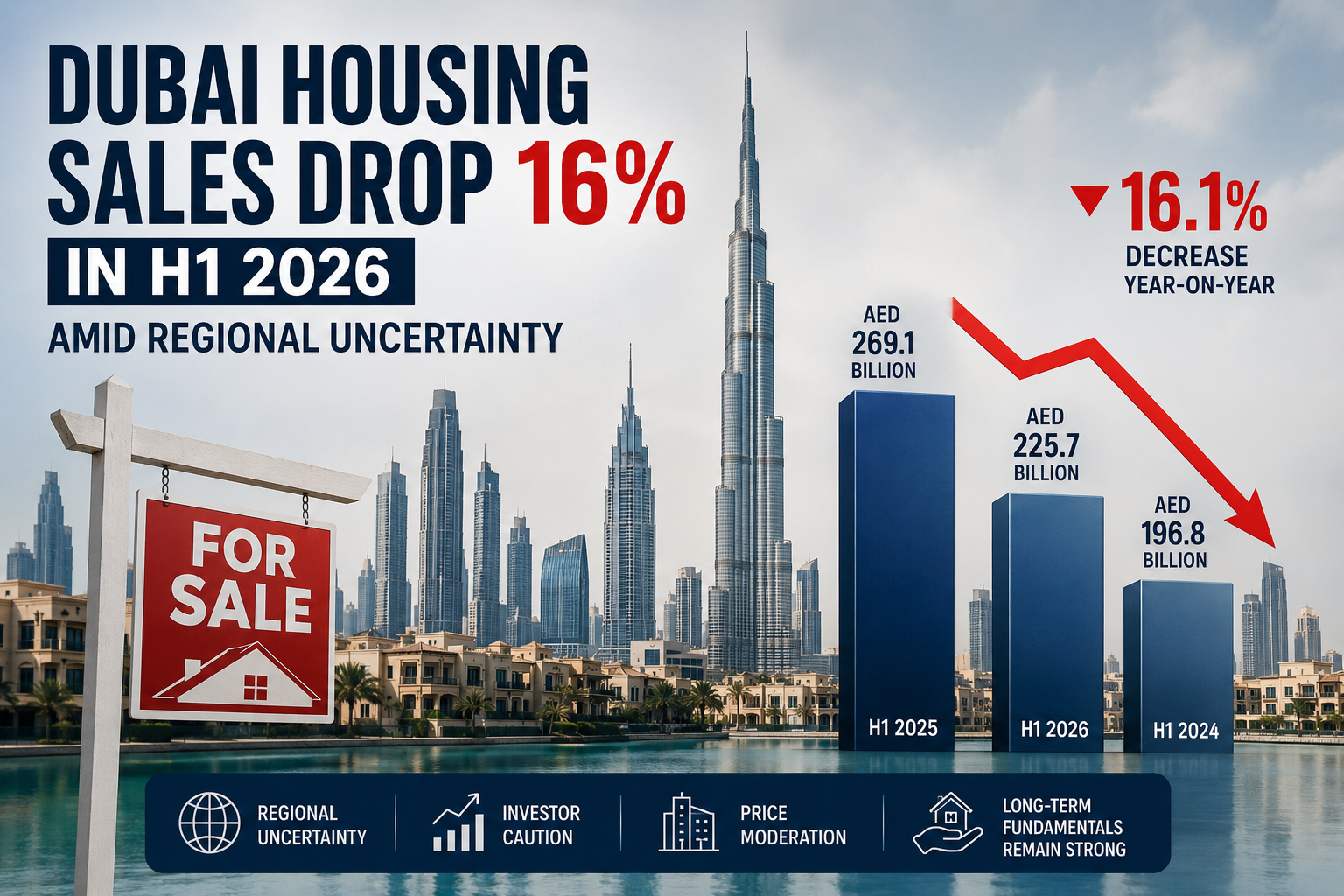
Dubai’s residential real estate market has experienced its first significant slowdown after several years of exceptional growth. According to the latest market data, housing sales during the first half of 2026 declined by 16.1% year-on-year, raising questions about whether the emirate’s property boom is finally cooling or simply entering a healthier phase of sustainable growth.
Despite the decline in transaction value, market analysts believe the slowdown reflects short-term geopolitical uncertainty rather than a structural weakness in Dubai’s economy. The emirate continues to attract international investors thanks to its tax-friendly environment, strong infrastructure, and long-term development strategy.
Dubai Real Estate Records AED 225.7 Billion in Housing Sales
The latest report shows that Dubai recorded AED 225.7 billion in residential property transactions during the first six months of 2026. While this represents a 16.1% decline compared to AED 269.1 billion during the same period in 2025, transaction values remain substantially higher than the AED 196.8 billion recorded in H1 2024.
This comparison highlights an important point: although activity has slowed from last year’s record-breaking levels, Dubai’s property market remains considerably stronger than it was only two years ago.
What Caused the Decline in Housing Sales?
The primary factor behind the slowdown has been increasing geopolitical uncertainty across the Middle East. Regional tensions affected investor confidence during the first half of the year, leading many buyers to delay purchasing decisions while monitoring economic and political developments.
International investors, who represent a significant portion of Dubai’s luxury property market, generally adopt a cautious approach during periods of uncertainty. Rather than withdrawing completely, many have postponed transactions until market conditions become more predictable.
Property Prices Also Show Signs of Moderation
Alongside lower transaction volumes, residential property prices have softened compared to the rapid appreciation experienced over the previous three years.
Industry reports indicate that average residential prices declined by approximately 7% compared to recent peaks, reflecting a more balanced relationship between supply and demand. However, pricing varies significantly by location, with premium waterfront communities and luxury developments continuing to outperform the broader market.
Rather than indicating a market crash, analysts view the adjustment as a normal correction following several years of exceptional price growth.
Luxury Property Continues to Attract Global Buyers
Although the overall market has slowed, demand for high-end residential properties remains relatively resilient.
International buyers continue to show interest in luxury villas, branded residences, waterfront apartments, and ultra-premium developments across Palm Jumeirah, Dubai Hills Estate, Dubai Marina, Dubai Islands, and Business Bay. Wealthy investors continue to view Dubai as a safe destination for long-term capital preservation and lifestyle investment.
This trend demonstrates that while mid-market demand may fluctuate, Dubai’s luxury segment continues to benefit from strong international appeal.
Government Policies Continue Supporting Investor Confidence
Dubai’s long-term investment fundamentals remain unchanged despite recent market volatility.
Several factors continue to support foreign investment, including long-term residency programmes, business-friendly regulations, world-class infrastructure, zero annual property tax, and high rental yields compared to many mature global markets.
These structural advantages continue attracting entrepreneurs, multinational executives, family offices, and international investors seeking stable investment opportunities.
Regional Tensions Have Influenced Financial Markets
The impact of geopolitical developments has extended beyond real estate into financial markets.
Dubai’s stock market experienced notable declines during periods of escalating regional tensions, particularly as investors reacted to concerns surrounding energy supplies, shipping routes, and broader economic uncertainty. Financial and property-related stocks recorded some of the largest losses during this period.
While these developments affected short-term sentiment, analysts generally expect markets to stabilise as geopolitical conditions improve.
Is Dubai’s Property Boom Over?
Many investors are asking whether the latest figures signal the end of Dubai’s remarkable real estate expansion.
Current evidence suggests otherwise.
Instead of a market collapse, analysts describe the current environment as a healthy market correction following multiple years of extraordinary growth. Rapid price appreciation during previous years naturally created expectations of moderation, particularly as new residential supply enters the market.
Demand remains supported by population growth, international migration, corporate expansion, tourism, and continued foreign direct investment.
Opportunities for Property Investors
Periods of slower market activity often create attractive opportunities for long-term investors.
With less competition and more negotiation flexibility, buyers may secure better prices, improved payment plans, or premium units that were previously difficult to acquire during peak market conditions.
Investors focusing on quality locations, reputable developers, and long-term rental demand may find the current market environment favourable compared with the intense competition experienced during previous years.
Outlook for the Second Half of 2026
The direction of Dubai’s housing market during the remainder of 2026 will depend on several important factors.
Improving regional stability, continued economic diversification, population growth, infrastructure investment, and renewed international investor confidence could support a recovery in transaction volumes.
At the same time, developers continue launching new projects, demonstrating confidence in Dubai’s long-term economic outlook despite temporary market adjustments.
Conclusion
Dubai’s housing sales declined by 16% during the first half of 2026, reflecting the impact of regional uncertainty on investor sentiment rather than a deterioration of the emirate’s underlying economic strength. Transaction values remain historically high, luxury demand continues to perform well, and Dubai’s long-term investment fundamentals remain intact.
For investors, the current market may represent a strategic opportunity rather than a warning sign. As geopolitical risks ease and confidence returns, Dubai is well positioned to maintain its status as one of the world’s leading real estate investment destinations.
Frequently Asked Questions
Why did Dubai housing sales fall by 16% in H1 2026?
The decline was largely driven by regional geopolitical uncertainty, which caused many investors to delay purchasing decisions despite Dubai’s strong long-term economic fundamentals.
How much were Dubai housing sales worth in H1 2026?
Dubai recorded approximately AED 225.7 billion in residential property transactions during the first half of 2026.
Are Dubai property prices falling?
Property prices have moderated from recent highs, with some reports indicating declines of around 4–7% in certain segments. However, prime and luxury locations continue to demonstrate resilience.
Is this a good time to invest in Dubai real estate?
Many market experts consider the current slowdown a market correction rather than a crash. Long-term investors may benefit from improved pricing, greater choice, and favourable payment plans while Dubai’s economic fundamentals remain strong.