The Dubai property market continues to outperform many of the world’s leading real estate destinations in 2026. While global property markets face challenges such as high interest rates, inflation, and slower economic growth, Dubai has maintained remarkable momentum through strong investor confidence, government reforms, infrastructure expansion, and sustained population growth. Residential, commercial, waterfront, and luxury developments continue attracting buyers from Europe, Asia, the Middle East, Africa, and North America.
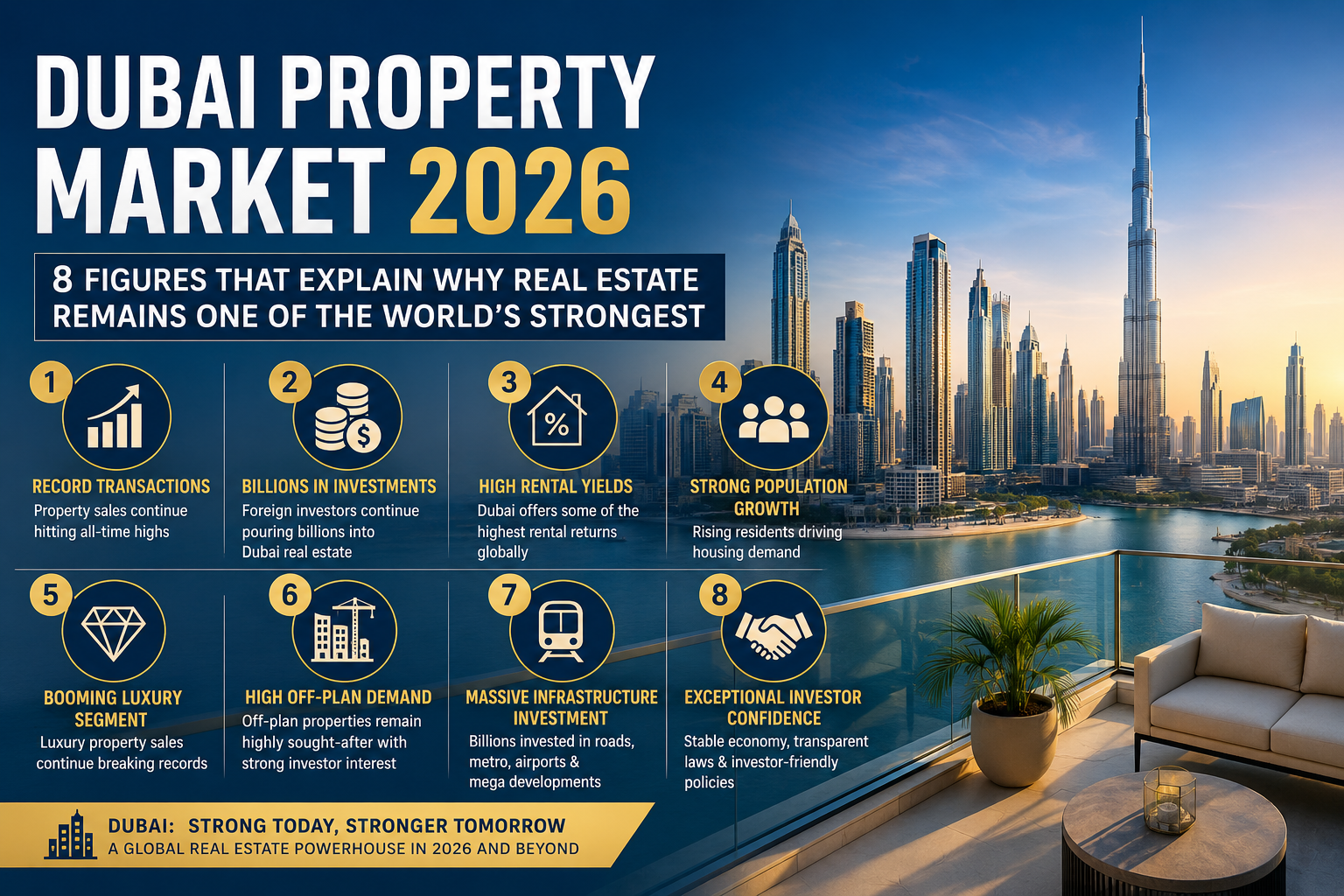
What separates Dubai from many international markets is that its success is not driven by speculation alone. Instead, the market is supported by measurable economic indicators, rising demand, limited premium inventory in prime districts, investor-friendly regulations, and a diversified economy. The following eight figures provide a clear picture of why Dubai remains one of the world’s strongest real estate markets in 2026.
1. Property Transactions Continue to Reach Record Levels
One of the strongest indicators of market health is transaction volume. Throughout 2026, Dubai has continued recording exceptionally high numbers of residential and commercial property sales across off-plan and ready markets.
Thousands of transactions are completed every month, demonstrating sustained buyer confidence rather than temporary speculative activity. Both first-time investors and institutional buyers remain active, while repeat investors continue expanding their property portfolios.
High transaction volumes also reflect the increasing confidence developers have in launching new communities and premium residential projects across the emirate.
2. Billions of Dollars Continue Flowing into Dubai Real Estate
Foreign direct investment remains one of Dubai’s greatest strengths. International buyers continue investing billions of dollars into residential apartments, luxury villas, branded residences, waterfront developments, and commercial assets.
Global investors increasingly view Dubai as a safe destination for capital preservation because of its:
- Political stability
- Business-friendly regulations
- Tax-efficient environment
- Strong legal framework
- Transparent property ownership laws
Investors from the United Kingdom, India, China, Russia, Europe, Saudi Arabia, and other GCC countries continue making Dubai one of the world’s most internationally diverse real estate markets.
3. Rental Yields Continue to Outperform Major Global Cities
Rental returns remain among Dubai’s strongest competitive advantages.
While many mature property markets generate rental yields between 2% and 4%, Dubai frequently offers significantly higher returns depending on location, property type, and management quality.
Popular investment areas continue attracting landlords because demand consistently exceeds available supply in many communities. High rental income combined with long-term capital appreciation makes Dubai particularly attractive for overseas investors seeking balanced investment performance.
4. Population Growth Continues Driving Housing Demand
Dubai’s rapidly expanding population remains one of the biggest drivers of property demand.
The emirate continues welcoming:
- Skilled professionals
- Entrepreneurs
- Digital nomads
- Corporate executives
- High-net-worth individuals
- International families
- Remote workers
Government initiatives including long-term residency options, business-friendly policies, Golden Visa programmes, and expanding employment opportunities continue encouraging more residents to relocate permanently.
As the population increases, demand rises across apartments, villas, townhouses, and premium communities.
5. Luxury Property Sales Continue Breaking Records
Dubai has firmly established itself as one of the world’s leading luxury real estate destinations.
Ultra-high-net-worth buyers continue purchasing waterfront villas, branded residences, penthouses, golf communities, and beachfront estates at record values.
Prime areas including Palm Jumeirah, Dubai Hills Estate, Emirates Hills, Downtown Dubai, Dubai Marina, and Dubai Islands continue attracting international wealth because they offer:
- Premium waterfront living
- World-class infrastructure
- Strong security
- International schools
- Luxury retail
- Excellent connectivity
Luxury transactions continue representing an increasingly important segment of Dubai’s overall property market.
6. Off-Plan Developments Remain Highly Popular
Dubai’s off-plan market continues performing exceptionally well in 2026.
Flexible payment plans, modern community planning, smart home technology, attractive pricing, and strong developer reputations continue encouraging investors to purchase before project completion.
Leading developers consistently launch new projects that sell significant inventories within days because demand continues exceeding available premium supply.
Off-plan investments also provide buyers with opportunities for long-term capital appreciation before project delivery.
7. Infrastructure Investment Continues Supporting Long-Term Growth
Another major figure supporting Dubai’s property market is the billions invested in infrastructure.
Major investments continue expanding:
- Metro networks
- Roads
- Airports
- Waterfront developments
- Tourism projects
- Mixed-use communities
- Smart city initiatives
Large-scale infrastructure improvements directly increase surrounding property values by improving accessibility, lifestyle quality, and commercial activity.
Government-backed master planning ensures new developments are integrated with transportation, education, healthcare, entertainment, and business districts.
8. Investor Confidence Remains Exceptionally High
Perhaps the most important figure cannot be measured by one statistic alone—it is investor confidence.
Dubai continues ranking among the world’s preferred destinations for international property investment because investors trust its long-term vision.
Confidence is supported by:
- Stable governance
- Transparent regulations
- Strong economic diversification
- Tourism growth
- Business expansion
- Long-term residency programmes
- Continuous urban development
Unlike markets heavily dependent on a single economic sector, Dubai benefits from finance, logistics, aviation, tourism, technology, manufacturing, and international trade, creating a resilient economic foundation for real estate.
Why Dubai Continues to Outperform Global Property Markets
Several structural advantages continue distinguishing Dubai from competing global cities.
Its tax-efficient environment, strategic geographic location, investor-friendly policies, modern infrastructure, world-class lifestyle, and diversified economy create a combination that few international markets can match.
Developers continue launching innovative projects while government authorities maintain policies encouraging sustainable growth rather than uncontrolled expansion. This balanced approach has helped Dubai avoid many of the challenges affecting other international property markets.
Furthermore, increasing demand from global investors seeking wealth preservation, lifestyle relocation, and business opportunities continues supporting long-term property values.
Outlook for Dubai Property Market Beyond 2026
Industry experts generally expect Dubai’s property sector to remain resilient beyond 2026. Continued infrastructure expansion, population growth, technological innovation, and international investment are likely to support steady demand across multiple property segments.
Although individual market cycles and price adjustments are natural in any real estate market, Dubai’s long-term fundamentals remain exceptionally strong. Demand for quality residential developments, luxury homes, commercial spaces, and branded residences is expected to continue as the emirate strengthens its position as a global financial, tourism, and investment hub.
For investors seeking stable returns, capital appreciation, and access to one of the world’s fastest-growing metropolitan economies, Dubai continues to present compelling opportunities across both established and emerging communities.
Conclusion
The Dubai property market in 2026 is supported by more than optimism—it is backed by measurable indicators including record transaction volumes, sustained foreign investment, attractive rental yields, strong population growth, thriving luxury sales, resilient off-plan demand, continuous infrastructure investment, and exceptional investor confidence. Together, these eight figures explain why Dubai remains one of the world’s strongest and most attractive real estate markets, offering long-term opportunities for investors, homeowners, and businesses alike.
Frequently Asked Questions (FAQs)
Why is the Dubai property market so strong in 2026?
Dubai benefits from strong foreign investment, rapid population growth, high rental yields, government reforms, modern infrastructure, and a diversified economy, all of which support sustained real estate demand.
Is Dubai still a good place to invest in property?
Yes. Dubai continues to attract global investors due to its tax-efficient environment, investor-friendly regulations, competitive rental returns, and long-term capital appreciation potential.
Which property types are most popular in Dubai?
Apartments, waterfront villas, branded residences, luxury penthouses, townhouses, and off-plan developments remain among the most sought-after property types in 2026.
Why are international investors choosing Dubai?
International buyers value Dubai for its economic stability, transparent legal system, strategic location, high quality of life, business opportunities, and strong real estate returns.
Will Dubai property prices continue to rise after 2026?
While all real estate markets experience normal cycles, Dubai’s long-term fundamentals—including infrastructure investment, population growth, and international demand—suggest continued resilience and growth potential over the coming years.