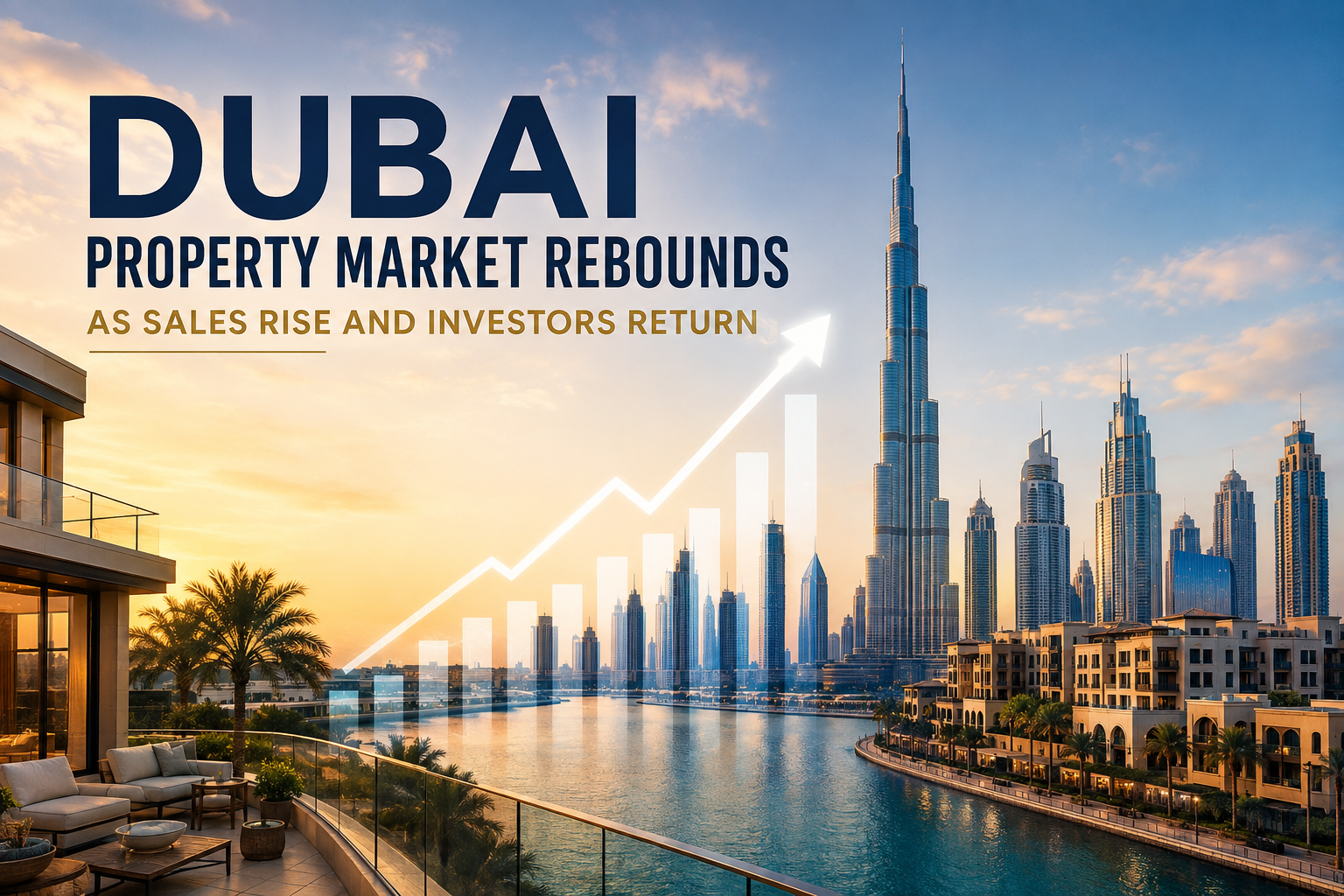
Dubai’s property market is showing renewed momentum as sales activity strengthens, investor confidence improves, and demand for residential and luxury real estate continues to attract buyers from around the world. The latest recovery signals suggest that Dubai remains one of the most closely watched real estate markets globally, supported by population growth, international investment, economic diversification and strong demand for quality housing.
The Dubai property market rebound is particularly important for investors evaluating opportunities in apartments, villas, branded residences, waterfront properties and off-plan developments. Rising transactions indicate that buyers are continuing to view Dubai real estate as both a lifestyle asset and a long-term investment opportunity.
Dubai Property Market Shows Signs of a Strong Recovery
Dubai’s real estate sector has experienced significant transformation over recent years. After periods of changing interest rates, affordability concerns and shifting global economic conditions, the market has demonstrated considerable resilience.
The latest increase in property sales reflects renewed confidence among both local and international investors. Buyers are returning to the market with greater interest in well-located properties, established communities and projects offering strong rental potential.
This recovery is not limited to one segment. Demand is being seen across apartments, villas, townhouses, luxury homes and investment-focused developments, although performance varies considerably by location and property type.
Why Are Investors Returning to Dubai Real Estate?
Several structural factors are supporting the return of investors to the Dubai real estate market.
Dubai continues to attract entrepreneurs, professionals, high-net-worth individuals and international businesses. Population growth creates additional demand for residential accommodation, while the city’s position as a regional business and tourism hub supports both residential and commercial property activity.
The UAE’s relatively investor-friendly environment is another important factor. International buyers can access a wide range of freehold properties, while Dubai offers established infrastructure, international connectivity and a highly developed property ecosystem.
For investors, these factors create a market where capital appreciation and rental income can potentially work together, depending on the property, location, purchase price and market conditions.
Rising Property Sales Signal Stronger Buyer Confidence
One of the clearest indicators of a market recovery is an increase in transaction activity. When buyers become more confident, they are more willing to commit capital to property purchases rather than waiting for further market corrections.
The rise in Dubai property sales suggests that investors increasingly believe the market can continue to deliver attractive opportunities despite higher borrowing costs and broader economic uncertainty.
Transaction growth also benefits developers, brokers, property managers and related businesses across the real estate ecosystem. Stronger sales can encourage developers to launch new projects and expand existing communities.
However, rising sales should not automatically be interpreted as evidence that every Dubai property will appreciate. Investors still need to assess location, developer reputation, service charges, rental demand, construction quality and exit liquidity.
International Investors Remain a Major Force
International investment has become one of the defining characteristics of Dubai’s property sector.
Investors from Europe, Asia, the Middle East, Africa and other regions continue to consider Dubai real estate because of its international business environment and established luxury property market.
For overseas buyers, Dubai offers a broad selection of investment options. These range from relatively affordable apartments to high-value villas, waterfront residences and branded luxury developments.
The international nature of demand also gives Dubai a degree of diversification that many purely domestic property markets do not have. Different investor groups may enter the market at different stages of the economic cycle, helping maintain transaction activity.
Luxury Real Estate Continues to Attract Global Wealth
Dubai’s luxury property market remains an important component of the broader recovery.
High-net-worth buyers are increasingly interested in properties that offer privacy, premium amenities, waterfront locations and distinctive architectural design. Areas such as Palm Jumeirah, Emirates Hills, Downtown Dubai, Dubai Marina and Dubai Hills Estate continue to receive attention from luxury buyers and investors.
Branded residences have also become increasingly prominent. These developments combine residential property with hospitality or luxury-brand positioning, creating an additional layer of appeal for international buyers.
The luxury segment can behave differently from the mass residential market, so investors should evaluate it independently rather than assuming that all Dubai properties follow the same price trends.
Off-Plan Property Remains Popular
The Dubai off-plan property market continues to play an important role in overall sales activity.
Off-plan developments can attract buyers through structured payment plans, new construction, modern amenities and potentially lower entry prices compared with completed properties in the same area.
Developers are also launching projects in emerging communities where infrastructure and surrounding amenities are expected to improve over time.
Nevertheless, off-plan property carries its own considerations. Investors should examine the developer’s track record, construction timeline, escrow arrangements, payment structure, expected completion date and comparable prices before committing capital.
Ready Properties Offer Immediate Rental Potential
While off-plan property attracts investors seeking future growth, ready properties remain attractive to buyers who want immediate use or rental income.
A completed apartment or villa can potentially be rented soon after purchase, allowing investors to assess actual rental demand rather than relying entirely on forecasts.
This makes Dubai rental property investment particularly relevant for investors who prioritise cash flow. However, rental yields vary significantly depending on the community, property size, purchase price, furnishing level and tenant demand.
Investors should calculate net rental returns after considering service charges, maintenance, management fees, vacancy periods and other ownership expenses.
Dubai Population Growth Supports Housing Demand
Population growth is another fundamental factor behind Dubai’s property market performance.
As more professionals, entrepreneurs and families relocate to Dubai for employment, business and lifestyle opportunities, demand for housing naturally increases.
The city has also continued to develop new residential communities designed for different segments of the population. From affordable apartments to large family villas and luxury residences, the expanding housing supply gives buyers a wide range of options.
For investors, population growth is particularly important because sustainable housing demand can provide support for both rental markets and property transactions.
Government Policies Strengthen Dubai’s Investment Appeal
Dubai’s real estate market also benefits from policies designed to attract international capital, entrepreneurs and long-term residents.
The UAE’s residency programmes, including long-term residency options for eligible individuals, have helped strengthen the connection between property ownership and long-term relocation.
For some investors, purchasing property is no longer simply a financial decision. It can also form part of a broader strategy involving residence, business expansion, family relocation and international mobility.
This combination of investment and lifestyle considerations continues to distinguish Dubai from many traditional property markets.
What Areas Are Investors Watching?
Location remains one of the most important factors in determining the performance of Dubai real estate.
Established districts with strong infrastructure, transport connections, retail facilities, schools and leisure amenities tend to attract consistent demand.
Downtown Dubai and Dubai Marina remain internationally recognised destinations, while communities such as Dubai Hills Estate, Dubai Creek Harbour, Jumeirah Village Circle and Dubai South continue to attract investors looking for different price points and growth opportunities.
Emerging areas may offer greater potential for future development, but they can also involve greater uncertainty. Investors should therefore consider infrastructure delivery, planned developments, accessibility and future supply before purchasing.
Rental Demand Remains an Important Investment Driver
Dubai’s strong rental market is another reason investors are returning.
A growing population, international workforce and temporary residents create continuous demand for rental accommodation. Short-term rental demand from tourists and business travellers can also influence selected locations.
However, investors should distinguish between gross rental yield and actual net returns. A property advertising an attractive gross yield may produce a considerably lower net return after operating costs.
A professional investment analysis should therefore include purchase costs, financing expenses, service charges, maintenance, property management, vacancy assumptions and taxes or fees applicable to the investor.
Is Dubai Property Still a Good Investment?
Dubai property can remain an attractive investment for buyers with appropriate risk tolerance and a long-term strategy, but there is no universal answer.
The market contains thousands of properties with different price levels, rental yields, developers, locations and future growth prospects. A prime waterfront villa and a small apartment in an emerging community should not be treated as identical investments.
Investors should focus on fundamentals rather than market headlines. Location quality, demand, developer credibility, purchase price, rental income, liquidity and long-term development plans are all important considerations.
The current Dubai property market rebound provides opportunities, but disciplined due diligence remains essential.
What Could Influence Dubai Property Prices Next?
Several factors could shape the next phase of the market.
Interest rates and mortgage affordability will influence leveraged buyers. New property supply will affect rental and resale markets in individual communities. Population growth will remain important for residential demand, while global economic conditions can influence international investment flows.
Infrastructure expansion and major development projects may also affect the attractiveness of emerging districts.
For investors, the most important point is that Dubai should be viewed as a collection of different micro-markets rather than one single property market. Performance can vary substantially from one community to another.
Dubai Real Estate Outlook
The outlook for Dubai real estate remains closely connected to the city’s ability to attract people, businesses and investment.
The combination of international demand, population growth, infrastructure development, tourism, business activity and investor-friendly policies continues to support the sector.
The latest increase in sales indicates that investors are once again showing confidence in Dubai property. If demand remains strong while the city’s economy continues expanding, selected residential and luxury segments could remain well positioned.
However, investors should avoid making decisions solely because sales volumes are rising. Successful property investment requires careful research, realistic financial modelling and an understanding of the specific market segment being targeted.
Final Thoughts
The Dubai property market rebound highlights the resilience and international appeal of the city’s real estate sector. Rising sales, returning investors and sustained housing demand are creating a positive environment for both residential buyers and property investors.
Dubai’s combination of global connectivity, luxury development, population growth, infrastructure and investment opportunities continues to make its property market highly competitive internationally.
For investors considering entering the market, the priority should be identifying properties with strong fundamentals rather than simply following short-term price movements. The right location, credible developer, appropriate purchase price and realistic rental expectations can make a significant difference to long-term investment performance.
Frequently Asked Questions About the Dubai Property Market
Is the Dubai property market recovering?
Yes. Rising sales activity and renewed investor participation indicate stronger confidence in several segments of the Dubai real estate market. However, recovery is not uniform across every property type or community.
Why are investors returning to Dubai property?
Investors are attracted by Dubai’s population growth, international business environment, rental demand, infrastructure, freehold ownership opportunities and luxury property market. Long-term residency options can also make property ownership attractive to some international buyers.
Is Dubai real estate a good investment in 2026?
Dubai real estate can offer attractive opportunities in 2026, but investment performance depends on the property, location, purchase price, rental demand and broader market conditions. Investors should conduct detailed due diligence before purchasing.
Is it better to buy off-plan or ready property in Dubai?
It depends on the investor’s objectives. Off-plan properties may offer payment plans and potential capital appreciation, while ready properties can provide immediate occupancy or rental income. Each option has different risks and financial considerations.
Which Dubai property locations are popular with investors?
Popular areas include Downtown Dubai, Dubai Marina, Palm Jumeirah, Dubai Hills Estate, Dubai Creek Harbour, Jumeirah Village Circle and other established or emerging communities. The best location depends on budget, rental strategy and investment objectives.
Can foreigners buy property in Dubai?
Foreign investors can purchase freehold property in designated areas of Dubai. The specific ownership structure and associated costs should be confirmed for the individual property and transaction.
Does Dubai property provide rental income?
Yes. Many Dubai properties are purchased specifically for rental income. Actual rental returns depend on location, property type, purchase price, tenant demand, operating costs and vacancy rates.
What risks should Dubai property investors consider?
Important risks include market volatility, oversupply in certain locations, changing rental conditions, financing costs, service charges, construction delays for off-plan projects and differences in liquidity between property types.
Will Dubai property prices continue to rise?
Future price movements cannot be guaranteed. Dubai’s population growth, economic expansion and international investment may support demand, but interest rates, new supply and global economic conditions can influence prices.
What should I check before buying Dubai property?
Investors should review the property’s location, developer or seller, title and ownership documentation, service charges, comparable sales, rental demand, payment structure, financing costs, expected net yield and potential resale liquidity before completing a purchase.