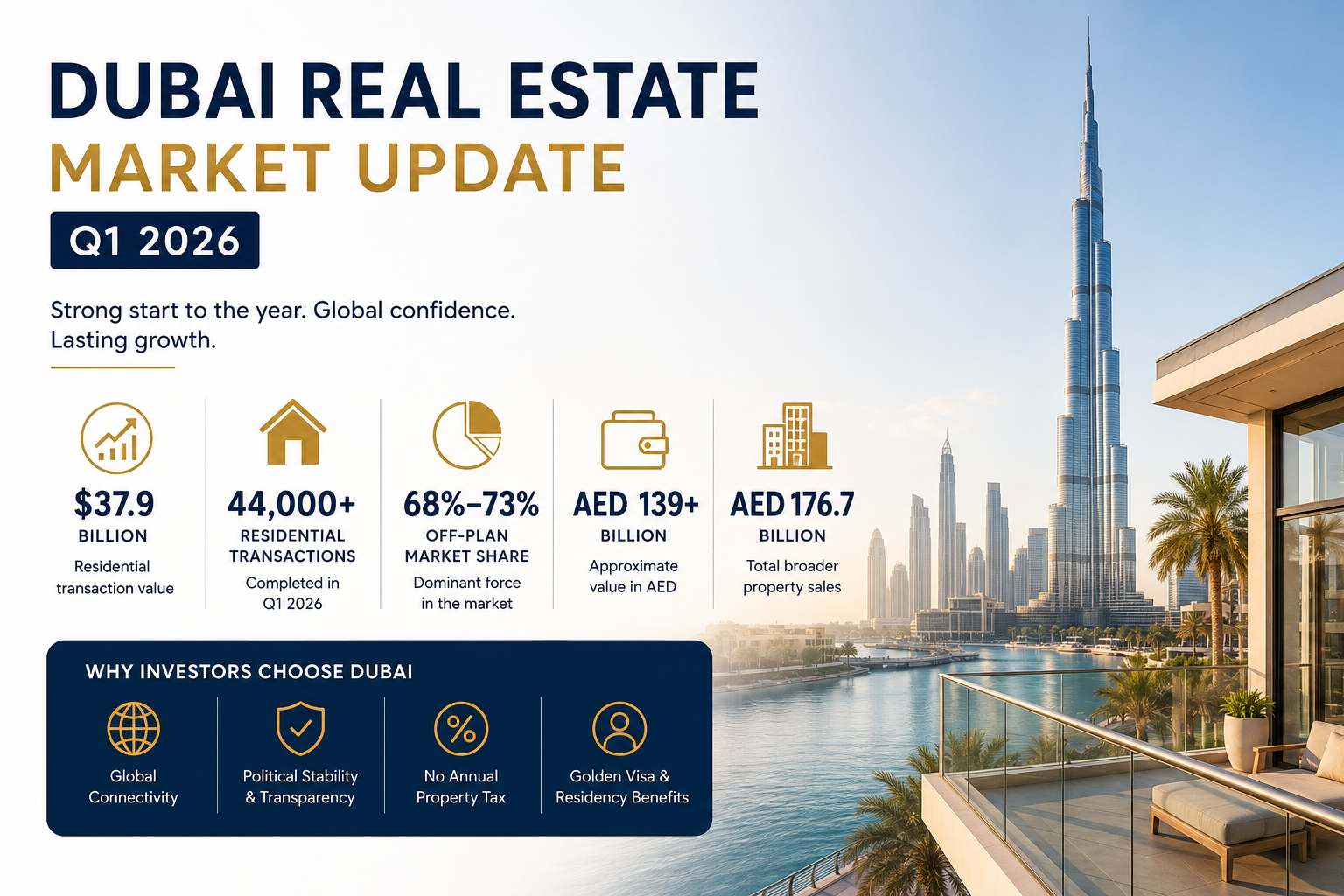
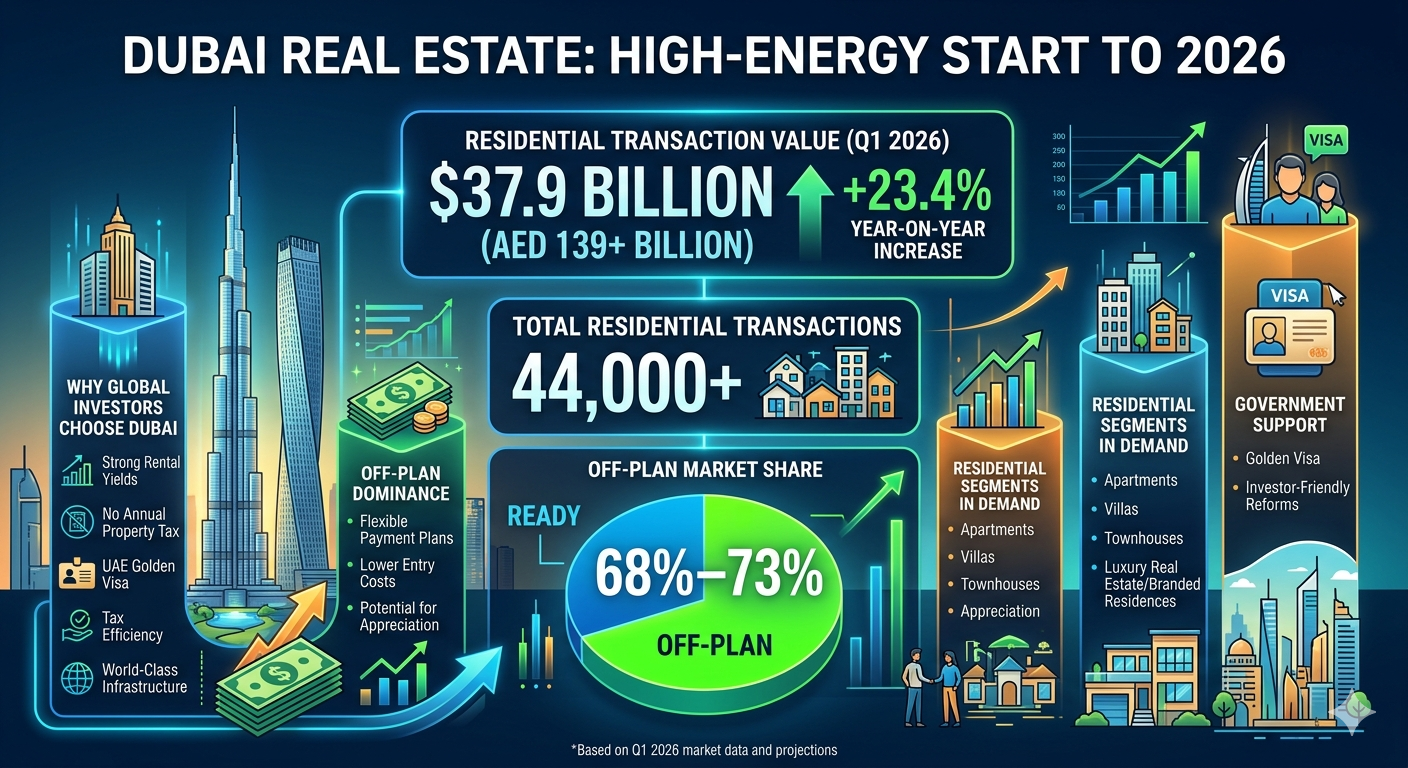
Dubai’s property market has started 2026 with the kind of energy that makes investors around the world stop and pay attention. Residential real estate transactions reached approximately $37.9 billion (around AED 139 billion) in the first quarter, highlighting that demand remains exceptionally strong. Market reports from leading brokerages and consultancies indicate that more than 44,000 residential transactions were completed between January and March, a clear sign that confidence in the emirate remains intact. Off-plan properties—homes purchased before completion—were the dominant force, accounting for roughly 68% to 73% of all residential deals.
This performance is not just about headline numbers. It reflects a deeper story about why Dubai continues to attract international capital. The city offers tax efficiency, world-class infrastructure, political stability, and long-term residency pathways through programs such as the UAE Golden Visa. Investors from Europe, Asia, Africa, and the Middle East see Dubai as a place where wealth can be preserved and grown. While many global property markets are facing affordability pressures and regulatory uncertainty, Dubai has positioned itself as a highly liquid and transparent market. Think of it as a magnet pulling in capital from every direction. Whether buyers are seeking rental income, capital appreciation, or a lifestyle upgrade, Dubai continues to deliver a compelling investment proposition.
Key Q1 2026 Numbers at a Glance
| Metric | Q1 2026 |
|---|---|
| Residential transaction value | $37.9 billion |
| Approximate value in AED | AED 139+ billion |
| Residential transactions | 44,000+ |
| Off-plan market share | 68%–73% |
| Total broader property sales | AED 176.7 billion |
| Year-on-year increase in value | 23.4% |
Why Global Investors Continue to Choose Dubai
Dubai offers something few cities can match: strong rental yields, no annual property tax, a globally connected economy, and an investor-friendly legal framework. Buyers can own freehold property in designated zones and access one of the most diverse tenant markets in the world. Population growth and corporate expansion continue to support both home sales and rental demand, creating a robust foundation for long-term appreciation.
Off-Plan Properties Dominate the Market
Off-plan real estate has become the undisputed engine of Dubai’s growth. These properties allow buyers to secure units at launch prices and pay over several years, often extending beyond handover. In Q1 2026, off-plan transactions represented the majority of all residential sales, reinforcing the market’s confidence in future developments.
Why are investors so enthusiastic about unfinished projects? The answer lies in leverage and timing. Developers frequently release units at prices below comparable ready properties. Buyers can enter the market with manageable installments instead of paying the full amount upfront. If the project is in a high-demand location and delivered by a reputable developer, the value can appreciate significantly before completion. It is similar to boarding a train before it leaves the station rather than trying to jump on after it reaches full speed.
The off-plan segment also reflects confidence in Dubai’s long-term vision. New master-planned communities in areas such as Dubai South, Jumeirah Village Circle, and Business Bay are attracting investors who are focused on future infrastructure, lifestyle amenities, and rental demand. As developers continue launching projects with appealing payment structures, off-plan is likely to remain the dominant force throughout 2026.
What Makes Off-Plan Investments So Attractive
Developers compete aggressively by offering low booking amounts, post-handover payment plans, and waived fees. These incentives lower the barrier to entry and make property ownership accessible to both seasoned investors and first-time buyers.
Flexible Payment Plans and Lower Entry Costs
A buyer can often reserve a unit with a small down payment and spread the remaining cost over several years. This structure preserves liquidity while allowing participation in one of the world’s most active property markets.
Residential Transactions Cross 44,000 Deals
More than 44,000 residential transactions in one quarter is an extraordinary level of activity. That figure underscores how broad-based demand has become. The market is no longer driven solely by ultra-luxury buyers. Mid-market apartments, family villas, and townhouses all contributed to transaction growth, indicating that end-users and investors are both active.
Apartments continue to dominate in terms of volume, particularly in high-yield areas such as Dubai Marina, Business Bay, and Jumeirah Village Circle. Villas and townhouses are also seeing strong demand as families prioritize space, privacy, and community living. This diversification is important because it shows the market is not dependent on one segment alone. A healthy property market resembles a well-balanced ecosystem, where multiple categories support sustainable growth.
The steady rise in population is another key factor. Dubai continues to attract entrepreneurs, remote professionals, executives, and families from around the world. As new residents arrive, they create demand for both rental and owner-occupied homes. This expanding population base provides a durable tailwind that supports sales volumes, occupancy levels, and long-term capital appreciation.
Apartments, Villas, and Townhouses in High Demand
Different buyer profiles are fueling different segments. Young professionals favor apartments close to business districts, while families increasingly choose villa communities with parks, schools, and retail amenities.
Popular Communities Driving Sales
Communities such as Dubai Hills Estate, Jumeirah Village Circle, Business Bay, and Dubai South continue to attract the highest levels of interest from both investors and end-users.
Luxury Real Estate Continues to Surge
Dubai’s luxury segment remains one of the strongest in the world. Prime areas like Palm Jumeirah, Downtown Dubai, and Emirates Hills are attracting ultra-high-net-worth individuals who are seeking prestige, privacy, and long-term asset security. These buyers are often less sensitive to financing costs and more focused on location, design, and exclusivity.
Branded residences have become a particularly powerful trend. Partnerships between developers and global hospitality brands offer hotel-style amenities, concierge services, and strong resale appeal. Waterfront penthouses and custom villas continue to set record prices, reinforcing Dubai’s reputation as a destination for trophy assets.
Luxury demand also has a signaling effect. When wealthy buyers commit substantial capital, it sends a message that confidence remains strong. Much like a lighthouse visible from afar, the prime market guides broader investor sentiment. Even buyers targeting affordable segments draw reassurance from the resilience of the top end.
Ultra-High-Net-Worth Buyers Fuel Growth
Many international buyers are relocating capital to Dubai to benefit from residency options, a favorable tax environment, and global connectivity.
Branded Residences and Waterfront Homes
These assets combine lifestyle and investment appeal, making them highly sought after by both owner-occupiers and investors.
Government Policies Supporting Market Expansion
Dubai’s real estate success is not accidental. It is the result of deliberate policy choices that encourage investment while maintaining market transparency. The UAE government has implemented reforms that make it easier for foreigners to buy property, establish businesses, and obtain long-term residency.
The UAE Golden Visa has been particularly influential. Qualifying property investors can secure long-term residency, reducing uncertainty and strengthening the case for ownership. Buyers are not simply purchasing a home—they are investing in a platform for living, working, and building a future in the region.
The absence of annual property taxes further enhances returns. In many global cities, recurring taxes erode rental income and long-term gains. Dubai’s low-tax structure allows investors to retain more of what they earn. Combined with a regulated registration system through the Dubai Land Department, these policies continue to support market credibility and global competitiveness.
Golden Visa and Investor-Friendly Reforms
Long-term residency has transformed buyer behavior, encouraging larger commitments and a more strategic approach to property ownership.
Tax Benefits and Regulatory Transparency
Clear ownership laws and efficient registration processes reduce friction and increase investor confidence.
Dubai Real Estate Market Outlook for the Rest of 2026
The outlook for Dubai real estate remains constructive, though the market is becoming more selective. Demand is still strong, but buyers are paying closer attention to pricing, developer reputation, and project quality. Betterhomes notes that off-plan accounted for around 68% of Q1 transactions, while analysts emphasize that investors are increasingly focused on value rather than speculation.
Potential risks do exist. Geopolitical tensions, global economic uncertainty, and a growing pipeline of new supply could influence short-term sentiment. Reuters reported in March that transaction volumes showed signs of temporary softening during regional tensions. Even so, most analysts continue to view Dubai as fundamentally supported by population growth, business expansion, and international demand.
For investors, 2026 offers meaningful opportunities, particularly in well-located projects from reputable developers. The key is disciplined due diligence. Review payment plans, expected rental yields, and handover timelines carefully. In a market with thousands of options, quality matters. The best investments are not always the loudest—they are the ones with solid fundamentals.
Opportunities and Risks for Investors
| Opportunities | Risks |
|---|---|
| Strong rental yields | Oversupply in some submarkets |
| Flexible off-plan payment plans | Geopolitical uncertainty |
| Population growth | Price sensitivity |
| Long-term residency incentives | Developer execution risk |
| No annual property tax | Market timing challenges |
Final Thoughts for Buyers and Sellers
Buyers should prioritize location, developer track record, and realistic cash-flow expectations. Sellers benefit from strong liquidity but must price competitively as the market becomes more discerning.
Conclusion
Dubai’s residential real estate market has entered 2026 with exceptional momentum. Transaction value reached $37.9 billion in Q1, with off-plan properties accounting for the majority of activity. More than 44,000 residential deals demonstrate that demand is broad-based and supported by both end-users and global investors.
The underlying drivers remain powerful: population growth, investor-friendly regulation, tax efficiency, and a continuous pipeline of new communities. Luxury assets are thriving, mid-market housing is active, and developers are offering increasingly flexible payment structures. These factors combine to create one of the most dynamic real estate markets in the world.
For anyone considering an investment, Dubai continues to offer a rare blend of lifestyle appeal and financial potential. As always, success depends on selecting the right project, conducting thorough due diligence, and focusing on long-term fundamentals rather than short-term hype.
Frequently Asked Questions
1. How much were Dubai residential real estate transactions in Q1 2026?
Residential transactions reached approximately $37.9 billion (AED 139+ billion) in the first quarter of 2026.
2. What percentage of transactions were off-plan?
Off-plan properties accounted for roughly 68% to 73% of residential sales during Q1 2026.
3. Why are off-plan properties so popular in Dubai?
They offer lower entry costs, flexible payment plans, and the potential for capital appreciation before project completion.
4. Is Dubai real estate a good investment in 2026?
Many investors view Dubai favorably because of strong rental yields, no annual property tax, and continued population growth.
5. What are the main risks to consider?
Key risks include project delays, oversupply in certain communities, and broader geopolitical or economic uncertainty.