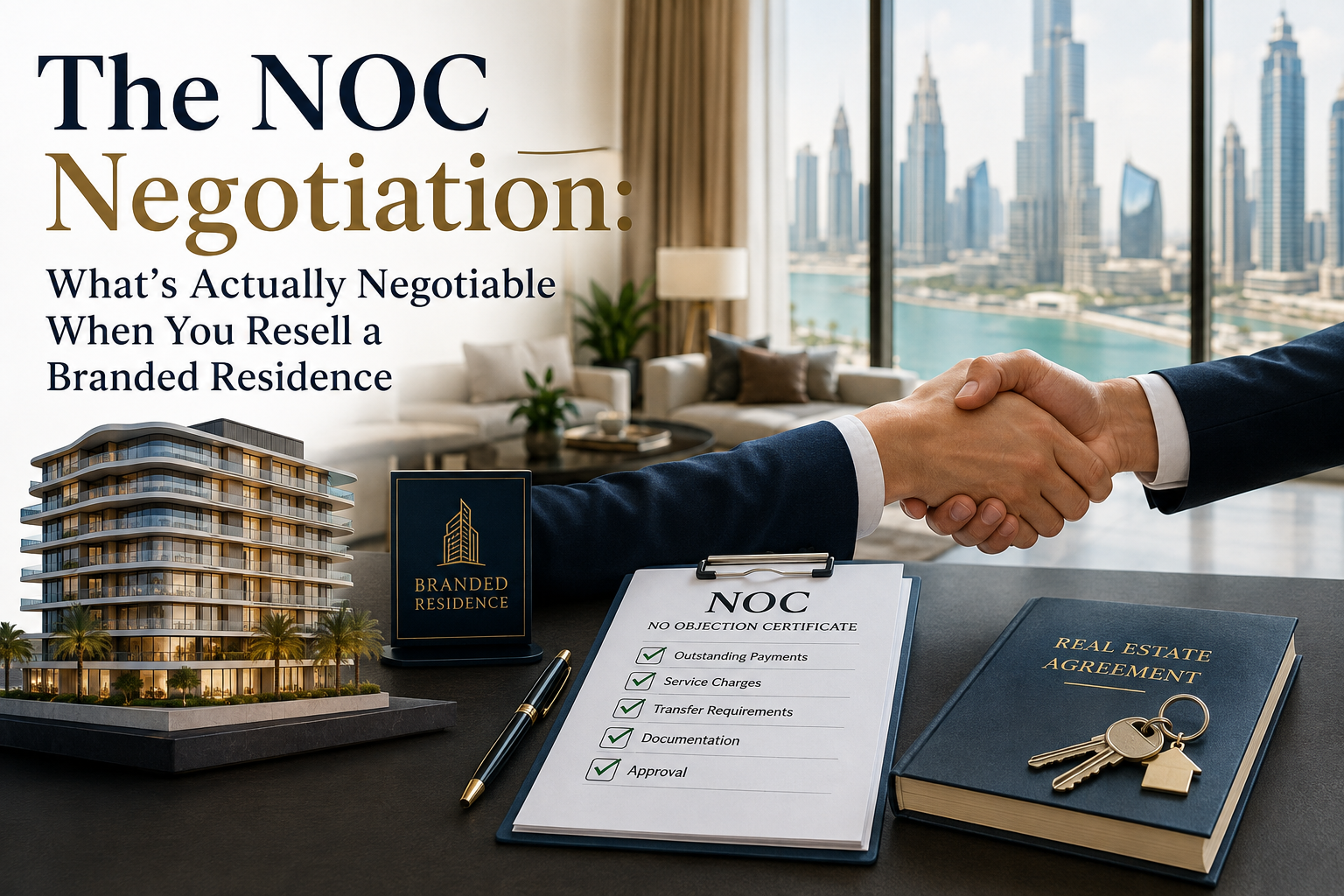
Reselling a branded residence can look straightforward on paper: an owner decides to sell, a buyer makes an offer, and the property changes hands. In practice, however, branded residences involve a much more complex transaction structure than a conventional apartment or villa.
One of the most important elements is the No Objection Certificate (NOC). The NOC confirms that the relevant developer, master developer, homeowners’ association, hotel operator, or other authorised entity has no objection to the transfer of ownership. For buyers and sellers of branded residences, obtaining the NOC can become a critical part of the resale process.
But an important question remains: what is actually negotiable during an NOC process?
The answer is more nuanced than simply asking whether the developer will “approve” the resale. Certain fees, timelines, outstanding balances, documentation requirements, and administrative issues may have room for negotiation, while contractual requirements, eligibility criteria, and transfer conditions are often much less flexible.
Understanding the difference can help property owners negotiate more effectively, avoid unnecessary delays, and protect the economics of their resale transaction.
What Is an NOC When Reselling a Branded Residence?
A No Objection Certificate is generally a formal confirmation that the authorised property stakeholder has no objection to the transfer of a property from the existing owner to a new buyer.
In a branded residence, the NOC process may involve more than a standard developer approval because the property can sit within a development connected to a recognised luxury hotel, hospitality company, lifestyle brand, or specialised management structure.
The NOC may confirm that the seller has fulfilled relevant obligations, including payment of service charges, developer instalments, administrative fees, or other amounts due before transfer.
For the buyer, the NOC provides an important layer of transaction certainty. For the seller, it can be one of the final administrative hurdles before completing the resale.
Why NOC Negotiation Matters in Branded Residences
Branded residences typically command a premium because they combine residential ownership with elements associated with a recognised luxury brand, such as hotel-style services, concierge facilities, premium amenities, interior standards, and professional property management.
That premium can make the resale transaction financially significant.
A relatively small NOC-related charge can therefore become important when the transaction involves a high-value property. More importantly, disagreements over outstanding payments or transfer requirements can delay completion and potentially affect the buyer’s financing, moving plans, or contractual deadlines.
The key is to understand which aspects of the NOC process are commercially negotiable and which are effectively non-negotiable compliance requirements.
NOC Fees: Can You Negotiate the Amount?
One of the first questions sellers ask is whether the NOC fee itself can be negotiated.
In many developments, the NOC fee is established by the developer or relevant authority and is applied according to a standard schedule. If the fee is contractually or administratively fixed, there may be little scope for reducing it.
However, that does not mean every cost associated with obtaining the NOC is automatically fixed.
There can be a distinction between the official NOC fee and additional costs connected with administration, document processing, outstanding accounts, clearance certificates, expedited processing, or other services.
A seller should therefore request a detailed statement showing exactly what each charge represents.
Instead of asking only, “Can you reduce the NOC fee?”, a more effective approach is to ask whether the total transfer-related charges contain discretionary or negotiable components.
Who Pays the NOC Fee?
The question of who pays the NOC-related costs can sometimes be more negotiable than the amount itself.
Depending on the market, transaction agreement, developer policy, and local practice, the buyer and seller may agree between themselves on how certain transaction expenses are allocated.
For example, a seller may agree to cover the NOC cost as part of the overall commercial negotiation, while the buyer may accept another expense that would otherwise fall to the seller.
The important distinction is that the buyer and seller can negotiate the economic burden between themselves even when the developer will not change its official fee.
The developer may still require the full amount from the party specified under its procedures, with reimbursement or adjustment handled separately between buyer and seller.
Outstanding Service Charges Are Usually More Complicated
Outstanding service charges can become one of the biggest issues during an NOC process.
A developer, management company, or homeowners’ association may require the seller’s account to be cleared before issuing the NOC. In that situation, the seller generally cannot simply negotiate away a legitimate outstanding liability.
However, there may be room to negotiate how the financial obligation is settled between the buyer and seller.
For example, the parties could agree to adjust the purchase price to reflect an outstanding amount, provided the relevant parties and transaction documentation permit the arrangement.
This is why buyers should conduct proper due diligence before signing a resale agreement. Outstanding charges should be identified early rather than discovered immediately before transfer.
Developer Instalments and Payment Defaults
Branded residences that are still under a developer payment plan introduce another layer of complexity.
If the seller has unpaid instalments, late payment charges, or other contractual obligations, the developer may require these matters to be resolved before issuing the NOC.
A buyer cannot normally assume that the NOC process will automatically erase the seller’s obligations.
Nevertheless, the commercial structure of the transaction may sometimes accommodate these liabilities. The parties could negotiate a purchase price adjustment, settlement mechanism, or payment arrangement, subject to the developer’s approval and the terms of the sale agreement.
The crucial point is that a private agreement between buyer and seller does not necessarily override the developer’s contractual rights.
Can You Negotiate NOC Processing Time?
Time can be particularly valuable in a high-value property resale.
A buyer may have mortgage approval that expires after a certain period. A seller may be coordinating the purchase of another property. Both parties may also have contractual completion deadlines.
Standard NOC processing timelines may be established by the relevant developer or management entity. However, some developments offer different processing channels, provided the applicable requirements and fees are met.
If timing is critical, sellers should ask about:
- Standard processing times
- Expedited processing options
- Required documentation
- Account clearance requirements
- Appointment availability
- Conditions that could delay approval
Rather than assuming the NOC will take a particular number of days, obtain the timeline directly from the responsible authority and build a realistic buffer into the transaction.
Documentation Requirements: Usually Not a Negotiating Point
Documentation is one area where sellers should not expect much flexibility.
The developer or relevant authority may require identification documents, ownership documents, payment records, clearance confirmations, buyer information, signed forms, or other transaction paperwork.
These requirements exist to establish ownership, verify the parties, confirm compliance, and reduce transaction risk.
Trying to negotiate away mandatory documentation is unlikely to be productive.
Instead, the smart strategy is to obtain the complete NOC checklist at the beginning of the resale process and prepare every document in advance.
Can the Developer Refuse an NOC?
An NOC is not necessarily a purely administrative formality.
Depending on the development structure and contractual documents, the issuing entity may have legitimate grounds to withhold approval until outstanding obligations or required conditions have been addressed.
Potential issues can include unpaid service charges, developer instalments, incomplete documentation, ownership discrepancies, unresolved disputes, or other contractual matters.
This is why sellers should not treat the NOC as something that can simply be obtained after finding a buyer.
A cleaner approach is to conduct a pre-NOC review before marketing the property for resale.
What About the Branded Residence Management Agreement?
Branded residences can have additional contractual relationships that do not typically exist with ordinary residential properties.
Depending on the project, there may be hotel management agreements, rental pool arrangements, property management contracts, service agreements, membership structures, or brand-specific operating requirements.
These agreements can affect what happens when ownership changes.
A buyer should therefore understand whether the resale transfers any obligations automatically and whether the new owner must enter into specific agreements with the operator or management company.
This is an area where professional legal and real estate advice can be particularly valuable because the brand name itself does not tell you the full contractual structure.
Brand-Related Requirements May Be Non-Negotiable
One of the defining characteristics of a branded residence is the relationship between the property and the associated brand.
Brand standards can cover everything from design and furnishing requirements to property management, services, amenities, and operational standards.
Some requirements may continue after resale because they protect the consistency and positioning of the development.
A seller should therefore avoid assuming that every aspect of the property can be changed after completion simply because ownership changes.
For buyers, understanding these restrictions is part of due diligence. For sellers, clearly communicating them can reduce misunderstandings during negotiations.
What Is Actually Negotiable?
The most useful way to approach an NOC negotiation is to divide the process into three categories.
Potentially Negotiable
Commercially, there may be room to negotiate:
Who bears certain transaction costs: Buyer and seller can often negotiate the economic allocation of costs between themselves.
Purchase price adjustments: Outstanding liabilities may influence the agreed sale price, subject to the relevant contractual and regulatory requirements.
Completion timing: The parties can often negotiate their own contractual deadlines around the NOC process.
Settlement arrangements: In certain situations, the parties may agree on how specific amounts are incorporated into the completion statement.
Expedited processing: Where the developer offers an accelerated service, the parties can decide whether the additional cost is commercially worthwhile.
Sometimes Negotiable
Some matters depend heavily on the developer, development, and contractual framework.
These can include administrative charges, specific clearance procedures, settlement of disputed amounts, processing arrangements, or documentation corrections.
The right question is not whether NOC procedures are “negotiable” in general, but which individual requirement is discretionary under the applicable rules.
Usually Non-Negotiable
Mandatory legal, compliance, ownership verification, and contractual requirements generally have limited flexibility.
These can include identity verification, proof of ownership, mandatory documentation, legitimate outstanding contractual obligations, developer payment requirements, and requirements imposed by applicable property regulations.
Trying to negotiate these away can create delays rather than savings.
The NOC Should Be Considered Before Signing the Resale Agreement
One common mistake is treating the NOC as the final administrative step after the commercial deal has already been agreed.
A better strategy is to consider NOC requirements before the sale contract becomes unconditional.
The seller should establish whether there are outstanding charges, payment obligations, documentation problems, or other issues that could prevent or delay approval.
The buyer should understand exactly what must happen before ownership can be transferred.
This creates greater certainty for both sides and reduces the risk of a transaction becoming trapped between a signed sale agreement and an unavailable NOC.
How Buyers Can Protect Themselves
Buyers of branded residences should perform due diligence beyond simply checking the property’s physical condition and asking price.
The buyer should understand the property’s financial status, service charges, developer obligations, management agreements, transfer requirements, and any restrictions connected with the branded residence structure.
It is also important to ensure that the sale agreement clearly addresses responsibility for outstanding liabilities and the conditions required for completion.
Where substantial money is involved, buyers should obtain independent legal advice rather than relying solely on the seller, broker, or developer’s commercial explanation.
How Sellers Can Make the NOC Process Easier
Sellers can reduce delays by preparing early.
Before accepting an offer, obtain an up-to-date account statement and identify outstanding payments or service charges. Confirm the documents required for the NOC and establish the current processing timeline.
It is also useful to communicate openly with the buyer about expected costs and responsibilities.
A transparent NOC process can strengthen the transaction because the buyer is less likely to discover unexpected liabilities after signing.
NOC Negotiation and the Dubai Branded Residence Market
Dubai has become one of the world’s most prominent markets for branded residences, with developments associated with internationally recognised hotel, automotive, fashion, and lifestyle brands.
The combination of luxury real estate, hospitality services, international buyers, and strong investor demand makes resale transactions particularly important.
For Dubai property investors, the NOC is therefore not merely paperwork. It can influence the speed, cost, and certainty of a property transfer.
The exact requirements vary between developments, so investors should never assume that the NOC process for one branded residence will be identical to another.
Common NOC Mistakes Sellers Should Avoid
One of the biggest mistakes is waiting until the buyer has already committed to investigate outstanding charges.
Another is assuming that the developer will negotiate every fee simply because the property is being resold.
Sellers should also avoid making promises about completion dates before confirming the NOC timeline.
Finally, parties should not rely on informal verbal assurances where important financial or contractual obligations are involved. Material agreements should be properly documented and reviewed.
Final Thoughts
The NOC negotiation when reselling a branded residence is less about bargaining with a developer over every requirement and more about understanding where flexibility actually exists.
Official fees may be fixed, but the allocation of costs between buyer and seller can often form part of the commercial negotiation. Outstanding liabilities may not disappear, but they can sometimes be reflected in the purchase price or settlement structure. Processing timelines may have limited flexibility, while mandatory compliance and documentation requirements generally should not be treated as negotiable.
For both buyers and sellers, the most effective strategy is to identify the NOC requirements early, obtain written confirmation of outstanding amounts, understand the contractual framework, and negotiate the economics of the transaction rather than attempting to override mandatory procedures.
In a high-value branded residence resale, that distinction can save time, prevent unexpected costs, and make the difference between a smooth completion and a delayed transaction.
Frequently Asked Questions
What is an NOC in a branded residence resale?
An NOC, or No Objection Certificate, is confirmation from the relevant authorised entity that it has no objection to the transfer of the property, subject to applicable requirements and settlement of outstanding obligations.
Can the NOC fee be negotiated?
The official NOC fee may be fixed by the developer or relevant authority. However, the buyer and seller may be able to negotiate who ultimately bears the cost as part of the overall transaction.
Who normally pays the NOC fee?
Responsibility varies according to the development, transaction terms, local practice, and applicable procedures. The buyer and seller should clearly establish responsibility in the sale agreement.
Can outstanding service charges prevent an NOC?
Yes. Depending on the development’s rules, outstanding service charges or other amounts may need to be settled before the NOC is issued.
Can a buyer negotiate the seller’s outstanding payments?
The buyer and seller may negotiate the commercial treatment of outstanding amounts, such as through a price adjustment or settlement arrangement, but a private agreement does not necessarily eliminate the developer’s right to receive amounts owed.
Can you speed up an NOC?
Some developers or management entities may offer expedited processing, while others follow a fixed procedure. The current process and any additional charges should be confirmed directly with the relevant authority.
Are NOC documentation requirements negotiable?
Mandatory identification, ownership, compliance, and transfer documentation is generally not negotiable. The most effective approach is to prepare the complete documentation package before initiating the transfer.
Does an NOC guarantee that the property sale will complete?
No. An NOC is an important part of the transfer process, but completion may also depend on financing, contractual conditions, registration, payment settlement, and other legal or administrative requirements.
Why are NOCs especially important for branded residences?
Branded residences can involve developers, hotel operators, property managers, homeowners’ associations, and brand-specific agreements. This can create additional transfer considerations compared with a conventional residential property.
What should buyers check before purchasing a branded residence?
Buyers should review the title and ownership position, outstanding service charges, developer payments, NOC requirements, management agreements, service charges, transfer costs, contractual restrictions, and any obligations that will transfer to the new owner.