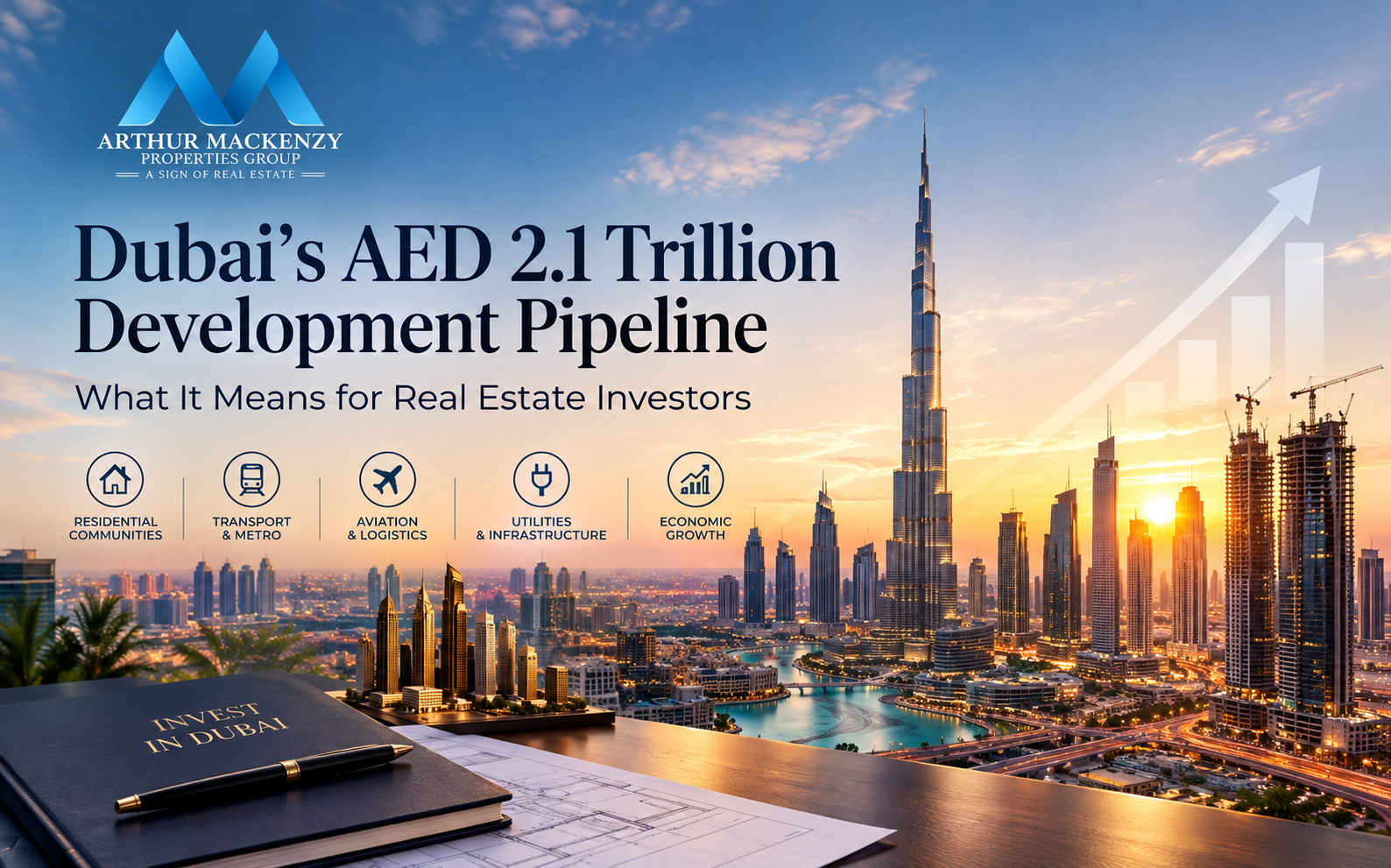
Dubai is entering another significant phase of urban expansion, creating new opportunities for property buyers and investors looking to benefit from the emirate’s long-term growth. With approximately AED 2.1 trillion worth of projects underway across real estate, transport, aviation, utilities, and economic infrastructure, the city is preparing for a new chapter of development.
Announced by Sheikh Mohammed bin Rashid Al Maktoum on October 13, 2026, the investment pipeline highlights Dubai’s ambition to accommodate a growing population, attract international businesses, and strengthen its position as a global destination for living, working, and investing.
For real estate investors, the announcement raises an important question: How could Dubai’s development pipeline influence property values, rental demand, and investment opportunities over the coming years?
At Arthur Mackenzy Properties, we believe that understanding infrastructure development, emerging communities, and future housing supply is essential when evaluating Dubai real estate opportunities.
Understanding Dubai’s AED 2.1 Trillion Development Pipeline
Dubai’s latest development announcement covers a broad range of projects designed to support economic expansion and improve the city’s infrastructure.
According to reporting by The National, the investment pipeline includes approximately AED 1.1 trillion allocated to real estate development through 2030, with around 350,000 residential units planned. Other major investments target aviation, roads, public transport, utilities, and commercial districts.
Key investment figures include:
- AED 2.1 trillion: Total value of active projects across Dubai.
- AED 1.1 trillion: Planned real estate investment through 2030.
- 350,000 residential units: Planned housing supply.
- AED 128 billion: Investment in Al Maktoum International Airport.
- AED 100 billion: Road and transport infrastructure investment.
- AED 151 billion: Planned power and water grid infrastructure.
- AED 100 billion: Allocation for the expansion of Dubai International Financial Centre (DIFC).
These figures demonstrate that Dubai’s growth strategy extends beyond constructing residential towers. The emirate is investing in the systems, transport connections, and commercial facilities needed to support future economic activity.
For investors, the broader picture matters because property performance is influenced not only by the building itself but also by the surrounding community, accessibility, employment opportunities, and quality of life.
1. Why the Real Estate Investment Allocation Matters
The AED 1.1 trillion real estate investment allocation is particularly important for property buyers because it signals the scale of planned residential development through 2030.
The addition of approximately 350,000 planned residential units could expand housing choices across different price points, property types, and communities.
This development may create opportunities for investors interested in apartments, townhouses, villas, and properties in emerging residential districts.
However, increased investment does not automatically translate into higher property prices. Market performance will depend on the relationship between new housing supply and actual buyer and tenant demand.
Investors should evaluate several factors before purchasing:
- The number of competing properties expected to be delivered nearby.
- The reputation and delivery history of the developer.
- Expected completion dates and construction progress.
- Rental demand from residents and professionals.
- Community facilities, transport access, and employment hubs.
- Purchase price relative to comparable completed properties.
A property in a well-connected community with sustainable tenant demand may offer a different risk profile from a similar unit in an area experiencing substantial new supply.
The key is to identify locations where housing demand can grow alongside development activity.
2. Infrastructure Development Could Reshape Property Demand
Infrastructure investment can influence real estate markets by improving accessibility, supporting employment, and making previously less-connected locations more attractive.
Dubai’s development pipeline includes major spending on aviation, roads, metro infrastructure, utilities, and commercial districts. Over time, these projects could influence where residents choose to live and where businesses establish operations.
Al Maktoum International Airport and Dubai South
Dubai’s investment in Al Maktoum International Airport is one of the most significant elements of the announced programme. The airport is being developed with a planned capacity of up to 260 million passengers annually.
The wider aviation and logistics ecosystem could support economic activity around Dubai South, subject to the timing and delivery of associated projects.
For property investors, Dubai South is worth monitoring because its long-term prospects are linked to airport expansion, logistics, employment, and transport connectivity.
Potential opportunities include:
- Residential apartments aimed at professionals.
- Townhouses and family-oriented housing.
- Properties serving logistics and aviation employees.
- Commercial real estate supporting businesses in the surrounding district.
Nevertheless, investors should assess current occupancy, existing rental demand, infrastructure completion schedules, and competing residential supply before making a decision. Long-term infrastructure plans should not be treated as a guarantee of immediate capital appreciation.
Roads and Metro Expansion
Dubai has also announced AED 100 billion in road and transport infrastructure investment, including the Dubai Metro Blue and Gold lines.
Improved connectivity can make residential communities more convenient for commuters and may increase their appeal to tenants who prioritise access to workplaces, schools, shopping, and leisure facilities.
When evaluating a property, investors should consider its actual distance from existing transport facilities and verify proposed routes and station locations using official project information.
It is important to distinguish between a project that has been announced, one under construction, and one that is operational. Each stage can have a different effect on property demand.
3. Commercial Expansion Could Support Residential Rental Demand
Dubai’s development plans also include substantial investment in commercial and financial districts.
The expansion of Dubai International Financial Centre, supported by an allocation of approximately AED 100 billion, is intended to strengthen the emirate’s position as an international financial and business hub.
A larger commercial ecosystem could create additional demand for accommodation from professionals, entrepreneurs, and businesses relocating or expanding in Dubai. The actual effect on housing demand will depend on employment growth, business occupancy, and the pace of project delivery.
For investors, established employment centres and well-connected residential communities may offer opportunities to attract long-term tenants.
Areas worth comparing include:
Business Bay: A mixed-use district with residential towers, offices, hospitality, and access to central Dubai.
Dubai Hills Estate: A master-planned residential community with family-oriented amenities and access to major road networks.
Jumeirah Village Circle (JVC): A residential area with a range of apartment and townhouse options across different price points.
Dubai South: A developing district whose future prospects are closely associated with aviation, logistics, and wider infrastructure investment.
Dubai Creek Harbour: A waterfront development offering residential properties and access to leisure and lifestyle facilities.
These communities serve different investment objectives. Their suitability depends on acquisition costs, rental comparables, expected holding periods, supply pipelines, and the investor’s tolerance for risk.
4. Will Dubai Property Prices Increase?
Dubai’s development pipeline provides a strong reason to examine the property market, but it does not establish that prices will rise uniformly across the emirate.
Property values are influenced by several interconnected factors, including population growth, employment, financing conditions, investor confidence, available housing supply, and the quality of individual developments.
Large infrastructure projects may support long-term demand in selected locations. At the same time, a substantial increase in housing supply could put pressure on rents and resale prices in communities where deliveries outpace demand.
Investors should therefore distinguish between three potential outcomes.
Capital Appreciation
Properties in communities benefiting from improving connectivity, established amenities, and sustained buyer demand may offer opportunities for long-term capital appreciation.
However, future price growth is not guaranteed. Investors should compare current asking prices with completed transactions and consider whether the expected benefits of future infrastructure are already reflected in the purchase price.
Rental Income
Rental returns depend on achievable rents, purchase costs, service charges, maintenance, vacancy periods, and other ownership expenses.
Rather than relying on advertised gross yields alone, investors should calculate estimated net rental income under realistic assumptions.
A property with a lower purchase price may offer an attractive yield, but only if tenant demand remains sufficiently strong and ongoing expenses are manageable.
Long-Term Investment Potential
Investors with longer holding periods may have more time to benefit from the gradual development of transport networks, employment centres, and community amenities.
However, a longer investment horizon does not eliminate market risk. Construction delays, changing tenant preferences, additional supply, and shifts in financing conditions can all affect returns.
A disciplined investment strategy should account for both potential growth and downside scenarios.
5. Off-Plan vs. Ready Properties: Which Strategy Makes Sense?
Dubai’s development pipeline may attract attention to both off-plan and completed properties. Each option offers different advantages and risks.
| Investment factor | Off-plan property | Ready property |
|---|---|---|
| Initial purchase | Often offers a staged payment structure, depending on the project | Usually requires a larger immediate capital commitment |
| Rental income | Generally unavailable until completion and handover | May generate income soon after purchase if tenant demand exists |
| Property selection | Buyers may access units early in a development cycle | Buyers can inspect the completed property and surrounding community |
| Main risks | Construction delays, delivery risk, future supply, and changes in market conditions | Maintenance costs, existing building condition, vacancy, and current market pricing |
| Investment focus | Potential future growth and planned community development | Existing rental demand, property condition, and current income potential |
When Off-Plan May Be Worth Considering
Off-plan properties may suit investors who can accept construction-related uncertainty and are comfortable with a longer wait before occupation or rental income.
Before committing, buyers should review the developer’s track record, project registration, escrow arrangements where applicable, payment milestones, contractual terms, service charges, and expected handover date.
Projected rental income and future resale values should be treated as estimates rather than assured outcomes.
When Ready Properties May Be Preferable
Completed properties can be more suitable for investors who prioritise immediate occupancy, established neighbourhoods, and the ability to evaluate current rental comparables.
A ready property also allows buyers to inspect the unit, building facilities, maintenance standards, and surrounding environment before purchase.
The right choice depends on an investor’s budget, financing arrangements, income requirements, and investment horizon rather than on market headlines alone.
6. How Investors Can Identify Opportunities in Emerging Communities
Not every area will benefit equally from Dubai’s development programme. The most effective approach is to analyse individual communities rather than assuming that citywide investment will generate uniform results.
Investors should consider the following factors when comparing locations.
Transport Accessibility
Evaluate access to existing roads, public transport, employment centres, and everyday services. Verify proposed infrastructure connections before assigning value to future improvements.
Housing Supply
Research the number of comparable units under construction or scheduled for handover. An area with substantial new supply may require stronger population and employment growth to maintain rental and resale demand.
Tenant Profile
Identify the people most likely to rent in the community, such as professionals, families, or employees working in nearby business districts.
The property type, unit size, amenities, and price should align with the needs of the intended tenant group.
Developer and Project Quality
Review the developer’s completed projects, construction progress, service arrangements, and contractual obligations. For off-plan purchases, verify the project’s regulatory status through the relevant official channels.
Total Investment Cost
Include the purchase price, registration fees, brokerage charges, financing costs, service charges, maintenance, insurance where applicable, and an allowance for vacancies.
These expenses can materially change the return on an investment, making a detailed financial assessment essential before purchase.
7. Risks Investors Should Consider Before Buying
Dubai’s development pipeline creates potential opportunities, but investors should not overlook the risks associated with large-scale construction and changing market conditions.
Potential oversupply: If residential deliveries exceed demand in a particular community, landlords may face stronger competition and slower rental growth.
Construction delays: Infrastructure and property projects may take longer than expected to complete, postponing anticipated benefits.
Changing market conditions: Interest rates, global economic conditions, geopolitical developments, and investor sentiment can influence property prices and transaction activity.
Developer and project risk: Off-plan buyers should carefully assess contractual commitments, construction progress, delivery schedules, and the developer’s track record.
Liquidity risk: Selling a property quickly at the desired price may not always be possible, particularly during periods of weaker demand.
Uncertain returns: Neither capital appreciation nor rental income is guaranteed. Investors should assess whether a property remains financially viable under more conservative assumptions.
A balanced strategy focuses on verified information, realistic financial projections, and an investment horizon that matches the buyer’s objectives.
8. What Should International Property Investors Do Next?
Dubai’s development plans may be relevant to international buyers seeking residential investments, rental income, or long-term exposure to the emirate’s property market.
However, overseas investors should pay particular attention to transaction procedures, currency movements, financing requirements, property ownership rules, and the practical management of a property from abroad.
A structured investment process can help reduce avoidable mistakes.
- Define your objective: Decide whether your priority is rental income, long-term appreciation, personal use, or a combination of these goals.
- Set a realistic budget: Account for transaction costs, financing, service charges, maintenance, and a reserve for unexpected expenses.
- Compare multiple communities: Evaluate established districts alongside emerging locations, using current market data and verified infrastructure plans.
- Assess individual properties: Compare prices, rental evidence, building quality, developer reliability, and future competing supply.
- Verify the legal and financial details: Review ownership eligibility, registration requirements, contractual obligations, and payment arrangements with appropriately qualified professionals.
- Plan your exit strategy: Consider the intended holding period, likely resale audience, potential transaction costs, and what would happen if market conditions weaken.
Working with an experienced property advisory team can help investors compare available opportunities and understand the practical differences between communities, developers, and property types.
Why Choose Arthur Mackenzy Properties?
At Arthur Mackenzy Properties, we recognise that successful real estate investment requires more than following major announcements or selecting a property based on projected growth.
Investors need to understand how infrastructure, residential supply, rental demand, and individual project fundamentals interact.
Our approach is centred on helping buyers evaluate property options in line with their investment goals, budget, and preferred holding period.
Whether you are exploring an off-plan apartment, a completed residential property, a family villa, or an opportunity in an emerging district, careful research and informed decision-making should remain at the centre of your strategy.
Dubai’s AED 2.1 trillion development pipeline offers an important perspective on the emirate’s long-term ambitions. The next step for investors is to identify which specific properties and communities align with their objectives and risk tolerance.
Conclusion: Turning Dubai’s Development Plans Into Informed Investment Decisions
Dubai’s AED 2.1 trillion development pipeline highlights a broad commitment to expanding housing, strengthening transport connectivity, improving utilities, and supporting economic growth.
The planned AED 1.1 trillion real estate allocation and approximately 350,000 residential units could reshape the emirate’s property landscape through 2030. Airport expansion, metro development, road improvements, and commercial district investment may also influence residential demand in selected communities.
Yet the scale of investment alone cannot determine which properties will perform best. Housing supply, affordability, developer quality, rental demand, acquisition costs, and wider economic conditions will remain essential considerations.
For investors, the opportunity lies in combining an understanding of Dubai’s long-term development strategy with detailed research into individual properties.