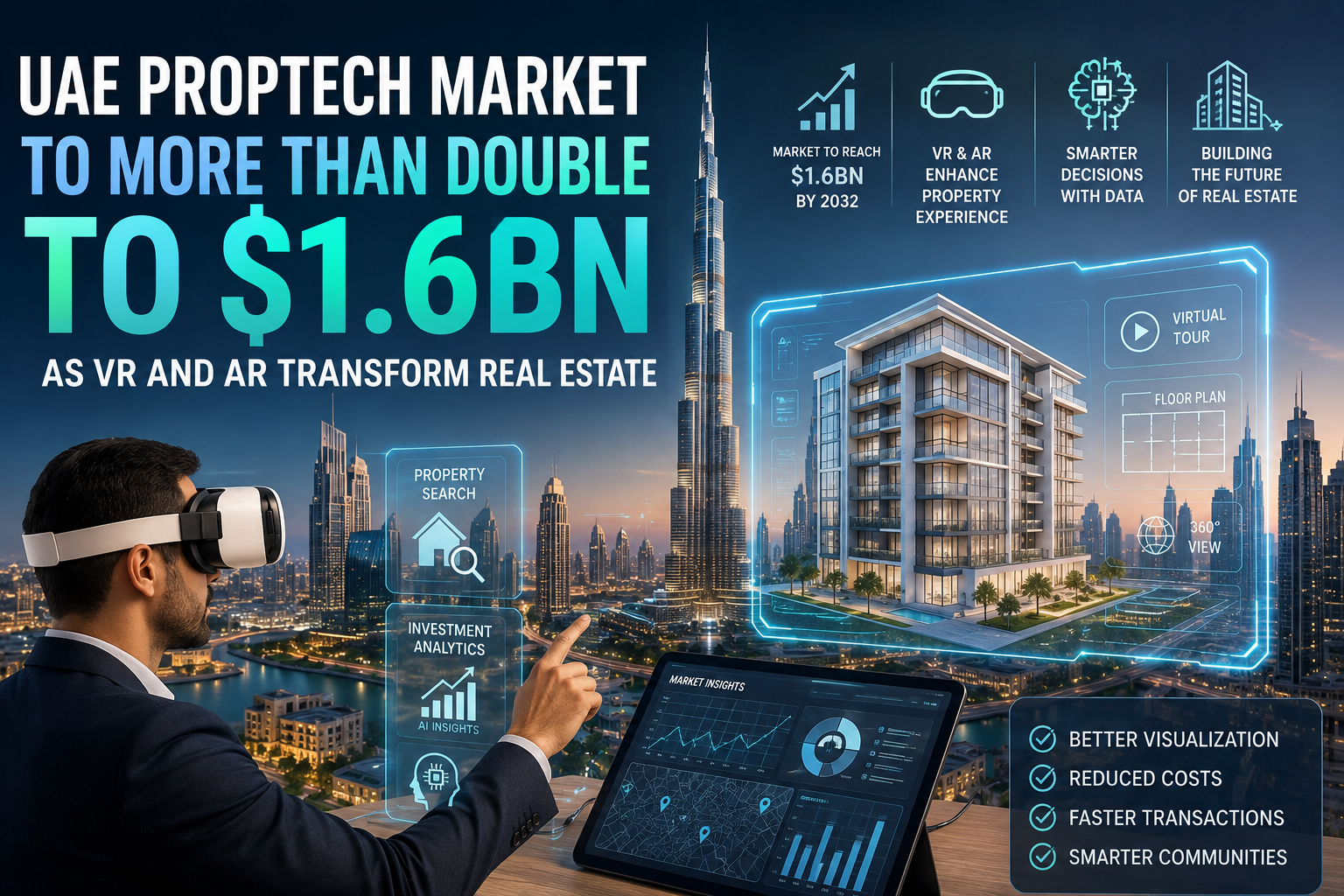
The UAE’s real estate sector is entering a new phase of digital transformation as PropTech, virtual reality (VR) and augmented reality (AR) become increasingly integrated into property development, sales and asset management.
The UAE PropTech market is forecast to grow from approximately $678 million in 2025 to $1.62 billion by 2032, more than doubling over the period. The forecast represents a compound annual growth rate (CAGR) of approximately 13.28% between 2026 and 2032, according to market research firm MarkNtel Advisors, as reported by Arabian Business and other industry sources.
This expansion reflects a broader shift in how property is designed, marketed, purchased and managed across the UAE. Instead of technology being limited to property listings and online searches, digital tools are increasingly becoming part of the entire real estate lifecycle.
For developers and investors, the change could mean faster decision-making, better project visualisation, more efficient operations and stronger engagement with buyers.
What Is PropTech?
PropTech, short for property technology, refers to digital technologies and platforms designed to improve the way real estate is developed, bought, sold, rented, financed and managed.
The sector includes a wide range of technologies, including artificial intelligence, big data analytics, virtual reality, augmented reality, smart-building systems, digital payments, property management platforms, automated valuation tools and online transaction solutions.
In the UAE, PropTech is becoming particularly relevant because of the country’s ambitious smart-city programmes, rapidly developing real estate sector and strong investment in digital infrastructure.
The result is a property market where technology is increasingly connecting developers, brokers, investors, landlords, tenants and buyers.
Why Is the UAE PropTech Market Growing?
Several structural factors are supporting the growth of PropTech in the UAE.
One of the biggest is the country’s continued investment in smart cities and digital infrastructure. Dubai and Abu Dhabi have positioned themselves as technology-driven urban centres, creating an environment where digital solutions can be integrated into buildings and real estate processes.
The scale and speed of property development are also important. Developers are working on increasingly complex residential, commercial, hospitality and mixed-use projects, creating demand for tools that can improve planning and collaboration.
At the same time, buyers are becoming more digitally sophisticated. International investors can increasingly research, compare and experience UAE properties remotely, making digital property experiences an important part of the sales process.
The UAE’s broader push toward digital transformation is therefore creating favourable conditions for PropTech companies and real estate businesses adopting new technologies. Dubai Land Department has also been actively developing an ecosystem that connects regulators, developers and technology companies.
VR Is Changing How Buyers Experience Property
One of the most visible PropTech developments is the growing use of virtual reality in property marketing and development.
Traditionally, buyers interested in an off-plan property had to rely on architectural drawings, floor plans, computer-generated images and physical showrooms.
VR changes that experience by allowing potential buyers to virtually walk through a property before it has been constructed.
A buyer can potentially explore the layout, move between rooms, examine views and understand the relationship between different spaces without physically visiting a completed building.
This is particularly valuable for Dubai’s off-plan property market, where international investors frequently purchase properties before construction is complete.
The ability to experience a development remotely can make the purchasing process more visual and interactive while helping buyers develop a clearer understanding of what they are purchasing.
Augmented Reality Takes Property Visualisation Further
While VR creates an immersive digital environment, augmented reality overlays digital information onto the physical world.
In real estate, AR can help architects, developers, investors and buyers visualise buildings, interiors and design concepts within an actual physical environment.
For example, an architect could use AR to examine how a proposed structure interacts with its surroundings, while a buyer could potentially visualise furniture, finishes or spatial configurations within a property.
This ability to combine digital information with physical environments can improve communication between stakeholders.
As the technology becomes more sophisticated, AR is expected to become increasingly relevant throughout the property development process.
Developers Can Identify Design Problems Earlier
One of the most important benefits of VR and AR is their potential to identify design issues before construction begins.
Traditional architectural plans can be difficult for non-specialists to interpret. A buyer or project stakeholder may understand the technical drawing but still struggle to visualise how the finished space will actually feel.
Immersive visualisation provides a more intuitive experience.
Developers, architects and clients can walk through digital versions of spaces, identify potential problems and make design adjustments before construction starts.
This could reduce the need for expensive changes later in the development process.
According to industry reporting, immersive visualisation is increasingly being used to improve design accuracy, communication and decision-making while helping reduce costly revisions.
PropTech Can Reduce Development Risk
Real estate development involves substantial financial risk. Construction costs, planning decisions, design changes and market demand can all affect project profitability.
Technology cannot eliminate these risks, but it can provide developers with better information before important decisions are made.
Digital modelling and immersive technologies can allow project teams to test layouts and visualise potential outcomes earlier in the development cycle.
This creates an opportunity to identify design inefficiencies before they become expensive construction problems.
For large-scale UAE developments, where projects can involve thousands of residential units and extensive infrastructure, even small improvements in planning and efficiency can have significant financial implications.
VR and AR Are Also Transforming Property Sales
The impact of immersive technology extends beyond construction and design.
Real estate sales teams can use VR and AR to provide potential buyers with a more engaging property presentation.
Instead of showing only photographs and floor plans, agents can provide virtual walkthroughs, interactive models and immersive demonstrations.
This can be especially useful for international buyers who cannot easily travel to Dubai or Abu Dhabi for every property viewing.
A potential investor based in London, Singapore, Mumbai or Riyadh can explore a development digitally before deciding whether to proceed with a purchase.
This supports the UAE’s position as an international real estate investment destination.
The Rise of Remote Property Buying
The growth of PropTech is also making remote property investment more practical.
International buyers increasingly expect real estate transactions to offer the same level of digital convenience they experience in other industries.
Property discovery can happen online. Virtual tours can replace some physical viewings. Digital documents can accelerate administrative processes, while technology can help buyers compare properties and evaluate market information.
The result is a property journey that is increasingly independent of geography.
This is particularly relevant to the UAE, where international investors represent an important part of the real estate market.
Recent industry analysis has highlighted how AI-led property discovery, virtual viewings, digital transactions and data tools are helping attract a younger and more internationally distributed group of UAE property investors.
PropTech Is Moving Beyond Property Sales
Although VR and AR are receiving significant attention, PropTech is much broader than immersive property viewing.
Technology is increasingly being applied to property management, rental payments, tenant engagement, maintenance, building operations and asset management.
Smart-building systems can collect data about energy consumption and building performance. Predictive maintenance tools can identify potential equipment problems before failures occur.
Digital platforms can streamline rent payments and communication between landlords and tenants.
Data analytics can help property owners understand occupancy, rental trends and asset performance.
This means PropTech is gradually moving from a sales and marketing tool into the operational infrastructure of real estate.
Artificial Intelligence Will Add Another Layer
Artificial intelligence is likely to become another major component of the UAE’s PropTech transformation.
AI can process large volumes of property data and help identify patterns in pricing, demand, occupancy and investment behaviour.
For developers, AI-powered analytics can potentially support decisions about where and what to build.
For investors, automated data analysis could help compare properties and identify market trends.
For property managers, AI can support predictive maintenance, customer service and operational decision-making.
The combination of AI, big data, VR, AR and smart-building technology could ultimately create a much more connected real estate ecosystem.
Dubai Is Strengthening Its PropTech Ecosystem
Dubai is already positioning itself as a regional centre for real estate technology.
In May 2026, PropTech Connect Middle East opened a regional office in the Dubai International Financial Centre (DIFC) with support from Dubai Land Department.
The inaugural PropTech Connect Middle East event held in Dubai earlier in 2026 attracted more than 3,000 participants and over 300 speakers, demonstrating the growing interest in the intersection between technology and real estate.
The development of this ecosystem is significant because successful PropTech markets require more than technology companies. They also need regulators, developers, investors, financial institutions and other stakeholders to work together.
Dubai’s approach is increasingly focused on creating that wider ecosystem.
UAE Smart-City Ambitions Support PropTech Growth
The UAE’s smart-city ambitions are another important factor behind the expansion of PropTech.
Smart cities depend on connected infrastructure, real-time data and digitally enabled services. Buildings are increasingly being viewed not as isolated structures but as components of larger urban systems.
This creates opportunities for PropTech companies working on building management, energy efficiency, mobility, security and resident services.
Dubai’s existing digital infrastructure provides a strong foundation for integrating these technologies into new developments.
As new communities are planned with smart-city principles from the beginning, technology can become embedded in the development rather than added after construction.
The Impact on Off-Plan Real Estate
Dubai’s strong off-plan property market could become one of the biggest beneficiaries of VR and AR.
Off-plan buyers face a fundamental challenge: they are purchasing something that does not yet physically exist.
Developers traditionally address this problem through show apartments, 3D renders, architectural models and brochures.
Immersive technologies provide another layer of certainty.
A potential buyer can experience a digital representation of the apartment, building and surrounding environment before construction is complete.
This could increase buyer confidence and make it easier for international investors to make decisions remotely.
PropTech Could Improve Transparency
Another potential benefit is greater transparency.
Digital platforms can provide buyers with access to more information about properties, developers, transaction processes and market conditions.
Data-driven tools can also make it easier to compare properties based on factors such as price, location, rental performance and historical trends.
However, technology alone does not guarantee accurate or unbiased information. Buyers still need to verify data through reliable sources and conduct appropriate due diligence.
The value of PropTech lies in improving access to information, not replacing professional judgment.
What Does the $1.6bn Forecast Mean?
The forecast that the UAE PropTech market could reach $1.62 billion by 2032 illustrates the scale of the opportunity.
From approximately $678 million in 2025, the market would more than double over seven years. The projected CAGR of 13.28% suggests sustained expansion rather than a short-term technology trend.
The growth will likely come from multiple areas rather than a single technology.
VR and AR are transforming visualisation. AI is improving analytics and automation. Smart-building systems are enhancing operations. Digital platforms are simplifying transactions and property management.
Together, these technologies are changing the infrastructure behind the real estate industry.
It is worth noting that different market research firms use different market definitions and methodologies. For example, Grand View Research publishes a separate UAE PropTech forecast that estimates $848.2 million by 2033, demonstrating why market-size figures should be interpreted according to the specific research methodology used.
What This Means for UAE Property Investors
For investors, the growth of PropTech could make the UAE property market easier to access and analyse.
Digital platforms can reduce the friction involved in finding properties, comparing opportunities and communicating with developers or agents.
VR and AR can make remote viewing more practical, while data tools can provide additional information for investment analysis.
However, technology should be considered an investment tool rather than a substitute for fundamental analysis.
Investors still need to examine location, developer reputation, property quality, service charges, rental demand, financing costs, payment plans and potential exit strategies.
The best technology cannot turn a poor property investment into a good one.
What This Means for UAE Developers
For developers, adopting PropTech could become increasingly important for remaining competitive.
Customers are becoming accustomed to digital experiences and expect faster access to information.
Developers that can provide immersive project experiences, digital sales journeys and data-driven customer engagement may have an advantage over companies relying entirely on traditional marketing methods.
Technology can also help developers improve internal processes, from project planning and design coordination to construction monitoring and asset management.
As the market becomes more competitive, PropTech could therefore move from being an optional innovation to an essential component of development strategy.
The Future of UAE Real Estate Will Be More Digital
The UAE’s real estate sector has already embraced digital property listings, online transactions and virtual tours. The next stage is considerably broader.
Properties are becoming digital models before they become physical buildings. Buildings are becoming connected assets. Buyers are becoming remote participants. Developers are using data to make decisions earlier in the development cycle.
VR and AR represent only one part of this transformation.
The convergence of immersive technology, artificial intelligence, data analytics and smart infrastructure could ultimately create a real estate market that is more visual, connected and data-driven.
Conclusion
The projected growth of the UAE PropTech market from $678 million in 2025 to around $1.62 billion by 2032 highlights the rapidly changing relationship between technology and real estate.
VR and AR are already changing how developers, architects and buyers visualise properties, particularly during the planning and off-plan sales stages. At the same time, AI, data analytics, smart-building systems and digital transaction platforms are expanding PropTech across the wider property lifecycle.
Dubai’s growing PropTech ecosystem and the UAE’s continued investment in digital infrastructure provide a strong foundation for further innovation.
For developers, the opportunity is to reduce risk, improve design and create better customer experiences. For buyers and investors, technology can make property more accessible and easier to understand.
As the UAE continues to develop smart cities and attract international real estate investment, PropTech is likely to become an increasingly important part of the country’s property market—and the next generation of UAE real estate may be designed, sold and managed as much through technology as through bricks and mortar.
Frequently Asked Questions
What is the UAE PropTech market?
The UAE PropTech market includes technology products and services designed to improve real estate development, transactions, sales, property management and building operations. It includes technologies such as VR, AR, AI, data analytics and smart-building systems.
How much is the UAE PropTech market expected to be worth by 2032?
According to the MarkNtel Advisors forecast cited in recent industry reporting, the UAE PropTech market is projected to reach approximately $1.62 billion by 2032, compared with around $678 million in 2025.
Why are VR and AR important for real estate?
VR and AR allow developers, architects and buyers to visualise properties and designs before construction is complete. This can improve communication, support better design decisions and potentially reduce costly revisions.
How can VR help Dubai property buyers?
VR can allow buyers to experience virtual walkthroughs of properties before they are built. This is particularly useful for international and remote buyers interested in Dubai’s off-plan property market.
Can PropTech reduce real estate development costs?
PropTech cannot guarantee lower costs, but technologies such as VR, AR and digital modelling can help identify design issues earlier, potentially reducing expensive changes during later stages of development.
Is PropTech only used for selling properties?
No. PropTech is increasingly used across the entire property lifecycle, including design, construction, sales, leasing, property management, maintenance, tenant engagement and asset management.
Is Dubai becoming a PropTech hub?
Dubai is actively developing its PropTech ecosystem. In 2026, PropTech Connect Middle East opened a regional office in DIFC with support from Dubai Land Department, while its inaugural Dubai event attracted more than 3,000 participants and over 300 speakers.
How will AI affect UAE real estate?
AI can support property valuation, market analysis, customer service, predictive maintenance, demand forecasting and investment research. Its integration with other PropTech tools could make real estate operations increasingly automated and data-driven.
Will VR replace traditional property viewings?
VR is more likely to complement than completely replace traditional viewings. It can be particularly useful for international buyers and off-plan developments, while physical inspections remain important for many property purchases.
What does the growth of PropTech mean for UAE property investors?
Greater PropTech adoption could make property research, remote viewing, market analysis and transactions more convenient. Investors should nevertheless continue to evaluate fundamental factors such as location, pricing, rental demand, service charges and developer quality before making investment decisions.