Dubai’s property market continues to demonstrate strong demand despite a massive pipeline of new homes under construction.
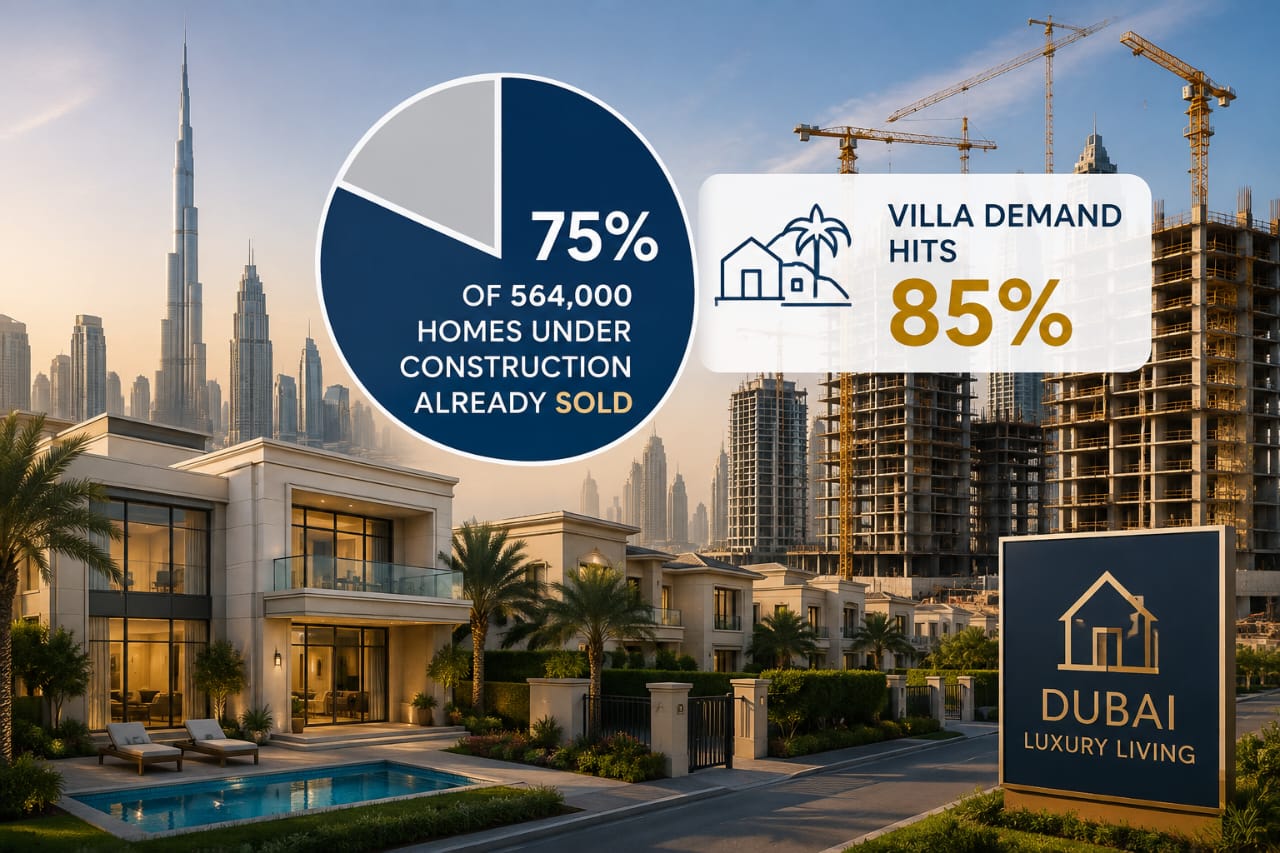
Around 75.5% of the 564,072 residential properties currently being built across Dubai have already been sold. That means 425,863 homes have already found buyers, even though many of the projects are not yet complete.
Demand is particularly strong in the villa segment. Around 85.4% of villas currently under construction have already been sold, compared with 74.1% of apartments.
The figures highlight an important trend in the Dubai real estate market: demand is continuing to absorb a significant proportion of new supply before properties are handed over.
With thousands of apartments and villas scheduled for completion over the coming years, the latest data provides insight into how buyers, investors and families are responding to Dubai’s expanding residential market.
Dubai Has More Than 564,000 Homes Under Construction
Dubai currently has 564,072 residential properties under construction, with the majority expected to be handed over by 2028.
Of this total, 425,863 properties have already been sold, resulting in an overall absorption rate of 75.5%.
This means that approximately three out of every four homes currently being developed have already been committed to buyers before completion.
The size of Dubai’s residential construction pipeline is substantial. However, the latest figures suggest that demand is continuing to keep pace with the supply entering the market.
For investors and developers, this level of pre-completion sales is an important indicator of continued confidence in Dubai’s off-plan property market.
Villa Demand Hits 85.4%
Villas are currently experiencing stronger demand than apartments.
Out of 68,297 villas under construction, approximately 58,349 have already been sold, producing an absorption rate of 85.4%.
Apartments account for the largest share of Dubai’s residential construction pipeline. Of the 495,775 apartments currently under construction, around 367,514 have already been sold, representing an absorption rate of 74.1%.
While both segments are recording strong sales activity, the difference highlights the particularly strong demand for larger homes and villa communities.
Several factors may be contributing to this trend, including demand from families, international buyers, long-term residents and investors looking for properties with more space and community-based amenities.
Why Are Villas Selling Faster Than Apartments?
The stronger absorption rate for villas suggests that buyers are placing significant value on space, privacy and lifestyle-focused communities.
Villas generally offer features such as:
- Larger internal living areas
- Private outdoor space
- Gardens and swimming pools
- More privacy
- Family-oriented communities
- Access to schools and community facilities
Dubai has also continued to develop large residential communities designed around family living.
For buyers relocating to Dubai or planning long-term residency, villas may provide an alternative to high-density apartment living.
The high absorption rate does not mean that every villa community is performing in exactly the same way. Location, developer reputation, pricing, payment plans and project quality remain important factors.
However, the overall data shows that villa demand is currently outpacing apartment demand across Dubai’s construction pipeline.
More Than 80% of Homes Due in 2026 Are Already Sold
Demand is even stronger for homes scheduled for handover in 2026.
Of the 96,585 residential properties expected to be completed this year, around 80,127 homes have already been sold.
This represents an overall absorption rate of 82.9%.
The figures include:
- 91,209 apartments, with approximately 82% already sold
- 5,376 villas, with approximately 95% already sold
The fact that a significant majority of homes scheduled for delivery in 2026 have already been purchased suggests that many buyers are willing to commit to properties before completion.
This remains one of the defining characteristics of Dubai’s off-plan property market.
Some Dubai Communities Have Reached 100% Absorption
Several residential areas have already recorded complete absorption for properties scheduled for handover in 2026.
According to the market data, apartments in Al Wasl due for completion this year have reached 100% absorption.
Villa communities with complete absorption for 2026 handovers include:
- Wadi Al Safa 5
- Nad Al Sheba First
- Al Hebiah Sixth
These figures demonstrate that demand is not concentrated in only one part of Dubai.
Different property types and communities are continuing to attract buyers depending on factors such as location, lifestyle, accessibility and the type of homes being developed.
Downtown Dubai Continues to Record Strong Demand
Downtown Dubai remains one of the strongest-performing areas in terms of absorption.
Around 92.2% of the 6,248 apartments currently under construction in Downtown Dubai have already been sold.
Demand is even stronger for properties scheduled for handover in 2026, with approximately 96.6% of those apartments already sold.
Downtown Dubai continues to benefit from its position as one of the city’s most established residential and lifestyle destinations.
The area offers proximity to major business districts, entertainment destinations and some of Dubai’s most recognisable landmarks.
For investors, established locations such as Downtown Dubai continue to attract both end-users and buyers interested in rental opportunities.
Business Bay Also Shows Strong Property Absorption
Business Bay is another major Dubai community recording strong demand.
Approximately 82.8% of the 30,317 apartments currently under construction in Business Bay have already been sold.
For apartments scheduled for handover in 2026, the absorption rate rises to approximately 88.7%.
Business Bay’s location near Downtown Dubai and its continued transformation into a mixed-use residential and commercial district have helped support demand.
The area attracts professionals, investors and residents looking for central locations and access to Dubai’s business and lifestyle infrastructure.
Other Dubai Areas Recording High Apartment Demand
Several other communities are also recording high absorption rates for apartments under construction.
Ras Al Khor
Around 93.5% of apartments currently under construction have already been sold.
Al Barsha South 2
The area has recorded an apartment absorption rate of approximately 85%.
Palm Jumeirah
For apartments scheduled for handover in 2026, approximately 93.5% have already been sold.
Jumeirah Lakes Towers
Approximately 92.8% of apartments scheduled for completion in 2026 have already been purchased.
The strong performance across different locations suggests that demand is spread across multiple parts of Dubai rather than being limited to a single residential district.
Villa Communities Are Recording Some of the Highest Absorption Rates
The strongest villa absorption rates are being recorded in several Dubai communities.
Al Hebiah Fifth
Approximately 98.7% of 2,060 villas under construction have already been sold.
Nad Al Sheba First
The community has recorded an absorption rate of approximately 98.2%.
Wadi Al Safa 5
Around 96.4% of villas currently under construction have been sold.
Al Yufrah
Villa absorption has reached approximately 94.7%.
Dubai South
Approximately 94.5% of villas under construction have already been sold.
These figures highlight the strong demand for villa communities across different parts of Dubai.
What Is Driving Dubai’s Strong Off-Plan Property Demand?
Dubai’s off-plan property market continues to attract buyers before projects are completed.
Several factors may be supporting this demand.
Confidence in Dubai’s Property Market
Investor confidence in Dubai’s regulatory environment and the quality of new developments may be helping support off-plan sales.
Buyers are willing to commit to properties that are still under construction when they believe the location, developer and project offer long-term value.
Flexible Payment Plans
Many off-plan projects are offered with structured payment plans that allow buyers to spread payments throughout the construction period.
This can make new properties more accessible to certain buyers compared with paying the full value of a completed property immediately.
Growing Demand for Residential Property
Dubai continues to attract international residents, entrepreneurs, investors and businesses.
As the population grows, demand for different types of housing can also increase.
International Investor Interest
Dubai remains an international property investment destination.
Overseas buyers can purchase properties for investment, personal use, relocation or rental income.
This international demand plays an important role in the city’s off-plan property market.
What Does a 75% Absorption Rate Mean for Dubai’s Property Market?
A high absorption rate indicates that a large proportion of available properties have already been purchased.
In this case, more than three-quarters of Dubai’s residential properties currently under construction have already found buyers.
This does not necessarily mean that every property investment will perform in the same way.
Dubai’s property market remains highly diverse, with significant differences between:
- Locations
- Property types
- Developers
- Price segments
- Payment plans
- Rental demand
- Future supply
However, the overall figures suggest that demand is currently absorbing a substantial portion of the new supply pipeline.
For developers, strong pre-completion sales can provide confidence that projects are attracting buyers.
For investors, the data provides additional insight into where demand is strongest across the market.
Could Dubai’s Growing Housing Supply Affect Prices?
Dubai has a significant number of homes scheduled for completion over the coming years.
A growing supply pipeline can influence competition between projects and communities.
However, supply figures should not be considered in isolation.
The impact of new homes on the market can depend on:
- Population growth
- International migration
- Investor demand
- Economic conditions
- Location-specific supply
- Rental market performance
- The type and quality of properties being delivered
The latest absorption figures indicate that demand is currently keeping pace with a large proportion of the residential development pipeline.
However, market conditions can change, and buyers should continue to analyse individual communities and projects rather than relying only on city-wide statistics.
What This Means for Dubai Property Investors
For investors, the strong sales rate among properties under construction highlights the continued importance of off-plan real estate in Dubai.
However, high overall demand does not automatically mean every project represents a strong investment.
Before purchasing an off-plan property, investors should consider:
- The location of the development
- The reputation and track record of the developer
- Current and future supply in the area
- The property’s purchase price
- Expected rental demand
- Service charges
- Payment plan structure
- Potential resale demand
- Project completion timelines
The strongest investment decisions are usually based on detailed research rather than market headlines alone.
A high absorption rate can indicate strong demand, but buyers should still evaluate whether an individual property matches their investment objectives.
What This Means for Dubai Homebuyers
For people planning to purchase a home in Dubai, the latest figures suggest that many properties are being purchased before completion.
This may mean that buyers who are interested in specific communities or villa developments need to monitor new launches carefully.
At the same time, buyers should avoid making rushed decisions simply because a project is selling quickly.
Important steps include comparing similar properties, reviewing payment obligations and understanding the expected handover schedule.
Buyers should also evaluate the lifestyle and practical aspects of a location, including transport, schools, retail facilities and access to workplaces.
Is Villa Demand Likely to Remain Strong?
Villa demand is currently outperforming apartment demand based on the latest absorption data.
The segment is benefiting from buyer interest in larger homes and community-based living.
However, future demand will depend on several factors, including the number of new villas entering the market, pricing, population growth and wider economic conditions.
Dubai’s residential market is constantly evolving, and different property types may perform differently depending on changes in buyer preferences.
The current 85.4% villa absorption rate nevertheless shows that demand for villas remains particularly strong across the existing development pipeline.
The Future of Dubai’s Off-Plan Property Market
The latest figures demonstrate the scale of Dubai’s off-plan real estate market.
With more than half a million homes currently under construction and approximately three-quarters already sold, developers are continuing to attract buyers well before projects are completed.
The strong performance of villas also highlights a growing demand for spacious and lifestyle-oriented residential communities.
As Dubai continues to expand, new communities, infrastructure projects and residential developments will continue to shape the property market.
The key question for investors will not simply be how many homes are being built, but where they are being built, who is buying them and whether demand continues to keep pace with future supply.
Conclusion
Dubai’s residential property market continues to show strong demand despite its extensive construction pipeline.
Out of 564,072 homes currently under construction, approximately 425,863 have already been sold, representing an overall absorption rate of 75.5%.
Demand for villas is particularly strong, with 85.4% of villas under construction already sold, compared with 74.1% of apartments.
The figures are also notable for homes scheduled for completion in 2026, where 82.9% have already been purchased, including approximately 95% of villas.
Several communities are recording particularly high absorption rates, including Downtown Dubai, Palm Jumeirah, Business Bay and a number of villa communities.
The data suggests that Dubai’s property demand is currently absorbing a significant proportion of future housing supply before completion.
For investors and buyers, however, the strongest approach remains careful research. Market-wide demand can provide useful context, but location, developer quality, pricing, rental potential and future supply should remain central to every property decision.
Frequently Asked Questions
What percentage of homes under construction in Dubai have already been sold?
Approximately 75.5% of the 564,072 residential properties currently under construction in Dubai have already been sold.
How many homes are currently under construction in Dubai?
Dubai currently has approximately 564,072 residential properties under construction, with many scheduled for handover by 2028.
How many Dubai homes under construction have already been sold?
Approximately 425,863 homes have already been sold.
Are villas selling faster than apartments in Dubai?
Yes. Villas currently have an absorption rate of approximately 85.4%, compared with 74.1% for apartments.
How many villas under construction in Dubai have been sold?
Out of approximately 68,297 villas under construction, around 58,349 have already been sold.
How many homes will be handed over in Dubai in 2026?
Approximately 96,585 homes are scheduled for handover in 2026.
What percentage of Dubai homes due in 2026 are already sold?
Approximately 82.9% of homes scheduled for handover in 2026 have already been sold.
Which Dubai areas are recording strong property demand?
Areas recording high absorption rates include Downtown Dubai, Business Bay, Palm Jumeirah, Ras Al Khor, Al Barsha South 2, Al Hebiah Fifth, Nad Al Sheba First, Wadi Al Safa 5, Dubai South and Al Yufrah.
Is Dubai’s off-plan property market still strong?
The latest figures indicate continued strong demand, with a significant proportion of properties under construction already sold before completion. However, buyers should still evaluate individual projects and locations carefully.
Should investors buy Dubai off-plan properties?
Whether an off-plan property is a suitable investment depends on individual financial goals and the specific project. Investors should consider location, developer reputation, pricing, payment plans, rental demand, service charges and future supply before making a decision.