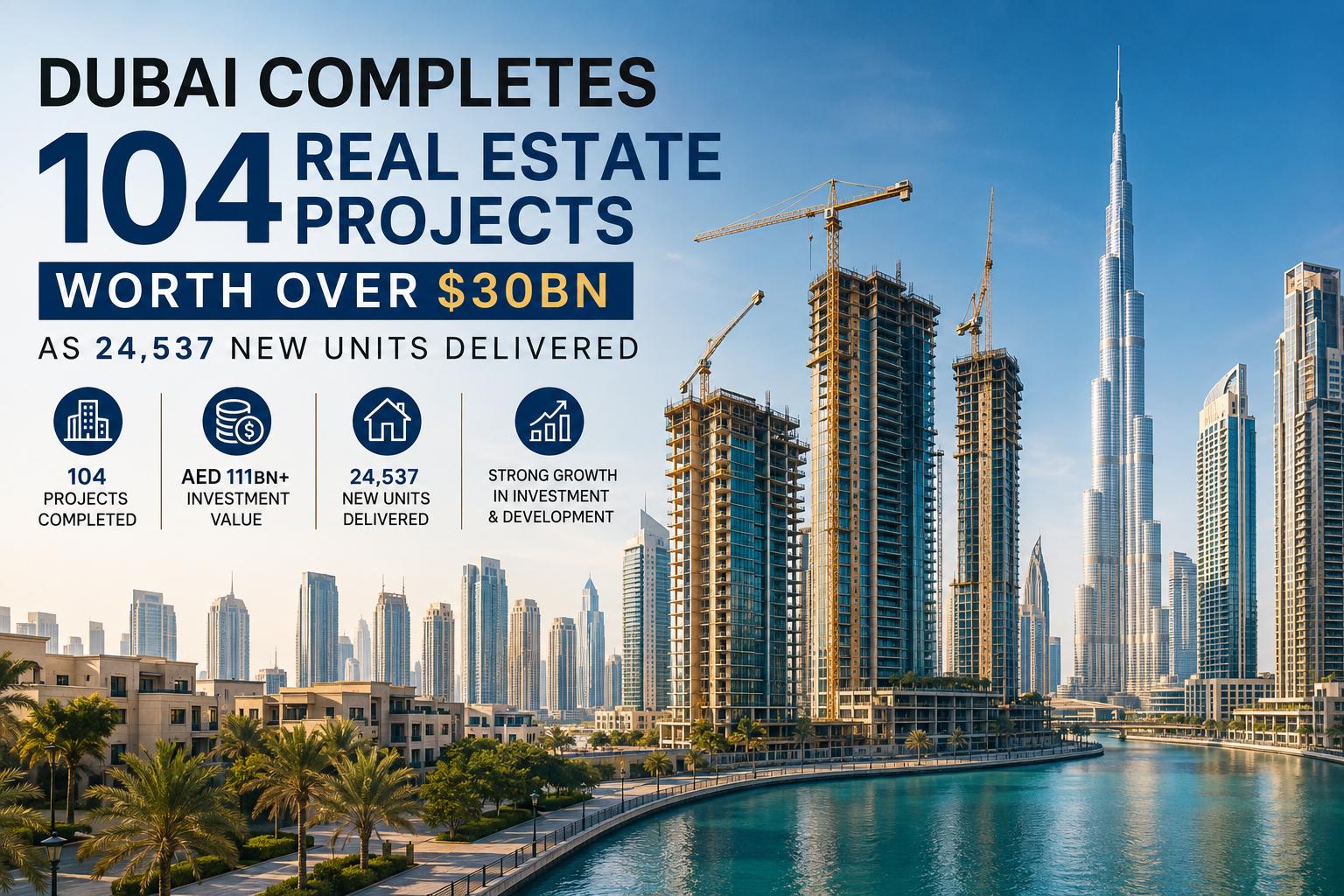
Dubai’s real estate sector has recorded another major milestone, with 104 property projects completed during the first half of 2026, representing investment of more than AED 111 billion ($30.2 billion). At the same time, developers delivered 24,537 new residential units, highlighting the scale of construction and investor confidence in Dubai’s property market.
The latest figures from the Dubai Land Department (DLD) point to a market that is not simply attracting new investment but is also converting that investment into completed developments and additional housing supply.
Dubai Completes 104 Real Estate Projects in H1 2026
Dubai completed 104 real estate projects between January and June 2026, a significant increase from the 75 projects completed during the same period in 2025.
That represents annual growth of approximately 38.7 percent in the number of completed projects. More importantly, the combined investment value of these projects exceeded AED 111 billion, compared with AED 73 billion in H1 2025.
This means the value of completed real estate projects increased by around 52 percent year-on-year, demonstrating that the expansion is occurring across both project volume and investment value.
The numbers provide another indication that Dubai remains focused on expanding its residential, commercial and mixed-use property infrastructure to accommodate rising demand from residents, businesses and international investors.
24,537 New Property Units Delivered
One of the most significant components of Dubai’s H1 2026 real estate performance was the delivery of 24,537 new units.
According to data reported from the Dubai Land Department, this represents an increase of approximately 36 percent compared with the 18,043 units delivered in H1 2025.
The increase in completed homes is particularly important because Dubai has experienced strong demand for residential property in recent years. Additional supply can give buyers and tenants a wider selection of apartments, villas and other residential options while supporting the continued expansion of the emirate’s population.
The delivery of thousands of completed units also demonstrates that Dubai’s property growth is increasingly supported by actual construction and handovers rather than being driven solely by new project launches.
Real Estate Investment Surges to AED 111 Billion
The value of investment associated with completed projects reached more than AED 111 billion, equivalent to approximately $30.2 billion.
That is a substantial increase from AED 73 billion during H1 2025.
The 52 percent increase suggests that developers and investors are committing significant capital to projects across Dubai. It also reflects continued confidence in the emirate’s long-term economic outlook and its ability to attract international capital.
Dubai Crown Prince Sheikh Hamdan bin Mohammed bin Rashid Al Maktoum said the rise in real estate transactions, projects and investment flows demonstrated renewed international confidence in Dubai’s economic environment.
Built-Up Area Also Expands
The growth was not limited to the number of projects and residential units.
The total built-up area associated with completed projects increased by approximately 23.4 percent, reaching around 1.95 million square metres during the first half of 2026, according to figures reported from DLD data.
This indicates that Dubai’s development pipeline is becoming larger in physical terms as well as financial terms.
For property investors, the increase in built-up space means more residential communities, commercial facilities and mixed-use developments are entering the market, potentially creating new opportunities across different segments.
What the Numbers Mean for Dubai Property Investors
The latest completion figures are significant for investors because they show that Dubai’s real estate market continues to operate at a high level of development activity.
For investors considering Dubai property, completed projects can provide a different proposition from off-plan developments. Ready properties allow investors to assess the actual location, construction quality, surrounding infrastructure and amenities before making a purchase.
Off-plan properties, meanwhile, can still offer opportunities where investors are comfortable with construction timelines and developer risk.
The growing number of completed developments also suggests that investors have an increasingly broad range of properties to consider, from apartments and villas to branded residences and mixed-use communities.
More Housing Supply Could Reshape Rental Markets
The delivery of 24,537 new units could also have implications for Dubai’s rental market.
Additional housing supply can help accommodate population growth and potentially moderate rental pressure in specific locations where new units are concentrated. However, the impact will vary significantly by community, property type and level of tenant demand.
Prime locations with strong connectivity, waterfront access, established amenities and proximity to employment centres may continue to command premium rents even as new properties enter the market.
Meanwhile, emerging communities could benefit from increased investment in roads, retail, schools, leisure facilities and other infrastructure.
Dubai Continues to Build for Population Growth
Dubai’s real estate development is closely connected to its broader economic and population strategy.
The emirate continues to attract entrepreneurs, professionals, investors and businesses from around the world. As the population and business community expand, demand for residential and commercial property naturally increases.
The completion of more than 100 projects in just six months demonstrates the scale at which Dubai is expanding its built environment.
The development pipeline also supports Dubai’s position as a global business and investment hub, with real estate playing a central role in the emirate’s economic diversification strategy.
Strong Developer Activity Signals Continued Confidence
The increase from 75 completed projects in H1 2025 to 104 in H1 2026 is particularly noteworthy.
A larger number of completed developments indicates that developers are continuing to move projects through the construction cycle despite changing market conditions.
For buyers, delivery is also an important indicator of market maturity. Developers that consistently complete projects can strengthen confidence among investors and end users, particularly in a market where off-plan sales represent a substantial part of property activity.
The latest figures therefore provide a useful snapshot of Dubai’s ability to translate real estate investment into physical assets.
What Buyers Should Watch in the Second Half of 2026
The strong first-half performance sets the stage for continued activity during the remainder of 2026.
Buyers and investors should pay close attention to several factors, including the pace of new project handovers, property prices, rental growth, mortgage costs, transaction volumes and population trends.
The location of newly completed units will also be important. A large increase in supply does not automatically mean prices will fall. Demand, infrastructure, property quality and accessibility will determine how individual communities perform.
Investors should therefore evaluate each project based on fundamentals rather than relying solely on Dubai-wide market statistics.
Dubai Real Estate Market: A Market Focused on Delivery
Dubai’s latest real estate figures tell a broader story about the emirate’s property market.
The completion of 104 projects worth more than AED 111 billion, combined with the delivery of 24,537 new units, demonstrates that Dubai continues to invest heavily in expanding its real estate infrastructure.
The 38.7 percent increase in completed projects and 52 percent rise in investment value compared with H1 2025 underline the strength of development activity.
For investors, the key takeaway is that Dubai’s property market is continuing to evolve through a combination of new launches, major capital investment and actual project completion.
As more homes and developments reach the market, the second half of 2026 could provide further insight into whether rising supply can keep pace with Dubai’s continuing demand from residents, businesses and international investors.
Frequently Asked Questions
How many real estate projects did Dubai complete in H1 2026?
Dubai completed 104 real estate projects during the first half of 2026, compared with 75 during H1 2025.
How much were Dubai’s completed real estate projects worth?
The completed projects represented more than AED 111 billion, or approximately $30.2 billion, in investment value.
How many new property units were delivered in Dubai?
Dubai delivered 24,537 new residential units in H1 2026, around 36 percent more than the 18,043 units delivered during H1 2025.
What does the increase in property completions mean for buyers?
More completed projects give buyers a larger selection of ready properties and may increase competition among developers and sellers. However, the effect on prices and rents will depend on demand and supply conditions in individual communities.
Is Dubai real estate still attracting investors?
The substantial increase in the value of completed projects indicates continued investment and developer activity. Dubai’s infrastructure, business environment and international investor base remain important factors supporting its property market.
Should investors choose completed or off-plan Dubai property?
Both can have advantages. Completed properties allow investors to inspect the actual asset and potentially generate rental income sooner, while off-plan properties may offer different pricing and payment structures. The appropriate choice depends on the investor’s objectives, budget, risk tolerance and investment timeline.