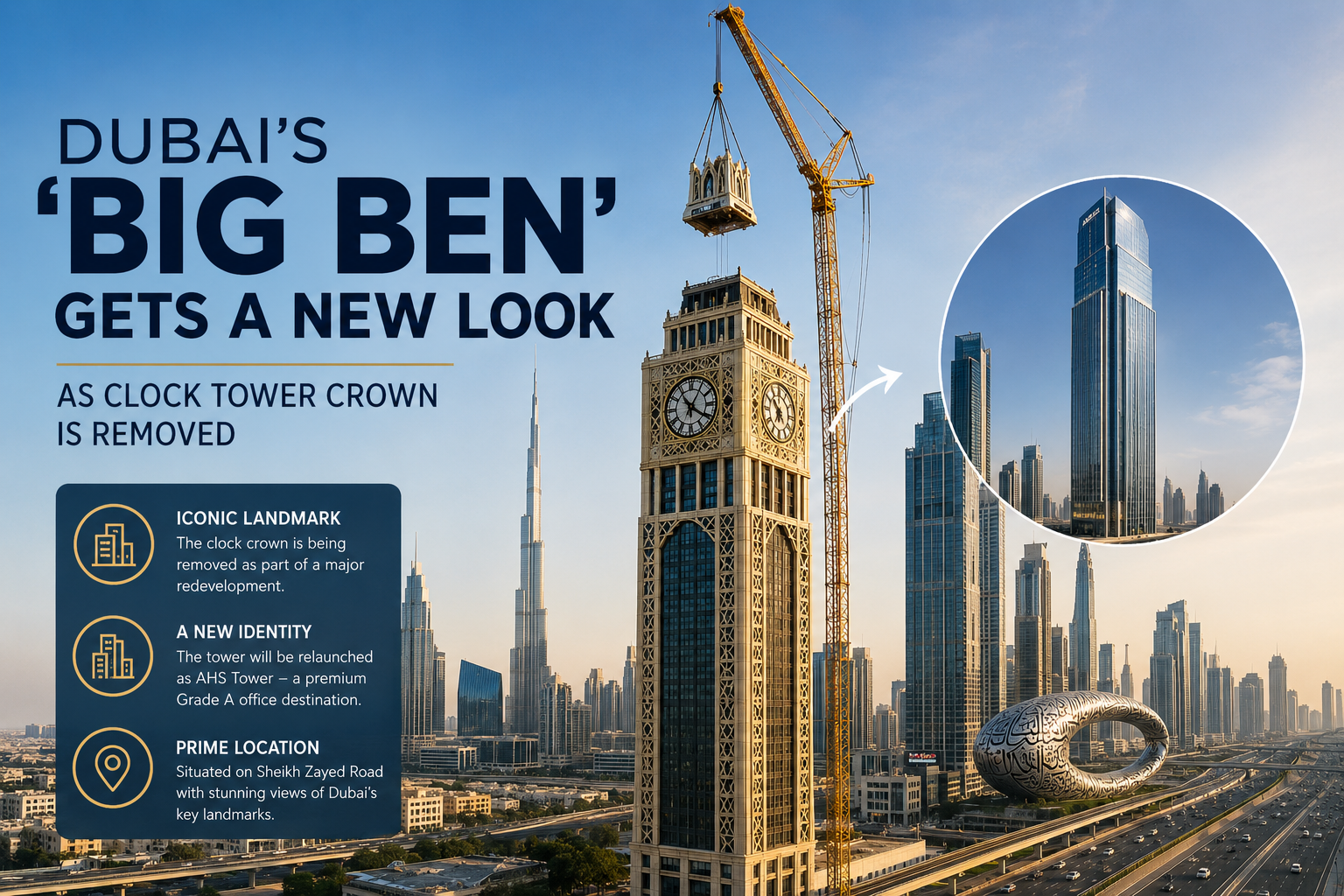
Dubai is once again reshaping one of its most recognisable landmarks. The tower long nicknamed Dubai’s “Big Ben” is undergoing a major transformation, with its iconic clock crown being removed as part of a wider redevelopment that will give the building a completely new identity.
Located on Sheikh Zayed Road, the tower is being redeveloped by AHS Properties and will be relaunched as AHS Tower. Rather than retaining its distinctive clock-inspired appearance, the revamped building is being positioned as a premium Grade A office destination designed for Dubai’s increasingly sophisticated commercial real estate market.
The redevelopment is another example of how Dubai is adapting existing landmark properties to meet changing demand while preserving the value of strategically located real estate.
What Happened to Dubai’s ‘Big Ben’?
The building became popularly known as Dubai’s “Big Ben” because its original design was inspired by London’s famous Elizabeth Tower. The clock feature became one of its defining architectural characteristics and helped make the building instantly recognisable from Sheikh Zayed Road.
That identity is now changing.
AHS Properties acquired the building from Commercial Bank of Dubai and is carrying out a major redevelopment. The clock is being removed alongside a new façade designed to establish a fresh architectural identity for the tower.
The building will now operate under the name AHS Tower. According to reporting, the tower has around 70 floors and rises more than 200 metres, making it a significant commercial property on one of Dubai’s most important business corridors.
Why Is the Clock Being Removed?
The decision to remove the clock is not simply a cosmetic change. It forms part of a broader strategy to reposition the property as a modern Grade A office tower.
AHS Group founder and CEO Abbas Sajwani said the clock is being removed while the façade is redesigned to give the building a new identity. The redevelopment is therefore focused on transforming the tower from a landmark associated with its distinctive clock into a contemporary business destination.
This approach reflects a broader trend in Dubai real estate, where older or existing structures in highly strategic locations are being upgraded rather than replaced entirely.
For developers, this can provide a significant advantage. A completed structure with an established location can potentially be repositioned faster than a completely new development, while still allowing the building to receive modern interiors, amenities and technology.
From Landmark Tower to Grade A Office Destination
The new AHS Tower is being designed around Dubai’s growing demand for premium office space.
According to the developer, the building will feature a full-glass exterior and a range of high-end amenities. These are expected to include a private members’ club, business centre, two-floor spa, sauna, steam room, lounge, indoor swimming pool, cigar room, indoor garden, full-floor gym and triple-height lobby.
The emphasis on amenities is significant because the modern Grade A office market is increasingly about more than conventional workspaces.
Companies today are looking for buildings that can support employee wellbeing, hospitality, networking and corporate branding. Premium office towers are therefore increasingly being developed as complete business ecosystems rather than simply collections of offices.
AHS Tower’s redevelopment reflects this changing definition of premium commercial real estate in Dubai.
A Strategic Sheikh Zayed Road Location
One of the biggest advantages of the property is its location.
Sheikh Zayed Road remains one of Dubai’s most important commercial and transportation corridors, connecting major business districts and landmark destinations across the city.
The tower also benefits from views towards several major Dubai landmarks, including the Dubai International Financial Centre (DIFC), the Museum of the Future, Burj Khalifa and the sea.
For a premium office development, this combination of location, visibility and views can be particularly valuable.
Prime commercial properties in established areas can offer advantages that newly developed buildings in emerging districts may take years to achieve. They already benefit from existing infrastructure, connectivity, surrounding businesses and established demand.
Dubai’s Growing Demand for Premium Offices
The transformation of the former “Big Ben” tower comes at a time when Dubai continues to attract international companies, investors and entrepreneurs.
As businesses expand their presence in the UAE, demand for high-quality commercial space has become an increasingly important part of Dubai’s property story.
The developer has described the city as lacking sufficient Grade A office stock and expects AHS Tower to contribute to this segment of the market.
The development therefore highlights an important shift within Dubai real estate.
While residential developments continue to attract significant investor attention, commercial property is also becoming an important area of opportunity. Premium offices in strategic locations can appeal to multinational companies, financial firms, technology businesses, professional services companies and entrepreneurs seeking a prestigious Dubai address.
Why Redevelopment Is Becoming Important in Dubai Real Estate
Dubai’s rapid growth has created a property market where location can be just as important as the age of a building.
An older tower in a prime location may have considerable potential if it can be repositioned to meet contemporary market expectations.
Rather than demolishing and rebuilding, developers can sometimes retain the existing structural framework while upgrading the façade, interiors, facilities and technology.
This strategy can help reduce development timelines while allowing a property to compete with newer buildings.
The AHS Tower project demonstrates how this model can work. The developer has highlighted that the existing structure was already complete, making the redevelopment faster than starting construction from scratch.
For Dubai’s mature real estate areas, this type of asset repositioning could become increasingly important.
What Does the Transformation Mean for Dubai Property Investors?
For property investors, the redevelopment of Dubai’s “Big Ben” offers an interesting lesson about the importance of location, asset repositioning and changing demand.
A landmark building does not necessarily need to remain unchanged to retain its importance. In a fast-moving property market such as Dubai, a building may become more valuable when its design and function evolve with market requirements.
AHS Tower is being repositioned towards the premium office market, which could allow the property to benefit from demand for Grade A commercial space.
The project also demonstrates how Dubai’s real estate market continues to move beyond traditional residential investment narratives. Commercial buildings, branded offices, mixed-use developments and upgraded legacy assets are increasingly becoming part of the city’s investment landscape.
A New Chapter for a Dubai Landmark
The removal of the clock marks the end of an era for one of Dubai’s most recognisable tower designs.
For years, the building’s clock helped give it a distinctive identity and earned it the nickname “Big Ben”. Its removal may change the skyline image that residents and motorists have become familiar with, but the redevelopment represents a deliberate attempt to create something different.
The new AHS Tower is being positioned as a modern business landmark rather than a clock tower.
That transformation reflects Dubai itself. The city has repeatedly demonstrated its willingness to reinvent existing districts, buildings and infrastructure in response to changing economic conditions.
As Dubai continues to strengthen its position as a global business and investment hub, properties that combine strategic locations with modern Grade A facilities are likely to remain highly relevant.
Dubai Real Estate Is Entering Another Phase of Transformation
The redevelopment of the former “Big Ben” tower is more than an architectural makeover. It illustrates how Dubai’s property market is evolving.
The city’s next generation of real estate is not being created solely through new construction. Existing buildings are also being upgraded, repositioned and given new purposes to match changing demand.
For investors and businesses, this creates a market where the potential of an asset can depend on more than its current appearance. Location, redevelopment potential, quality of amenities, accessibility and long-term commercial demand can all influence the future value of a property.
As AHS Tower moves towards its new identity, Dubai’s skyline once again demonstrates one of its defining characteristics: constant change.
The clock may be disappearing, but the building is being prepared for a new role in Dubai’s commercial real estate story.
Frequently Asked Questions
What happened to Dubai’s Big Ben tower?
Dubai’s tower popularly known as “Big Ben” is undergoing a major redevelopment. Its clock is being removed and the building is being relaunched as AHS Tower with a new façade and modern office facilities.
Where is Dubai’s Big Ben tower located?
The tower is located on Sheikh Zayed Road in Dubai, one of the city’s major commercial and transportation corridors.
What will the building be called after redevelopment?
The building is being relaunched as AHS Tower following its redevelopment by AHS Properties.
Why is the clock being removed?
The clock is being removed as part of a new façade and wider redevelopment intended to give the building a new identity as a modern Grade A office tower.
Will AHS Tower be a residential building?
The redevelopment is focused on creating a premium commercial office destination rather than a conventional residential tower. Planned facilities include a business centre, private members’ club, gym, spa, indoor pool and other premium amenities.
Why is Grade A office space important in Dubai?
Dubai’s continued expansion as an international business hub is supporting demand for high-quality office accommodation. Premium Grade A buildings can attract companies looking for modern facilities, prestigious addresses and comprehensive workplace amenities.
What does the project mean for Dubai real estate?
The redevelopment highlights the growing importance of asset repositioning in Dubai. Existing buildings in prime locations can be upgraded and transformed to meet new market demand, creating another avenue for commercial real estate investment and development.