The UAE real estate market is entering a new phase of digital transformation. Technology is no longer simply supporting property transactions behind the scenes; it is changing how buyers discover homes, how investors evaluate opportunities, how developers market projects and how residents experience their properties.
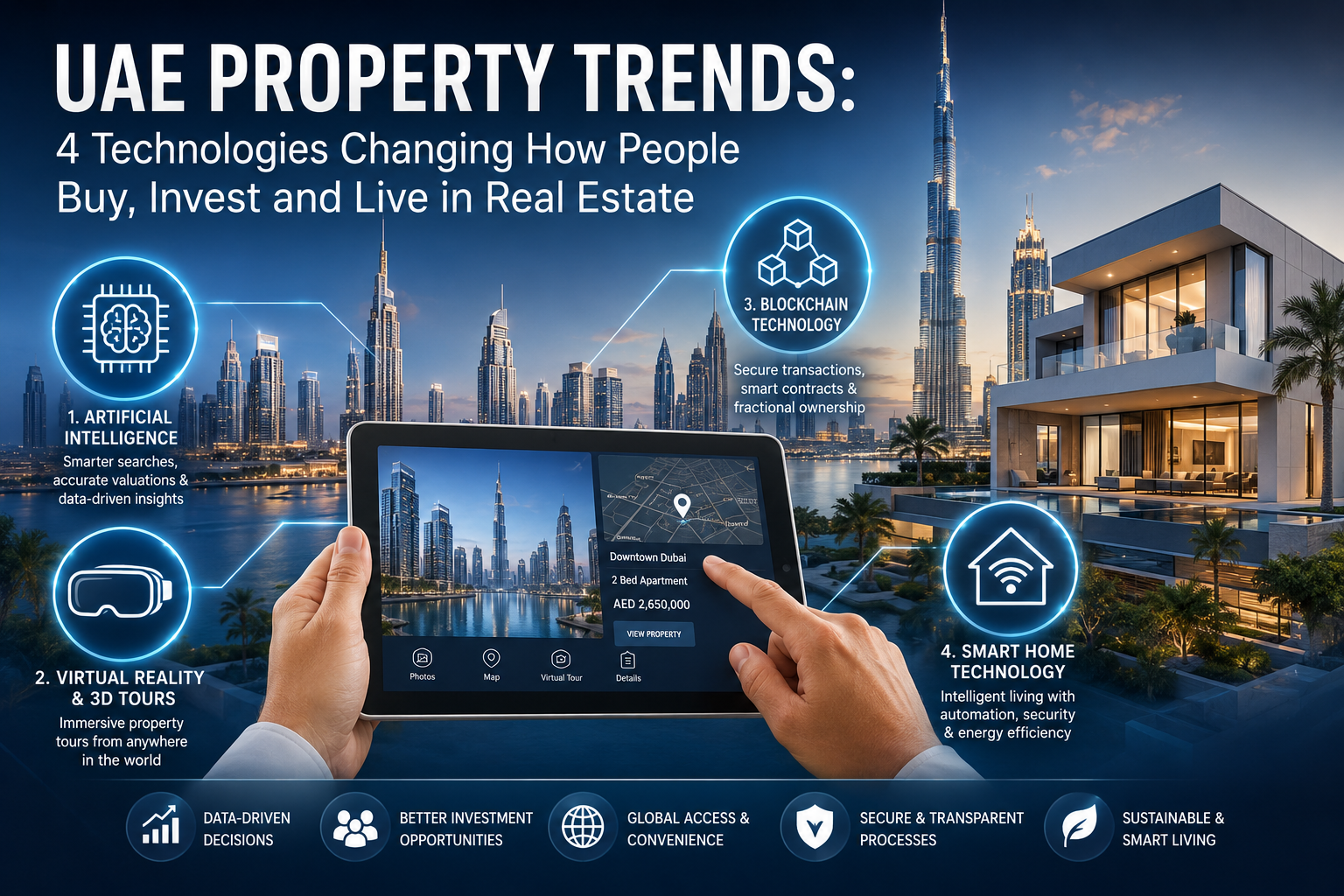
From artificial intelligence and virtual reality to blockchain and smart-home systems, emerging technologies are making the UAE property sector more connected, data-driven and accessible. For buyers and investors, these innovations can mean faster decisions, better market intelligence and more personalised property experiences.
As Dubai and Abu Dhabi continue to attract international investors, the adoption of real estate technology is becoming an increasingly important competitive advantage. Here are four technologies that are reshaping how people buy, invest in and live in UAE real estate.
1. Artificial Intelligence Is Transforming Property Search and Investment
Artificial intelligence is becoming one of the most influential technologies in the UAE property market. AI-powered platforms can analyse large volumes of property listings, transaction data, market trends and buyer preferences to provide more personalised recommendations.
Instead of manually searching through hundreds of listings, prospective buyers can increasingly use intelligent property platforms to identify homes that match their preferred location, budget, property type, amenities and investment objectives.
For investors, AI can provide another layer of market analysis. Algorithms can evaluate historical transaction data, rental performance, supply levels and neighbourhood trends to help identify potentially attractive investment opportunities.
AI-Powered Property Valuation
One of the most useful applications of artificial intelligence is automated property valuation. Traditional valuations often require a combination of comparable transactions, property inspections and professional expertise. AI can complement this process by analysing much larger datasets.
For example, an AI system may compare similar properties based on location, size, building characteristics, historical prices, rental yields and market activity. This can give buyers and investors a more data-driven starting point when assessing whether a property is fairly priced.
AI does not eliminate the need for professional due diligence, but it can make the initial research process significantly more efficient.
AI and Predictive Market Analysis
AI is also being used to identify patterns that may not be immediately obvious to individual investors. Predictive analytics can help assess potential changes in rental demand, transaction volumes and neighbourhood development.
For UAE property investors, this could become particularly valuable as new infrastructure, transport links, tourism developments and residential communities reshape different parts of the market.
2. Virtual Reality and 3D Technology Are Changing Property Viewings
Virtual reality is removing one of the traditional barriers associated with international property investment: physical distance.
The UAE attracts buyers from across the Middle East, Europe, Asia and other international markets. Many prospective buyers cannot visit Dubai or Abu Dhabi every time they want to inspect a property. Virtual reality and immersive 3D technology allow them to explore properties remotely.
Virtual Property Tours
Developers and real estate agencies can create interactive digital tours that allow potential buyers to move through apartments, villas and commercial properties virtually.
Instead of relying exclusively on photographs and floor plans, buyers can explore room layouts, finishes, views and amenities through an immersive experience.
This is particularly useful for off-plan property. Developers can use 3D visualisation to show buyers what a future development may look like before construction is completed.
Better International Investment Experiences
Virtual reality can also make cross-border property investment more convenient. An investor living overseas may be able to shortlist several properties, conduct virtual tours and compare developments without immediately travelling to the UAE.
This does not replace physical inspections when appropriate, but it can significantly reduce the number of properties that need to be visited in person.
For UAE developers targeting international investors, immersive technology can therefore become a powerful sales and marketing tool.
3. Blockchain Is Making Property Transactions More Digital
Blockchain technology has the potential to change how ownership records, transactions and investment structures are managed within real estate.
At its core, blockchain provides a digital ledger that can record transactions in a transparent and secure manner. When integrated with appropriate regulatory and property-registration systems, the technology could help streamline aspects of real estate transactions.
The UAE has been actively exploring digital transformation across government and financial services, making the country an important market for blockchain-based property innovation.
Smart Contracts and Real Estate
Smart contracts are one potential application. These are programmable agreements that can automatically execute predefined actions when specific conditions are met.
In a real estate context, smart contracts could eventually help automate certain transaction processes, documentation requirements or payment stages, subject to applicable legal and regulatory frameworks.
The potential benefit is greater efficiency and reduced reliance on manual processes.
Tokenisation and Fractional Property Investment
Property tokenisation is another emerging trend attracting attention. Tokenisation involves representing an ownership interest or economic interest in a real-world asset through digital tokens.
For investors, this could potentially make fractional participation in real estate more accessible. Instead of purchasing an entire property, an investor could potentially acquire a smaller interest in a qualifying asset through a regulated platform.
However, tokenised real estate remains an evolving area. Investors should carefully examine the legal structure, ownership rights, regulatory status, platform security and underlying asset before committing capital.
4. Smart-Home Technology Is Changing How People Live
Technology is not only transforming the process of buying property. It is also changing what buyers expect from the properties themselves.
Smart-home technology is increasingly becoming a feature of modern UAE residential developments, particularly in premium and luxury segments.
Smart lighting, automated climate control, connected security systems, smart locks, voice-controlled devices and energy-management systems can all be integrated into modern homes.
Smart Homes and Convenience
Residents can use connected devices to control lighting, air conditioning, appliances, curtains and security systems through smartphones or centralised platforms.
In a country where climate control is particularly important, intelligent cooling systems can also help residents manage energy consumption while maintaining comfortable indoor temperatures.
Smart Security
Connected security technology is another important component of smart residential developments. Digital access systems, smart cameras, video doorbells and remote monitoring can provide residents with greater visibility over their homes.
For luxury developments, these technologies can form part of a broader premium living experience.
Energy Efficiency
Smart-home systems can also contribute to more efficient property management. Automated lighting and cooling controls can adjust consumption according to occupancy and usage patterns.
As sustainability becomes more important to buyers and developers, technology-enabled energy management could become an increasingly valuable feature in UAE properties.
How These Technologies Are Changing the UAE Property Market

The biggest transformation is not happening through one technology alone. AI, immersive visualisation, blockchain and smart-home systems are increasingly working together to create a more digital real estate ecosystem.
A prospective buyer might discover a property through an AI-powered search platform, analyse its investment potential using data analytics, explore it through a virtual tour, complete parts of the transaction digitally and eventually live in a connected smart home.
This creates a property journey that is significantly different from the traditional process of browsing newspaper advertisements, visiting multiple properties and completing extensive paperwork manually.
Technology Is Also Increasing Competition Among Developers
As technology becomes more important to buyers, developers are under increasing pressure to differentiate their projects.
A new development may compete not only on location, architecture and price but also on its digital experience, smart-home capabilities, energy efficiency and technology infrastructure.
Luxury buyers in particular may expect integrated digital services as part of the overall residential experience.
Developers that invest in technology at the planning and construction stages can potentially create properties that are more attractive to digitally focused buyers and international investors.
What Technology Means for UAE Property Investors
For investors, technology can improve access to information, but it also creates a need for greater due diligence.
AI-generated investment recommendations should not be treated as guaranteed forecasts. Virtual tours cannot always reveal construction quality or actual surroundings. Blockchain-based investment structures require careful legal and regulatory examination. Similarly, smart-home features should be evaluated based on reliability, maintenance and long-term compatibility.
Technology should therefore be viewed as a decision-support tool rather than a substitute for professional advice and independent research.
Investors should still consider location, developer reputation, title and ownership structure, service charges, rental demand, financing costs, liquidity, market supply and potential capital appreciation before purchasing a UAE property.
The Future of UAE Real Estate Is Digital
The UAE has positioned itself as one of the world’s leading markets for innovation, and real estate is becoming an important part of that transformation.
Artificial intelligence is making property search and market analysis more personalised. Virtual reality is making property viewing more accessible to international buyers. Blockchain is opening new possibilities for digital transactions and property investment. Smart-home technology is redefining the residential experience.
Together, these technologies are helping create a property market that is faster, more connected and increasingly data-driven.
For buyers and investors, the key is understanding how these technologies can improve decision-making without losing sight of the fundamentals of real estate investment. Technology can make the journey easier, but factors such as location, value, demand and long-term market potential remain central to successful property investment.
Frequently Asked Questions
What technologies are changing UAE real estate?
The four major technologies include artificial intelligence, virtual and 3D reality, blockchain and smart-home technology. These are influencing property search, investment analysis, transactions, marketing and residential living.
How is AI being used in Dubai real estate?
AI can be used for property recommendations, automated valuation, market analysis, customer service, lead management and predictive analytics. It can help buyers and investors process large amounts of property and market data more efficiently.
Can international buyers view UAE properties virtually?
Yes. Virtual tours and 3D property experiences allow international buyers to explore many properties remotely before travelling to the UAE for physical inspections or other stages of the purchasing process.
What is property tokenisation?
Property tokenisation involves representing an ownership or economic interest in a real-world property through digital tokens. The structure, investor rights and regulatory treatment depend on the specific platform and applicable laws.
Are smart homes becoming popular in Dubai?
Smart-home technology is increasingly being incorporated into modern residential developments, particularly premium and luxury properties. Features can include automated lighting, climate control, security systems and digital access.
Will technology make UAE property investment safer?
Technology can improve transparency, information access and transaction efficiency, but it does not eliminate investment risk. Buyers should continue to conduct independent due diligence and obtain appropriate legal, financial and property advice.
Conclusion
Technology is rapidly becoming an integral part of the UAE real estate ecosystem. From the first property search to the final living experience, digital tools are changing how people interact with property.
As artificial intelligence, virtual reality, blockchain and smart-home technology continue to mature, UAE real estate is likely to become even more connected and digitally enabled. For buyers, investors and developers, understanding these trends will be increasingly important for navigating the next generation of the UAE property market.